Contents
- 1. Cape Verde: Country Overview
- 2. Putting Cape Verde on the Map
- 3. What Others Say About Cape Verde
- 4. Tax Benefits: What Cape Verde Has to Offer
- 5. Tax Rates at a Glance
- 6. Tax Residency: What Triggers It
- 7. Double Tax Treaties
- 8. Avoid Remaining Tax Resident at Home
- 9. Tax Considerations When Leaving Your Home Country
- 10. Company Setup & Corporate Tax
- 11. Who Should (and Shouldn't) Move to Cape Verde
- 12. Visas and Residence Permits
- 13. Path to Citizenship
- 14. Banking in Cape Verde
- 15. What Makes Cape Verde Genuinely Attractive
- 16. Cost of Living in Cape Verde
- 17. Buying Real Estate in Cape Verde
- 18. Retiring in Cape Verde
- 19. US Citizens: What You Need to Know
- 20. Correct Preparation
- 21. Automatic Exchange of Information (OECD CRS)
- 22. Further Relocation Formalities
- 23. How We Help With Your Move to Cape Verde
I.
Cape Verde: Country Overview
Cape Verde (officially Cabo Verde) is a sovereign Atlantic archipelago of ten volcanic islands approximately 570 km west of the Senegalese coast in West Africa. The country covers approximately 4,000 km² and has a population of approximately 600,000. The capital, Praia, sits on the largest island (Santiago) and is the country's commercial and administrative centre. The two main expatriate islands are Sal (international airport hub, beach resorts) and Boa Vista (tourism destination, Sahara-like dunes). São Vicente (with Mindelo, the cultural capital) is the third significant centre.
Cape Verde operates in Portuguese (official language) and Cape Verdean Creole (Kriolu — the everyday language). Portuguese is the language of government, education, business, banking, and the courts. English is increasingly common in tourism and at international hotels but is not a universal business language. The legal system is based on Portuguese civil law; the Constitutional Court and the Supreme Court of Justice provide the principal jurisdictions. The currency is the Cape Verdean Escudo (CVE), pegged to the euro at approximately 110.27:1 since 1998 — providing complete currency stability against the eurozone.
Cape Verde is a stable parliamentary democracy — the country has been ranked among the most democratic and least corrupt nations in Africa for decades. It is a member of the CEDEAO/ECOWAS (Economic Community of West African States), the United Nations, the Community of Portuguese Language Countries (CPLP), and various regional bodies. The country has a Special Partnership with the European Union — closer than most ACP countries but short of full association — and the escudo's euro peg makes Cape Verde effectively part of the eurozone monetary area.
On the tax side, Cape Verde operates a residence-based worldwide taxation model with specific preferential regimes for retirees and foreign investors. The two key frameworks for HNW relocation are:
- 1.Green Card (Autorização de Residência Permanente / Permanent Residence Authorization): Available to foreigners who establish second residence in Cape Verde. Qualifying retiree-holders of the Green Card receive a personal income tax EXEMPTION on foreign retirement income (under the Personal Income Tax Code — CIRPS). The Green Card also provides 50% reduction on the Single Property Tax (IUP) for 10 years and exemption from IUP on transmission. This is the flagship retirement framework.
- 1.Foreign Investor Regime — 10% flat on foreign-source income: Available to foreign investors meeting specific criteria. 10% flat tax on foreign-sourced income (and on capital gains, also at 10%) — a competitive rate for active HNW clients with international income flows.
Standard residents (without Green Card or Foreign Investor status) are taxed on worldwide income at progressive rates from 16.5% to 27.5% under the IRPS / IRPS framework. Non-residents are taxed only on Cape Verde-source income at flat rates equivalent to the resident progressive scale.
Other tax features: corporate income tax (IRPC) reduced to 20% from 2025 (down from 21%); VAT (IVA) 15%; no inheritance tax for direct heirs (modest stamp duties on transfers); no annual wealth tax in the typical Western sense. Special economic zones (SEZ) on Sal and Boa Vista offer corporate tax incentives.
What to be aware of. Cape Verde is not a 0% tax jurisdiction across the board — only the Green Card retiree framework provides 0% on foreign retirement income, and only the Foreign Investor regime provides the 10% flat rate. Working-age HNW clients with active local-source income face the standard 16.5%–27.5% progressive scale. The DTA network is very limited — only Portugal, Mauritius, Senegal, and a handful of others have comprehensive DTAs with Cape Verde. The country participates in OECD CRS automatic exchange. Cape Verde is not in the EU or Schengen but the escudo's euro peg and Special Partnership status provide unusual integration with the EU institutional framework.
II.
Putting Cape Verde on the Map
Cape Verde — Atlantic archipelago, 570 km west of Senegal
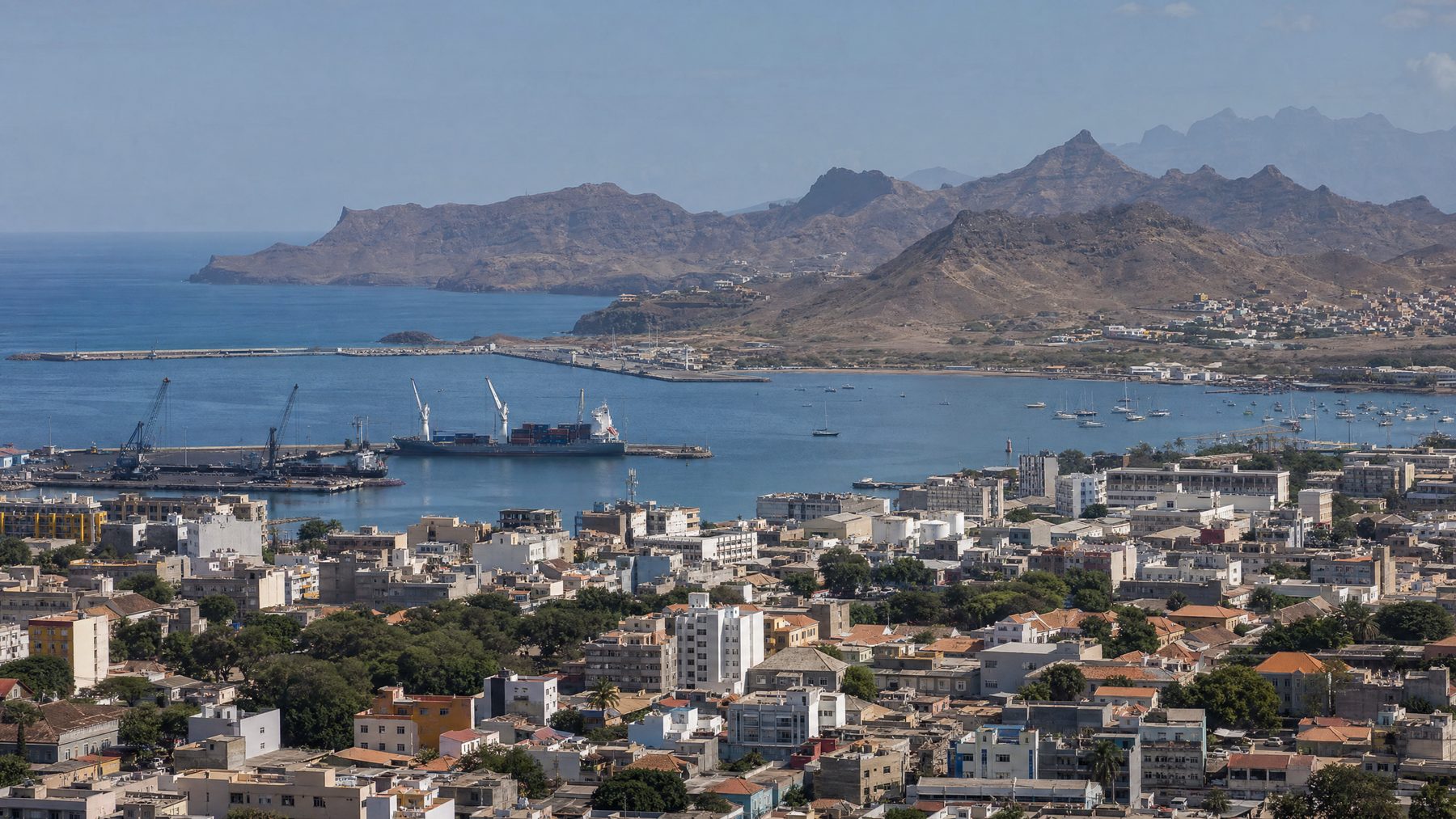
Cape Verde arrives in the Atlantic light — the volcanic mountains of Santo Antão rising directly from the sea, the white-sand beaches of Sal and Boa Vista stretching for kilometres, the morna music of Cesária Évora drifting from a café in Mindelo, the trade winds blowing constantly from the northeast, the smell of grilled fish at the Tarrafal beach in Santiago. The country has a distinctive Atlantic-Creole character — Portuguese colonial heritage, African Sahel cultural influences, Caribbean musical and culinary cross-currents from centuries of transatlantic trade.
The archipelago divides into two groups: the Barlavento (windward) islands in the north — São Nicolau, São Vicente, Santa Luzia (uninhabited), Santo Antão, Sal, and Boa Vista — and the Sotavento (leeward) islands in the south — Maio, Santiago, Fogo, and Brava.
Santiago, the largest island, contains the capital Praia (population ~150,000) and most of the country's administrative infrastructure. The Cidade Velha (UNESCO World Heritage Site) was the first European colonial city in the tropics — founded in 1462 — with the Pelourinho slave column and the ruins of the original cathedral. Tarrafal, on the northern coast, has a famously beautiful beach and the haunting former concentration camp where Salazar's Portuguese regime imprisoned political dissidents.
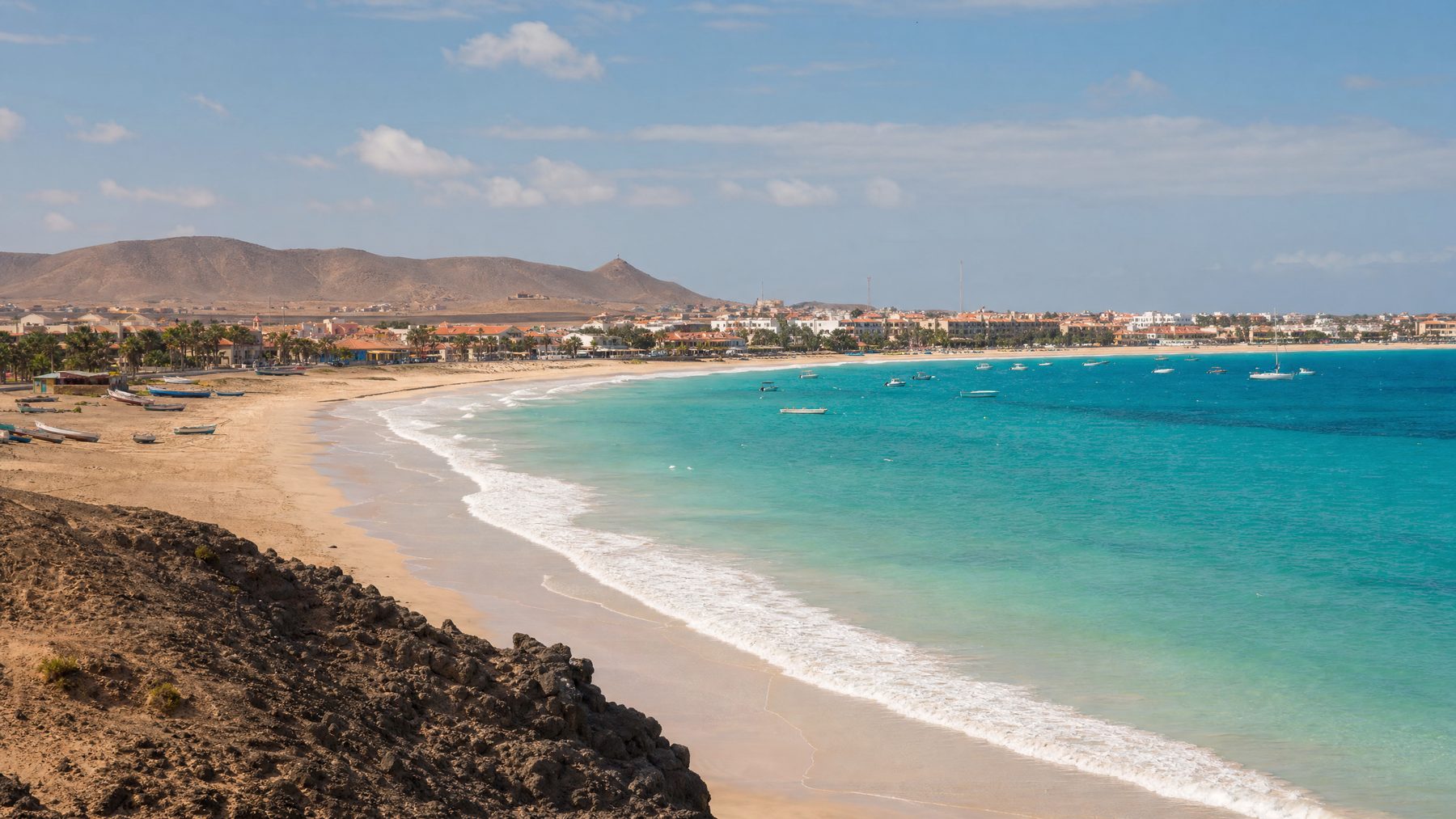
Sal (population ~40,000) is the principal international gateway — Amílcar Cabral International Airport (SID) handles direct flights to Lisbon, Madrid, Paris, Amsterdam, London, Manchester, Frankfurt, Munich, Milan, Boston, and many other European/North American hubs. Santa Maria, on the southern tip of Sal, is the tourism centre — long white beaches, the dive sites of the Three Gros, the Pedra de Lume salt crater (a unique flotation experience). Many European retirees are based in Sal given the connectivity and tourism infrastructure.
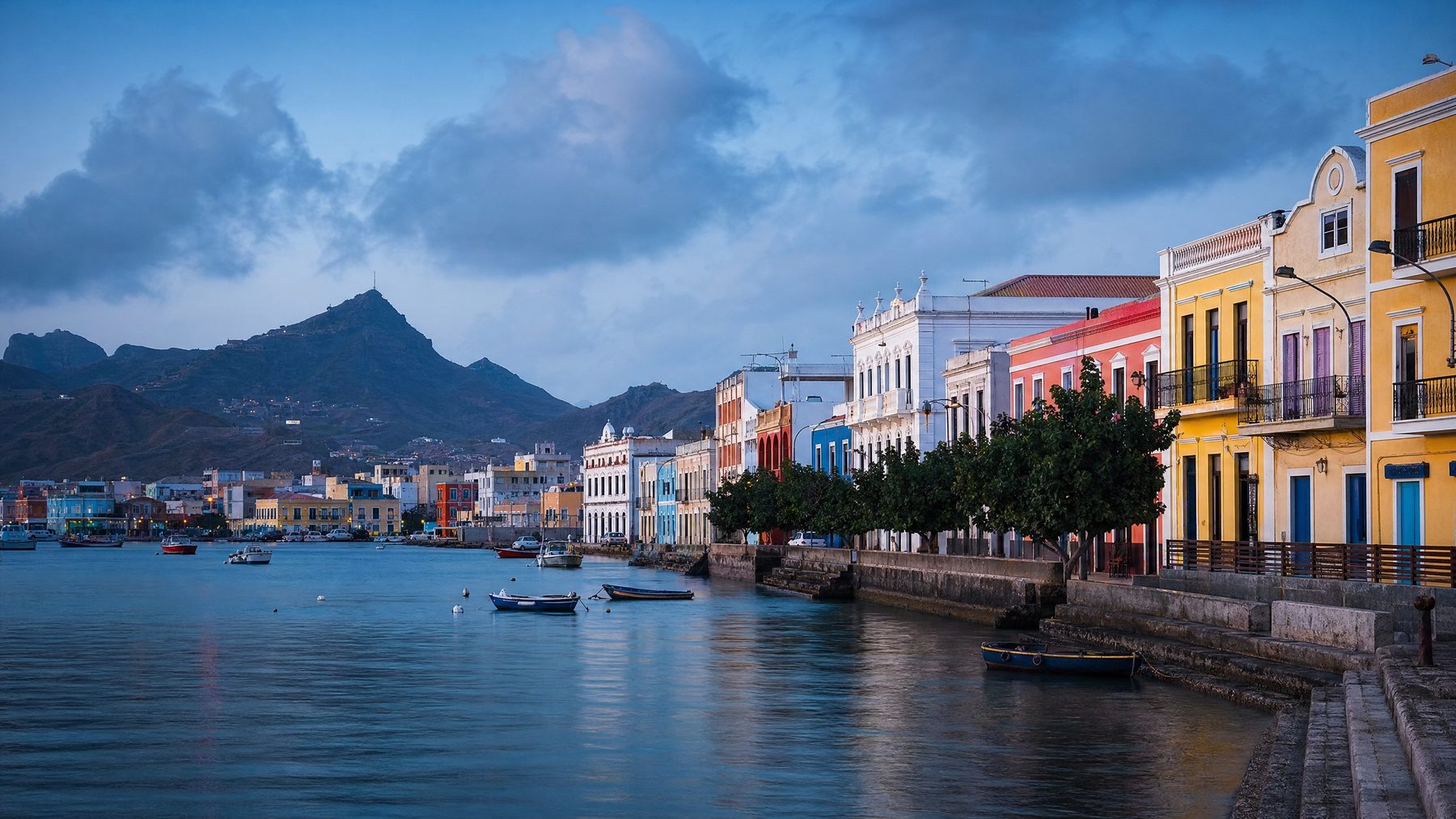
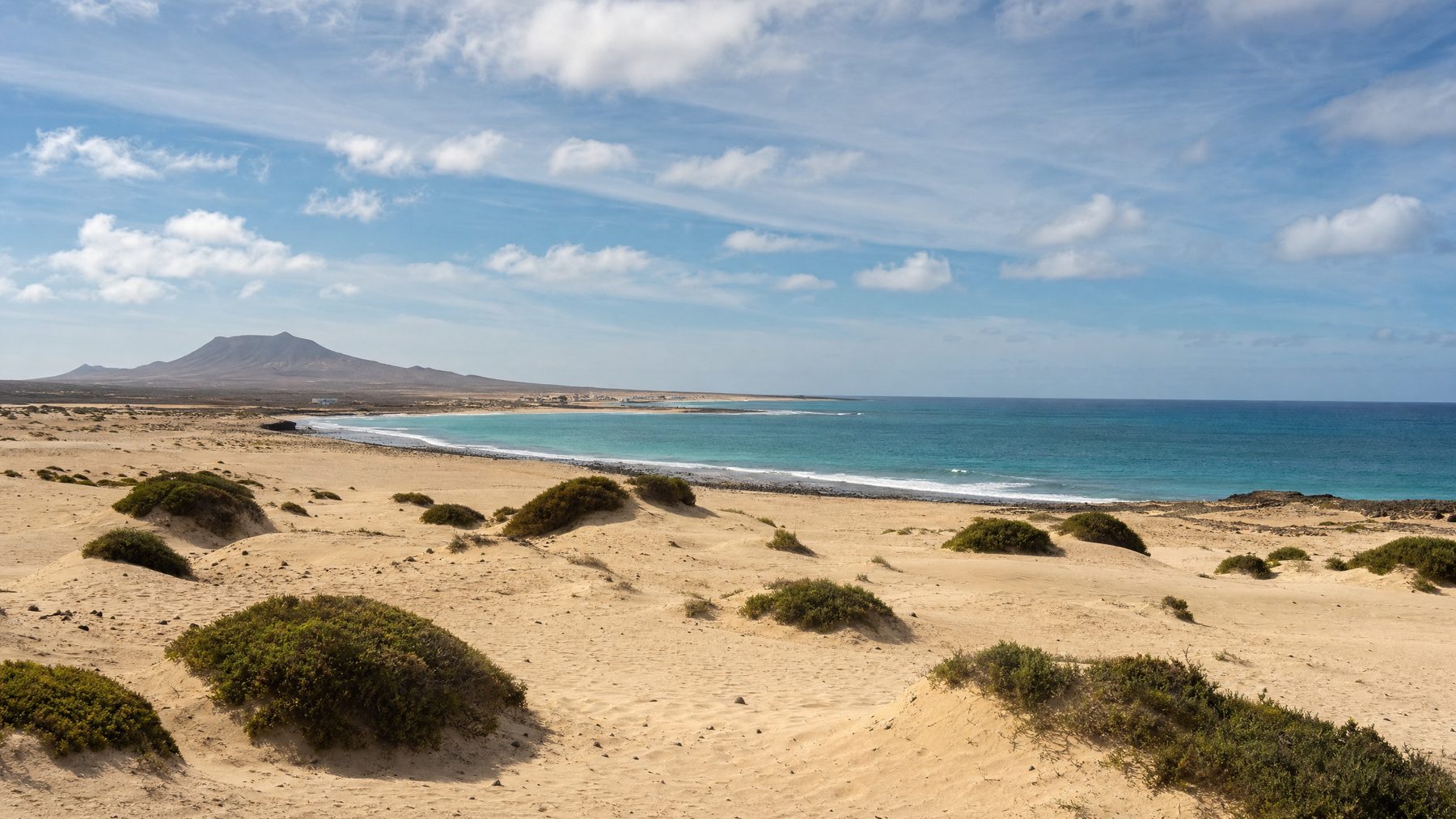
Boa Vista, the third-largest island, has the Sahara-like sand dunes of Viana, the long beaches of Praia de Chaves and Praia de Santa Mónica, the loggerhead turtle nesting sites, and a developing tourism economy. São Vicente, with the city of Mindelo, is the cultural capital — the Carnival, the morna and coladeira music tradition, the colonial port architecture, the proximity to Santo Antão (one of the world's great hiking islands — the Paúl Valley, the Cova crater, the Punta do Sol coastline).
- ›Fogo is dominated by Pico do Fogo (2,829 m), an active volcano — the Chã das Caldeiras village inside the caldera produces excellent volcanic-soil wine. Brava, the smallest inhabited island, is famous for its flowers and as the birthplace of poet Eugénio Tavares.
- ›Connectivity to Europe and North America is excellent for an Atlantic archipelago. Sal is the principal hub: direct flights to Lisbon (3.5 hours, multiple daily on TAP and Cabo Verde Airlines), Paris (5 hours), Amsterdam (5.5 hours), Frankfurt (5.5 hours), London (5.5 hours), Manchester (5.5 hours), Madrid (4 hours), Milan (5 hours), Boston (5.5 hours, seasonal), and several other European cities. Praia (Santiago) has direct service to Lisbon and several West African capitals. Direct flights to most major European cities — typically 3.5–5.5 hours from Western Europe and 5.5 hours from Boston — is unmatched among Atlantic archipelagos south of the Azores.
The trade-wind climate is the practical advantage. Year-round temperatures 22–28°C, dry climate, very little rainfall (most islands receive under 200mm annually), constant Atlantic breeze. Among the most consistent year-round climates anywhere in the Atlantic.
III.
What Others Say About Cape Verde
"Cape Verde is what Madeira was in 1980 — beautiful, uncrowded, Portuguese-speaking, with year-round mild weather and an emerging retirement community of Europeans who arrived first and never left. The advantage that won't last is the property prices."
— Travel writer, Mindelo, 2024
"I moved to Sal in 2018 with the Green Card programme and have been on the foreign-retirement-income exemption ever since. My UK pension is fully exempt from Cape Verde tax. The combination of 0% retirement income tax, year-round 26°C, the eurozone-pegged currency, and direct flights to Lisbon and London makes the financial arithmetic work cleanly."
— British retiree, Sal, 2025
"Santo Antão is one of the great hiking destinations in the world — the Paúl Valley, the Cova crater, the volcanic ridges that drop directly to the Atlantic. There are very few places left where you can do this kind of mountain walking with this little human pressure. Cape Verde has not yet been discovered the way Madeira and the Azores were."
— Hiking guide, Santo Antão, 2025
IV.
Tax Benefits: What Cape Verde Has to Offer
Cape Verde is a structurally interesting Atlantic archipelago for retirees and foreign investors — and one of the few jurisdictions outside the pure-zero-tax frameworks that offers a 0% personal-tax outcome on foreign retirement income through a clear, codified residence framework.
- ›Green Card foreign retirement income exemption — qualifying retiree-holders of the Cape Verde Green Card (Autorização de Residência Permanente) receive a personal income tax EXEMPTION on foreign retirement income under the Personal Income Tax Code (CIRPS). Such exempt income is not aggregated to any other income subject to CIRPS. Effective 0% Cape Verde tax on foreign retirement income for qualifying retirees — among the cleanest framework anywhere outside the pure 0%-tax jurisdictions.
- ›Foreign Investor Regime — 10% flat on foreign-source income — qualifying foreign investors pay a 10% flat rate on foreign-sourced income (and on capital gains, also 10%). Useful for HNW clients with active international income flows who do not qualify for or do not pursue the Green Card retirement framework.
- ›Green Card 50% IUP property tax reduction — Green Card holders receive a 50% reduction on the Single Property Tax (IUP) for 10 years following acquisition, plus exemption from IUP on transmission and on mortis causa succession.
- ›No inheritance tax for direct heirs — transfers to spouse, children, parents are not subject to inheritance tax. Modest stamp duties apply on transfers to non-direct heirs.
- ›No annual wealth tax — no annual tax on net worth or accumulated wealth.
- ›Investment Residence from EUR 60,000 — relatively low investment threshold compared to most European Golden Visa alternatives. Eligible: real estate, productive business projects, special economic zone (SEZ) investments. Provides residence card for up to 5 years and right to manage assets locally.
- ›Eurozone-pegged currency — the Cape Verdean escudo (CVE) has been pegged to the euro at 110.27:1 since 1998 (formerly to the Portuguese escudo). Provides complete currency stability for euro-denominated retirees. Effectively eurozone monetary access without EU membership.
- ›Standard personal income tax 16.5%–27.5% — moderate rates by Western European standards. Top rate 27.5% applies above CVE 5,000,000 (~EUR 45,000) annual income.
- ›Corporate income tax (IRPC) 20% — reduced from 21% effective 2025. Special Economic Zones (SEZ) on Sal and Boa Vista offer further reductions. REMPE (Special Regime for Small and Micro-Sized Enterprises) provides simplified compliance.
- ›Solar energy / renewable energy incentives — foreigners investing in solar projects can obtain residence permits with tax incentives and zero import duties on equipment.
- ›Direct connectivity to Europe and Boston — 3.5–5.5 hour direct flights from most Western European cities; 5.5 hours from Boston. Better connectivity than the Azores for Atlantic-archipelago purposes.
- ›Stable democracy, low corruption, Portuguese institutional framework — consistently ranked among Africa's most democratic and least corrupt nations. Portuguese civil law tradition provides predictable legal infrastructure.
V.
Tax Rates at a Glance
The most important tax rates in Cape Verde are as follows. Note that these have been simplified and should be used as general guidance only.
| Tax | Rate | Notes |
|---|---|---|
| Personal Income Tax — bottom rate | 16.5% | Lower bracket |
| Personal Income Tax — top rate | 27.5% | Above CVE 5,000,000 (~EUR 45,000) |
| Foreign retirement income — Green Card holders | 0% | Exempt under CIRPS; not aggregated |
| Foreign-source income — Foreign Investor Regime | 10% flat | Qualifying foreign investors |
| Foreign-source capital gains — Foreign Investor Regime | 10% flat | Same regime |
| Tax basis — residents (standard) | Worldwide income | At progressive rates |
| Tax basis — non-residents | Cape Verde-source only | At flat rates equivalent to resident progressive |
| Capital Gains — real estate (residents) | Standard income tax rates | Progressive |
| Capital Gains — financial instruments (residents) | Specific WHT rates | Variable by category |
| Inheritance Tax — direct heirs | 0% | None for spouse, children, parents |
| Wealth Tax | 0% | None |
| Gift Tax | Modest stamp duties | On transfers between non-direct heirs |
| Corporate Income Tax (IRPC) | 20% | Reduced from 21% effective 2025 |
| Corporate Income Tax — SEZ (Sal, Boa Vista) | Reduced | Specific incentives |
| Corporate Income Tax — REMPE | Simplified rates | Small and micro-sized enterprises |
| Withholding Tax — dividends to non-residents | 10% | Reduced by DTA where applicable |
| Withholding Tax — interest to non-residents | 10% | Reduced by DTA where applicable |
| Withholding Tax — royalties to non-residents | 10% | Reduced by DTA where applicable |
| VAT (IVA) — standard | 15% | Goods and services |
| VAT — reduced rate | 8% | Specific sectors |
| Single Property Tax (IUP) | Variable | Property tax framework |
| Green Card IUP reduction | 50% for 10 years | Plus exemption on transmission |
| Stamp Duty on property purchase | Tiered | Standard rates apply |
| Tax residency threshold | 183+ days OR permanent home | Standard tests |
| Investment Residence minimum | EUR 60,000 | Real estate or productive projects |
| DTAs | Limited (Portugal, Mauritius, Senegal, others) | Small network |
| CRS exchange | Yes | Annual automatic exchange |
| EU / Schengen | No / No | Special Partnership with EU |
| Currency peg | EUR (1:110.27) | Since 1998 |
Cryptocurrency and Crypto Assets
Cape Verde has no specific cryptocurrency taxation regime for individuals. Personal crypto disposals fall under general Cape Verde income/capital gains tax rules. For Green Card retiree-holders, foreign-source crypto disposals fall outside the foreign-retirement-income exemption framework (which is limited to qualifying retirement income, not investment income generally). For Foreign Investor Regime clients, foreign-source crypto gains fall within the 10% flat rate. The country is positioning itself as a digital economy hub, with the Remote Working Cabo Verde programme and broader digital nomad incentives — but a comprehensive crypto-asset framework has not yet been published. Standard advice: obtain current-position confirmation before significant Cape Verde-resident crypto positioning.
VI.
Tax Residency: What Triggers It
Under Cape Verde tax law, an individual is considered a tax resident if they meet either of the following criteria:
- ›183-day rule: Physical presence in Cape Verde for more than 183 days in a 12-month period.
- ›Permanent establishment / home: Maintaining a home in Cape Verde with the intention to reside there.
Tax residents are subject to Cape Verde taxation on worldwide income at progressive rates 16.5%–27.5% under the standard regime — modified by the Green Card retiree exemption (0% on foreign retirement income) or the Foreign Investor Regime (10% flat on foreign-source income).
- ›For the Green Card foreign retirement income exemption to apply: - The applicant must hold the Green Card (Autorização de Residência Permanente) - The applicant must be a retiree - The income must be foreign-source retirement income (foreign pensions, foreign retirement schemes) - The exempt income is not aggregated to other income subject to CIRPS
- ›For the Foreign Investor Regime to apply: - The applicant must qualify as a foreign investor under specific criteria - The 10% flat rate applies to qualifying foreign-source income (and capital gains)
Non-residents are taxed only on Cape Verde-source income at flat rates equivalent to the resident progressive scale.
- ›Documentation matters. Establishing and maintaining Cape Verde tax residency requires evidence: a registered Cape Verde address (lease or property title), passport stamps demonstrating physical presence, utility bills, banking, the residence permit (Autorização de Residência) or Green Card, and a Cape Verde Tax Identification Number (NIF) issued by the Direcção-Geral dos Impostos (DGI).
- ›Critical for the Green Card retirement framework: The Green Card status is the gateway to the foreign-retirement-income exemption. Green Card application typically requires several years of prior temporary residence, demonstrated stable income, and clean criminal record. Pre-application planning is essential.
VII.
Double Tax Treaties
Cape Verde has concluded a limited number of double tax agreements — significantly fewer than most European or major Caribbean alternatives.
Active DTA partners include:
- ›Portugal (the principal partner)
- ›Mauritius
- ›Senegal
- ›Macau (PRC SAR)
- ›Spain (limited)
The Portugal–Cape Verde DTA is by far the most important treaty. It allocates pension taxation rights, provides reduced cross-border withholding rates, and supports the substantial Portuguese retiree migration to Cape Verde. For Portuguese nationals, the Cape Verde route can be particularly favourable — combining the Portugal-CV DTA with the Green Card exemption framework can produce highly tax-efficient retirement positioning.
- ›There is no comprehensive DTA between Cape Verde and the United Kingdom, Germany, France, Belgium, the Netherlands, Italy, the United States, or Canada. This is a significant structural limitation. For retirees from these countries, source-country pension and investment-income withholding continues at standard non-treaty rates without treaty relief. The Cape Verde Green Card exemption applies to the foreign retirement income from a Cape Verde-resident perspective — but cannot reduce source-country withholding in the absence of a DTA.
- ›Practical implications for major retirement-source countries:
- ›UK pensioners: UK-source pension taxation under domestic rules continues; Cape Verde Green Card 0% exemption applies on the Cape Verde side. Net outcome: UK tax + Cape Verde 0% = UK tax only.
- ›German Rente: German-source pension taxation under §49 EStG continues; Cape Verde Green Card 0% exemption applies on the Cape Verde side.
- ›French retirees: Similar position — French-source pension taxation continues; Cape Verde 0% on the local side.
- ›Portuguese retirees: DTA applies — typically allocating taxation rights to residence (Cape Verde), where the Green Card framework provides 0%. Most favourable outcome of any major source country.
Cape Verde has signed the OECD Multilateral Convention on Mutual Administrative Assistance in Tax Matters and has implemented OECD CRS automatic exchange. The country has signed multiple Tax Information Exchange Agreements (TIEAs) covering broader administrative cooperation without treaty relief.
The DTA limitation is the principal structural disadvantage of Cape Verde compared to alternatives like Portugal NHR (recently revoked), Madeira tax framework, or other established European retirement destinations.
VIII.
Avoid Remaining Tax Resident at Home
Relocating to Cape Verde does not automatically end your tax obligations elsewhere. The critical question is whether you have genuinely severed tax residency in your country of origin.
The most common triggers that can keep you tax-resident at home:
- ›Available dwelling: Any long-term residence that remains available for your use is sufficient to maintain a taxable domicile in many countries. Surrendering it before departure is a precondition of a clean exit in Germany (§1 EStG Wohnsitz), Austria, Switzerland, and many other jurisdictions.
- ›Centre of vital interests: If your family, your business, your social connections, and your financial affairs remain in your home country, most tax authorities will argue that your centre of life has not genuinely moved.
- ›183-day rule (home country): Spending more than 183 days in your home country in a calendar year will typically trigger residency there.
- ›Extended unlimited tax liability (Germany — §2 AStG): Germany's erweiterte unbeschränkte Steuerpflicht under §2 AStG can keep German nationals taxable in Germany for up to ten years after departure if they move to a low-tax country. Cape Verde under the Green Card retiree framework (0% on foreign retirement income) IS classified as a low-tax country under §2 AStG for German retirees benefiting from the exemption. The Foreign Investor Regime at 10% flat may also trigger §2 AStG analysis. For German nationals, §2 AStG planning is essential.
A genuine relocation to Cape Verde requires that you actually live there — that your home is there, your daily life is there, and that you can demonstrate this with documentation.
The test is not where you are registered. The test is where you live. Tax authorities in Portugal, Germany, France, the UK, and other major source countries are experienced at identifying sham relocations and have the legal tools to challenge them. Proper advice before you move — not after — is essential. Particularly important given the limited Cape Verde DTA network — there is no treaty backstop for most non-Portuguese retirees.
IX.
Tax Considerations When Leaving Your Home Country
Before you relocate, you need to understand what tax consequences arise in your current country of residence at the point of departure.
Among the countries that levy a meaningful exit tax or deemed-disposal charge:
- ›Portugal. The Portugal-Cape Verde DTA provides standard tie-breaker rules. Portuguese nationals retiring to Cape Verde benefit from the comprehensive treaty framework. Portugal NHR (Non-Habitual Resident) regime was revoked for new applicants; clients who became residents by 2024 may still benefit. For Portuguese retirees moving to Cape Verde, the route is generally favourable.
- ›Germany. Applies an exit tax on unrealised gains in shareholdings of 1% or more under §6 AStG. Cape Verde under Green Card 0% retirement exemption IS classified as low-tax under §2 AStG, so the 10-year extended German tax liability applies for German nationals — taxing ongoing German-source income and certain foreign-source income flows. There is no Germany-Cape Verde DTA, so no treaty relief is available. Pre-departure planning is essential.
- ›United Kingdom. Statutory Residence Test (SRT) exit-date analysis required. There is no UK-Cape Verde DTA. UK pensioners moving to Cape Verde face UK-source pension taxation under domestic rules without treaty relief.
- ›France. Exit tax applies to unrealised gains on securities and company rights above €800,000. Cape Verde is non-EU/EEA; the deferral mechanism for EU moves does not apply. No comprehensive France-Cape Verde DTA as of 2026.
- ›Belgium. Belgian nationals retiring to Cape Verde face Belgian source-country withholding without treaty relief. No comprehensive Belgium-Cape Verde DTA.
- ›Netherlands. Deemed disposal applies to substantial shareholdings (5% or more) at the point of emigration. No comprehensive Netherlands-Cape Verde DTA.
- ›Italy. Italian nationals face Italian source-country withholding. No comprehensive Italy-Cape Verde DTA.
- ›United States. The "expatriation tax" under IRC §877A treats long-term residents and citizens as having sold all worldwide assets at fair market value on the day they relinquish citizenship or residency. No comprehensive US-Cape Verde DTA.
Beyond exit tax, you may remain subject to limited tax liability in your home country after the move — for example, on rental income, dividends, or pension payments. Severing tax residency does not necessarily sever all tax obligations.
⚠ Obtain Local Tax Advice in Your Home Country. The information above provides a general overview of the departure tax rules that commonly apply when leaving high-tax jurisdictions. It is not legal or tax advice. The rules in your specific home country are complex, change frequently, and depend entirely on your personal circumstances. Before you take any steps to relocate, obtain written advice from a qualified tax adviser who is licensed in your home country and experienced in international relocations. A consultation with us is a good starting point — but it does not substitute for country-specific legal advice from a practitioner in your jurisdiction of departure. For Cape Verde, the limited DTA network makes pre-departure planning particularly important — you cannot rely on treaty mechanisms to resolve cross-border tax conflicts.
X.
Company Setup & Corporate Tax
Cape Verde's corporate framework operates under the General Tax Code. The corporate income tax (IRPC) rate was reduced to 20% from 21% effective 2025.
The most common structures:
- ›Sociedade por Quotas (Lda): Portuguese-tradition private limited liability company. Standard vehicle for most businesses. Single-member version permitted.
- ›Sociedade Anónima (SA): Public/private company structure for larger businesses.
- ›Branch / Permanent Establishment: Foreign companies can register a branch in Cape Verde.
- ›Special Economic Zone (SEZ) entities: Companies operating in the SEZs of Sal and Boa Vista benefit from preferential tax treatment — corporate tax reductions, customs duty exemptions, and simplified regulatory frameworks for tourism, services, and specific industries.
- ›REMPE (Special Regime for Small and Micro-Sized Enterprises): Simplified compliance and reduced rates for qualifying small businesses.
Cape Verde offers corporate tax incentives for:
- ›Tourism investments (resorts, hotels)
- ›Renewable energy projects (solar, wind) — including residence permits with tax incentives and zero import duties on equipment
- ›Special Economic Zones (Sal, Boa Vista)
- ›Export-oriented businesses
- ›Small and micro-sized enterprises (REMPE)
- ›Foreign investment is encouraged through Cabo Verde TradeInvest (CVTI), the country's investment promotion agency. Most modern business sectors are open to foreign investment without nationality restrictions.
- ›For Green Card retirees, Cape Verde company setup is generally NOT relevant — the foreign-retirement-income exemption framework is designed for retirees with foreign passive income, and Cape Verde local business activity is separate from the Green Card exemption.
- ›For Foreign Investor Regime clients, Cape Verde company structures may be relevant for active business operations alongside the 10% flat-rate framework on foreign-source income.
Permanent establishment risk is the central warning. A Cape Verde company that is effectively managed from another country may be treated as resident there for tax purposes. Genuine substance — directors meeting in Cape Verde, key decisions taken locally, operations conducted in Cape Verde — is essential.
XI.
Who Should (and Shouldn't) Move to Cape Verde
Section 11 is where the relocation decision becomes practical.
Good Fit
- › HNW retirees with foreign-source pension income seeking a Atlantic-archipelago base with 0% tax on foreign retirement income — particularly Portuguese, British, German, French, Belgian, Italian, and Dutch retirees who can clear the Green Card eligibility framework.
- › Portuguese retirees specifically — the Portugal-Cape Verde DTA combined with the Green Card retirement exemption produces among the most tax-efficient retirement frameworks available to Portuguese nationals.
- › HNW investors with portable foreign-source income seeking the 10% flat-rate Foreign Investor Regime — useful for clients who do not qualify as retirees but have substantial international investment income.
- › Lifestyle-prioritised clients seeking Atlantic island living with year-round mild climate, eurozone-pegged currency, direct flights to Lisbon and major European cities, and an emerging European retiree community.
- › Real estate investors seeking lower-priced Atlantic island property — Cape Verde prices remain materially below the Azores, Madeira, and Canary Islands.
- › Renewable energy investors (solar, wind) — specific incentive frameworks combined with year-round sunshine.
- › Digital nomads and remote workers — the Remote Working Cabo Verde programme provides a digital nomad visa framework.
Poor Fit
- × Anyone seeking comprehensive 0% taxation across the board — only Green Card retiree foreign-retirement-income is at 0%; other income types fall under standard regime or Foreign Investor 10%.
- × Working-age HNW clients with active local-source income — the standard 16.5%–27.5% progressive scale applies.
- × German nationals without proper §2 AStG planning — the Green Card 0% framework is genuinely low-tax, triggering 10-year extended German liability.
- × Clients prioritising treaty-network access — Cape Verde's DTA network is very limited (Portugal, Mauritius, Senegal, and a handful of others).
- × Clients seeking pure English-language environments — Portuguese and Cape Verdean Creole are the working languages; English availability is increasing but not universal.
- × US citizens expecting Cape Verde status to eliminate US tax filing — the US taxes citizens on worldwide income regardless of residence; no comprehensive US-Cape Verde DTA.
- × Clients seeking absolute privacy — Cape Verde is fully CRS-compliant, FATCA-cooperative, and beneficial-ownership-transparent.
- × Clients seeking sophisticated international banking — Cape Verde's banking sector is functional but not deep; HNW clients typically maintain primary banking in Portugal, Switzerland, or other European centres.
XII.
Visas and Residence Permits
Cape Verde offers several pathways for foreign nationals seeking long-term residence:
- ›Visitor entry (visa-free): Citizens of EU/EEA, UK, US, Canada, and many other countries can enter Cape Verde visa-free or with visa-on-arrival for stays up to 30 days. Note: NOT a residence permit.
- ›Temporary Residence Permit: First-stage authorisation for stays beyond 90 days — for work, study, retirement, family reunification, or investment purposes. Issued by the Direcção de Estrangeiros e Fronteiras (DEF). Initially 1-year, renewable for 2-year cycles thereafter.
- ›Investment Residence (Investor Permit): Available to foreigners investing EUR 60,000 or more in real estate or productive projects in Cape Verde. Provides residence card for up to 5 years and right to manage assets locally. Processing typically 3 months under recent reforms (down from 6 months previously).
- ›Retiree / Financially Independent Residence: For individuals with stable foreign pension or passive income. Documentation: pension entitlement, bank statements, foreign address surrender, criminal record check. Particularly popular on Sal, São Vicente, and Santiago.
- ›Permanent Residence (Green Card / Autorização de Residência Permanente): Granted after 5 years of continuous legal stay with stable income and integration proof. Provides almost all rights of nationals except voting. Critical: the Green Card is the gateway to the foreign-retirement-income tax exemption framework under CIRPS.
- ›Remote Working Cabo Verde (Digital Nomad Visa): For remote workers and freelancers. Initial 6-month period, renewable for another 6 months. Requires proof of income, health insurance, accommodation arrangements.
- ›Solar Energy Residence: Foreigners investing in solar energy projects can obtain residence permits with tax incentives and zero import duties on equipment.
- ›Family reunification permits: For spouses, partners, and dependent children of Cape Verde residents.
- ›Study, employment, humanitarian permits: Various specific categories.
The typical retirement pathway is:
- 1.Initial Temporary Residence Permit (retiree or financially independent category)
- 2.Renewals through 5-year horizon
- 3.Permanent Residence / Green Card after 5 years of continuous legal stay
- 4.Foreign-retirement-income tax exemption activated upon Green Card grant for qualifying retirees
The Investment Residence pathway can compress this timeline — EUR 60,000+ investment supports faster residence card issuance, though the 5-year continuous stay requirement for the Green Card / permanent residence remains.
Visa and permit rules can change. Always verify current requirements with the Cape Verde Embassy or Consulate in your country of residence before making any plans.
XIII.
Path to Citizenship
Cape Verde citizenship requires 5 years of continuous legal residence under a valid residence permit, plus standard naturalisation criteria.
Standard naturalisation requires:
- ›5 years of continuous legal residence in Cape Verde
- ›Adequate knowledge of Portuguese
- ›Good character (clean criminal record)
- ›Knowledge of Cape Verdean civic and constitutional matters
- ›Financial stability
- ›Approval at the discretion of the relevant authorities
- ›There is no Citizenship by Investment programme in Cape Verde. Naturalisation is a standard administrative process subject to discretionary approval.
- ›Dual citizenship is generally permitted under Cape Verdean law — including with Portuguese citizenship, which provides EU access for those who qualify.
- ›The Cape Verde passport provides visa-free or visa-on-arrival access to approximately 70 countries, including the EU Schengen Area (visa-free for short stays under specific arrangements), Brazil (CPLP framework), Russia, Singapore, and most African countries (CEDEAO/ECOWAS framework). The US, UK (post-Brexit), and Canada require visas. The passport is moderately strong by global standards — significantly stronger than many African passports given Cape Verde's stable democratic credentials.
- ›For Portuguese-speaking-country (CPLP) residents: Cape Verde has special arrangements with Portugal, Brazil, Angola, Mozambique, and other Portuguese-speaking nations under the Community of Portuguese Language Countries framework — including residence and naturalisation simplifications in some categories.
- ›For HNW clients prioritising EU passport access: Cape Verde naturalisation does NOT directly provide EU citizenship. However, Cape Verde citizenship can support eligibility for Portuguese citizenship by descent or special CPLP frameworks in specific cases. For genuine EU access, Portugal direct naturalisation pathways or EU Golden Visa alternatives are typically more efficient.
XIV.
Banking in Cape Verde
Cape Verde's banking sector is functional but small — appropriate for a country of 600,000 people. The country has a mix of local and Portuguese-affiliated institutions, all under the supervision of the Banco de Cabo Verde (BCV).
Major banks operating in Cape Verde:
- ›Banco Comercial do Atlântico (BCA): The largest bank, full retail and commercial services
- ›Banco Interatlântico: Portuguese Caixa Geral de Depósitos affiliate, full services
- ›Banco Caboverdiano de Negócios (BCN): Full-service commercial bank
- ›Caixa Económica de Cabo Verde: Long-established savings and commercial bank
- ›Ecobank Cabo Verde: Pan-African Ecobank Group presence
- ›BNI Cabo Verde: Banco Nacional de Investimentos
Account opening for non-residents requires passport, residence permit (or proof of pending application), proof of address, source-of-funds documentation. Multi-currency accounts (CVE, EUR, USD) are standard. The CVE-EUR peg means euro-based banking is straightforward.
The banking sector is CRS-compliant and FATCA-cooperative. Banco de Cabo Verde applies foreign exchange controls — capital movements above prescribed thresholds require regulatory clearance. Profit repatriation by foreign investors is permitted with appropriate clearance.
For Cape Verde tax residents (whether under Temporary Residence, Green Card, or Foreign Investor Regime), the typical banking architecture is:
- ›Local Cape Verde account — for residence administration, daily expenses, property maintenance, and Green Card / Foreign Investor compliance.
- ›Primary international booking centre — Portugal (Banco Comercial Português, Caixa Geral de Depósitos, Millennium BCP, Novobanco), Switzerland, Luxembourg, the UK, Spain — for the bulk of investment portfolios. Portugal is the natural complement for most Cape Verde residents given the language, cultural ties, eurozone integration, and the Portugal-Cape Verde DTA.
Important: not all banks are compatible with all residencies. Some Swiss and Singaporean private banks have specific protocols for African-resident clients. Source of wealth documentation must be impeccable. Several private banks impose minimum asset thresholds (typically EUR 1–5 million).
Important: not all banks are compatible with all residencies. Some Swiss and Singaporean private banks have restrictions on clients resident in certain jurisdictions, and compliance requirements vary. Residency status, income profile, source of wealth, and business type all affect which institutions will accept you and on what terms. We help clients navigate this before they commit to any banking structure.
XV.
What Makes Cape Verde Genuinely Attractive
Cape Verde is attractive when judged as a complete relocation platform for retirees and Atlantic-archipelago-prioritised clients — not as a slogan.
- ›The Green Card foreign-retirement-income exemption is genuinely competitive. 0% tax on foreign retirement income for qualifying Green Card retirees is among the cleanest framework anywhere outside the pure 0%-tax jurisdictions. The codified statutory basis under CIRPS provides legal certainty.
- ›Eurozone-pegged currency. The CVE-EUR peg at 110.27:1 since 1998 provides complete currency stability for euro-denominated retirees — effectively eurozone monetary access without EU membership friction.
- ›Direct connectivity to Europe and Boston. 3.5–5.5 hour direct flights from most Western European cities; 5.5 hours from Boston. Better connectivity than the Azores; comparable to Madeira; significantly better than most Caribbean alternatives for European retirees.
- ›Year-round mild Atlantic climate. 22–28°C year-round, dry climate, constant trade winds. Among the most consistent year-round climates in the Atlantic.
- ›Lower property prices than Azores, Madeira, Canary Islands. Cape Verde property remains materially cheaper than established European Atlantic destinations — for buyers willing to invest in an emerging market with continued upward trajectory.
- ›Stable democracy and Portuguese institutional framework. Consistently ranked among Africa's most democratic and least corrupt nations. Portuguese civil law tradition. Predictable regulatory environment. Strong CPLP and Special EU Partnership relationships.
- ›Investment Residence at EUR 60,000. Among the lowest investment-residence thresholds in any meaningful jurisdiction. Compares favourably with Portuguese Golden Visa (€500K+ historically), Spanish Golden Visa (€500K), or other European alternatives.
- ›Foreign Investor Regime 10% flat. For HNW clients with active international income flows, the 10% flat rate provides genuinely competitive treatment without requiring the Green Card retirement framework.
- ›The attraction has to be handled honestly. The DTA network is very limited — only Portugal-Cape Verde provides comprehensive treaty support, leaving most other nationalities without treaty relief from source-country withholding. The Green Card requires 5 years of prior residence — meaning the 0% retirement framework only activates after a multi-year transition. The Portuguese language barrier is real for non-Lusophone clients. The local infrastructure is more developed than Vanuatu but less than the Caribbean major CBI states. Cape Verde rewards clients who understand it as a 5-year transition to a 0% retirement framework with eurozone-pegged currency and Atlantic-archipelago lifestyle — and is structurally suboptimal for those expecting immediate 0% treatment or comprehensive treaty access.
XVI.
Cost of Living in Cape Verde
Cape Verde offers moderate cost of living — significantly cheaper than mainland Portugal, Spain, or Italy, but materially more expensive than Southeast Asian or Latin American alternatives. Tourism areas (Sal, Boa Vista) are more expensive than residential areas (Praia, Mindelo).
Typical monthly costs for an internationally mobile retiree or family in Cape Verde (2026 planning ranges):
| Category | CVE/month | GBP/month | EUR/month |
|---|---|---|---|
| 1-bed apartment, Praia / Mindelo | CVE 50,000–110,000 | £380–840 | €450–1,000 |
| 1-bed apartment, Santa Maria (Sal) | CVE 80,000–165,000 | £610–1,260 | €725–1,500 |
| 2-bed villa / townhouse, prime areas | CVE 110,000–275,000 | £840–2,090 | €1,000–2,500 |
| Premium villa, Sal / Boa Vista | CVE 220,000–550,000 | £1,670–4,180 | €2,000–5,000 |
| International school (annual per child) | CVE 770,000–1,650,000 | £5,860–12,560 | €7,000–15,000 |
| Private health insurance (annual individual) | CVE 110,000–330,000 | £840–2,510 | €1,000–3,000 |
| Restaurant meal, mid-range (per person) | CVE 1,000–2,750 | £8–21 | €9–25 |
| Monthly groceries, single person | CVE 25,000–55,000 | £190–420 | €225–500 |
| Utilities and internet, apartment | CVE 8,000–17,500 | £61–133 | €72–160 |
- ›Comfortable single retiree (no children): CVE 110,000–220,000/month (£840–1,670 / €1,000–2,000)
- ›Family of four with private schooling: CVE 330,000–660,000/month (£2,510–5,020 / €3,000–6,000)
- ›Premium retiree lifestyle on Sal/Boa Vista: EUR 3,500+/month
These figures are planning ranges, not promises. The CVE-EUR peg means budgets translate cleanly to euro terms.
- ›Travel costs are favourable. Direct flights to Lisbon, Madrid, Paris, Amsterdam, Frankfurt, London, Boston are EUR 200–800 economy, EUR 800–2,500+ business. Multiple daily flights to Lisbon (TAP and Cabo Verde Airlines) provide reliable European connectivity.
- ›Healthcare: Basic and primary care available on Santiago (Praia), São Vicente (Mindelo), and Sal. For complex specialist treatment, retirees typically travel to Portugal (3.5 hours direct). Comprehensive international health insurance is essential — Bupa Global, Cigna Global, AXA Global Healthcare, with premiums EUR 1,000–3,000+ per individual annually.
XVII.
Buying Real Estate in Cape Verde
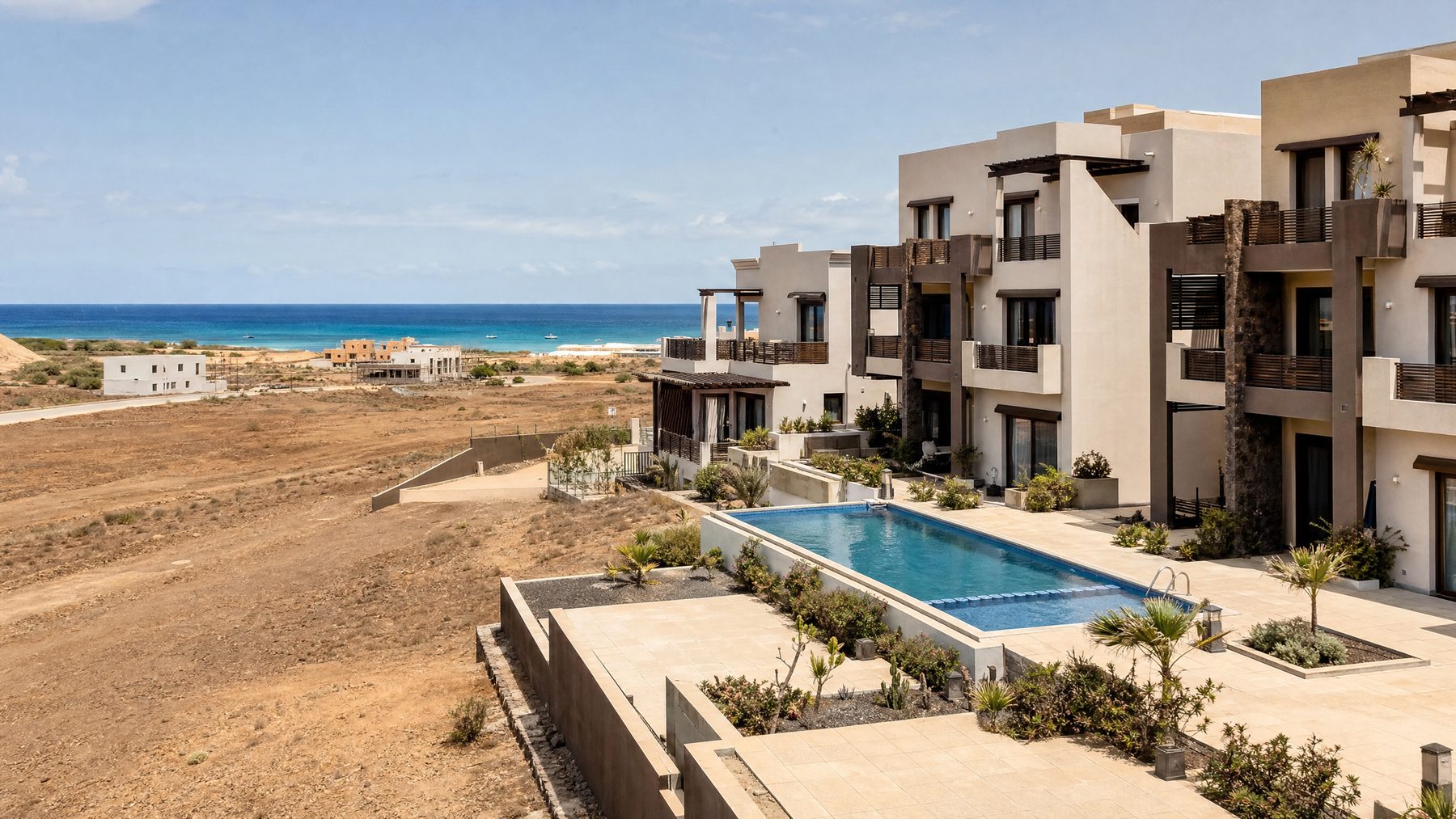
Buying real estate in Cape Verde is accessible to foreigners with relatively few restrictions — and EUR 60,000+ investment in real estate qualifies for the Investment Residence permit, making property purchase a direct residence pathway.
For internationally mobile buyers, the main points are:
- ›Ownership rules: Foreigners can own freehold property in Cape Verde without nationality-based restrictions for most residential and commercial categories. Notarial registration and a Cape Verde Tax ID (NIF) are required.
- ›Investment Residence threshold: EUR 60,000 — property purchase at or above this level qualifies for the Investment Residence permit, providing residence card for up to 5 years.
- ›Green Card IUP property tax benefit — Green Card holders receive 50% reduction on the Single Property Tax (IUP) for 10 years, plus exemption from IUP on transmission and on mortis causa succession.
- ›Transaction costs: Stamp duty 1.5%; notary fees ~1.5%; legal fees 1–2%; agent commission 3–5%. Total buyer-side cost typically 6–10% of purchase price.
- ›Market and rental profile: Sal (Santa Maria, Espargos, Pedra Lume) is the prime market for European retirees and tourism investors. Boa Vista (Sal Rei, Cabral) is the second tourism market. Praia (Santiago) and Mindelo (São Vicente) are the principal residential markets. Santo Antão is a niche market for hiking-tourism properties. Rental yields run 5–8% gross in tourism areas; long-term residential rentals are lower yield but more stable.
- ›Hurricane and storm exposure: Cape Verde sits at the eastern end of the Atlantic hurricane formation zone — most hurricanes pass north or south of the islands. Direct hurricane impact is rare but tropical storms occur. Properties on the coast must be built to appropriate standards and insured.
- ›Volcanic activity: Pico do Fogo on Fogo Island is an active volcano (last erupted 2014–2015). Sal, Boa Vista, and Maio are low-lying islands without active volcanic activity. Praia (Santiago) and Mindelo (São Vicente) are moderately seismic.
The practical approach is to rent in the first phase while exploring different islands, then purchase based on lifestyle preferences and Investment Residence considerations.
Transaction cost table (Cape Verde):
| Cost item | Typical amount | Notes |
|---|---|---|
| Stamp duty | ~1.5% | Of purchase price |
| Notary fees | ~1.5% | Plus disbursements |
| Legal fees | 1–2% | Buyer's solicitor |
| Real estate agent | 3–5% | Typically split |
| Annual property tax (IUP) | Variable | 50% reduction for Green Card holders for 10 years |
| Capital gains on resale | Income tax rates / 10% (Foreign Investor) | Within the applicable regime |
XVIII.
Retiring in Cape Verde
Cape Verde is a structurally interesting retirement destination — particularly for European retirees seeking Atlantic-archipelago lifestyle, eurozone-pegged currency, and the 0% Green Card foreign-retirement-income exemption.
The principal retirement pathway is:
- 1.Temporary Residence Permit (Retiree / Financially Independent category) — initial residence
- 2.Continuous 5-year residence with renewals
- 3.Green Card (Permanent Residence Authorization) — flagship status
- 4.Foreign-retirement-income exemption activated upon Green Card grant under CIRPS
For retirees with foreign pension income:
- ›Standard residence (pre-Green Card): Foreign pension income is generally subject to Cape Verde personal income tax under the standard regime (16.5%–27.5% progressive). DTA relief applies where treaties exist (Portugal in particular).
- ›Green Card status: Foreign retirement income is fully exempt from Cape Verde personal income tax under CIRPS. Such exempt income is not aggregated to other income subject to CIRPS. Effective 0% Cape Verde tax for qualifying retirees.
Pension-source country considerations:
- ›Portuguese state pension (Caixa Geral de Aposentações) and most Portuguese private pensions: Under the Portugal-Cape Verde DTA, generally taxable in residence country (Cape Verde) — combined with the Green Card exemption, this produces 0% effective tax on Portuguese pensions for Cape Verde Green Card retirees. Most favourable retirement-tax pathway available to Portuguese nationals.
- ›UK state pension and most UK private pensions: No UK-Cape Verde DTA. UK-source taxation continues under domestic rules; Cape Verde 0% exemption (Green Card) on the local side. Net outcome: UK tax + Cape Verde 0%.
- ›German Rente: No Germany-Cape Verde DTA. German source-country withholding under §49 EStG continues. §2 AStG analysis applies for the 10-year extended German liability.
- ›French retirement (CNAV, AGIRC-ARRCO): No comprehensive France-Cape Verde DTA. French source-country taxation continues; Cape Verde 0% on the local side.
- ›US Social Security: US citizens taxed on worldwide income regardless; FEIE not applicable to pensions; FTC limited (Cape Verde tax = 0%, so no offset against US tax).
- ›Climate: Atlantic / Sub-Tropical — year-round 22–28°C, dry climate, constant northeast trade winds. Cooler high-altitude microclimates on Santo Antão, Fogo, and São Nicolau. Genuinely pleasant for retirees; little seasonal variation.
- ›Healthcare: Basic and primary care on Santiago, São Vicente, and Sal. For complex specialist treatment, retirees travel to Portugal (3.5 hours direct). Comprehensive international health insurance essential — Bupa Global, Cigna Global, with premiums EUR 1,000–3,000+ per individual annually.
- ›Cost of living: see Section XVI. Comfortable single retiree budget EUR 1,000–2,000/month; couple EUR 1,500–3,000/month including private healthcare and travel. Significantly cheaper than mainland Portugal, Spain, or Italy.
- ›Community: Substantial Portuguese, British, German, French, Italian, and Dutch retirement communities — particularly on Sal (Santa Maria), São Vicente (Mindelo), and increasingly on Boa Vista. The Portuguese-speaking framework makes Lusophone integration natural; English-language expat networks are well-established in tourism areas.
XIX.
US Citizens: What You Need to Know
US citizens and long-term green card holders are taxed by the United States on their worldwide income, regardless of where they live. Relocating to Cape Verde does not end US tax obligations.
Key considerations for US citizens in Cape Verde:
- ›Foreign Earned Income Exclusion (FEIE): US citizens who qualify as bona fide residents of Cape Verde can exclude up to US$132,900 of foreign earned income from US federal income tax for 2026. Applies to wages and self-employment — not passive income such as pensions.
- ›Foreign Tax Credit: Cape Verde income tax paid can generally be credited against US tax on the same income. For US Green Card retirees on the Cape Verde 0% foreign-retirement-income exemption, there is no Cape Verde tax to credit against — meaning US citizens pay full US tax on their pension income with no Cape Verde offset.
- ›No comprehensive US-Cape Verde DTA: The two countries do not have a comprehensive double tax agreement.
- ›FBAR (FinCEN Form 114): US persons with Cape Verde bank accounts exceeding US$10,000 must file FBAR annually.
- ›FATCA (Form 8938): Cape Verde has FATCA cooperation. US persons must file Form 8938.
- ›PFIC: US citizens holding non-US mutual funds, ETFs, or pooled investments face the punitive PFIC regime.
- ›CFC and Subpart F: US citizens holding majority stakes in Cape Verde companies face CFC reporting and Subpart F passive-income inclusion. Form 5471 required.
- ›Self-Employment Tax: No US-Cape Verde totalization agreement. US self-employment tax applies regardless.
- ݤ877A Expatriation: US citizens who renounce citizenship and meet "covered expatriate" tests face mark-to-market deemed sale of worldwide assets.
- ›OBBBA (One Big Beautiful Bill Act, July 2025): Made TCJA brackets permanent; raised QSBS Section 1202 cap to US$15M; raised federal estate tax exemption permanently to US$15M from 2026.
For US citizens, Cape Verde is primarily a lifestyle and Atlantic-archipelago destination, not a US tax-elimination tool. The Cape Verde Green Card 0% exemption produces full Cape Verde tax savings — but US citizens remain subject to US worldwide taxation with no FTC offset (because there is no Cape Verde tax to credit). The US-Cape Verde DTA absence further limits planning options. US citizens should compare Cape Verde against alternatives like Puerto Rico Act 60 (US-territory tax benefits without expatriation) before committing.
US citizens considering Cape Verde should work with a qualified US international tax adviser alongside local Cape Verde counsel.
XX.
Correct Preparation
Before your move to Cape Verde, a number of important questions need to be answered.
Do I need to give up my home country property?
To genuinely shift your centre of life to Cape Verde, surrendering your principal residence in your home country is generally non-negotiable for tax-residence purposes. Particularly important for German nationals — Cape Verde under the Green Card 0% retirement exemption is classified as a low-tax country under §2 AStG, and the 10-year extended liability framework applies in full.
Should I pursue Temporary Residence then Green Card, or Investment Residence?
The standard retirement pathway is Temporary Residence Permit → 5 years continuous → Green Card → foreign-retirement-income exemption activated. Investment Residence (EUR 60,000+) provides faster initial residence card issuance but does NOT compress the 5-year continuous-stay requirement for Green Card eligibility. For most retiree clients, the Temporary Residence pathway is sufficient; Investment Residence becomes meaningful when combined with property purchase or business investment goals.
When does the 0% foreign-retirement-income exemption activate?
Upon grant of the Green Card (Permanent Residence Authorization). This typically requires 5 years of continuous prior legal residence. Plan for this 5-year horizon from the start — the early years under Temporary Residence are subject to the standard regime (16.5%–27.5% progressive on worldwide income, modified by available DTA mechanisms).
Should I pursue the Foreign Investor Regime instead?
The Foreign Investor Regime (10% flat on foreign-source income) is a separate framework for HNW clients with active international income flows who do not meet retiree eligibility. For retirees, the Green Card 0% exemption is more favourable; for active investors, the 10% flat rate may be more appropriate.
How quickly can I open a bank account?
Cape Verde bank account opening typically takes 2–4 weeks at major banks (BCA, Caixa Económica, BCN). Multi-currency accounts (CVE, EUR, USD) are standard. The CVE-EUR peg means euro banking operates predictably.
What happens to my existing company?
A relocation abroad has consequences for your existing business. For German nationals, §6 AStG exit tax applies on departure for shareholdings ≥1%. For Portuguese nationals, the Portugal-Cape Verde DTA framework provides standard treaty support. Discuss with your adviser before moving.
Do I need to set up a Cape Verde company?
For Green Card retirees, NO. For Foreign Investor Regime clients, possibly relevant for active business operations. For Investment Residence pathway, typically yes — the EUR 60,000+ investment in productive projects often requires a Cape Verde company structure.
How much money should I transfer in advance?
You can transfer funds to a Cape Verde bank account, subject to bank source-of-funds documentation and Banco de Cabo Verde regulatory framework for large amounts. The Investment Residence threshold (EUR 60,000+) must be transferred via approved channels.
What is the language situation?
The official language is Portuguese; Cape Verdean Creole (Kriolu) is the everyday language. Government, banking, and legal services operate in Portuguese. English availability is increasing in tourism areas (Sal, Boa Vista) but is not universal in business or government. For non-Lusophone clients, Portuguese language acquisition is genuinely valuable.
What about the limited DTA network?
The Portugal-Cape Verde DTA is the principal treaty; for most other nationalities (UK, German, French, Belgian, Dutch, Italian, US), no comprehensive DTA exists. This means source-country withholding on income flowing to Cape Verde continues at standard non-treaty rates. The Cape Verde Green Card 0% exemption applies on the Cape Verde side only — it cannot reduce source-country withholding.
Deregistering from your home country
Standard deregistration with the residents' register and tax authority. Portuguese departers via the Finanças Portal. German Abmeldung at the Bürgeramt. UK SA109 Self Assessment Residence form. For US citizens, no deregistration is possible — citizenship-based taxation continues.
XXI.
Automatic Exchange of Information (OECD CRS)
Cape Verde participates in the OECD Common Reporting Standard (CRS) automatic exchange framework. Cape Verde financial institutions identify account holders and report account details to the Direcção-Geral dos Impostos (DGI), which automatically shares this information with the tax authority of the account holder's country of tax residence on an annual basis.
The key point is that CRS follows tax residence, not nationality or citizenship. A Cape Verde tax resident (whether under Temporary Residence, Green Card, or Foreign Investor Regime) is reported under Cape Verde residence — not under the country of the original passport.
Cape Verde is a signatory to the OECD Multilateral Convention on Mutual Administrative Assistance in Tax Matters and has implemented BEPS minimum standards. Beneficial ownership transparency has been substantially upgraded in line with international standards.
US citizens are different. Affected by FATCA instead. Cape Verde financial institutions identify US persons under FATCA procedures and report through bilateral arrangements. US citizens with Cape Verde accounts must additionally file FBAR and Form 8938 directly with US authorities.
Key point: CRS and FATCA are not problems for those who have relocated correctly. They are problems for those who have not.
XXII.
Further Relocation Formalities
Upon establishing residence in Cape Verde:
- ›Immigration registration: Submit Temporary Residence Permit application at the Direcção de Estrangeiros e Fronteiras (DEF) or via the digital DIRE portal. Standard documentation: passport, proof of foreign income/pension, proof of Cape Verde address, criminal record check, medical certificate, photographs, health insurance.
- ›Tax registration: Cape Verde Tax Identification Number (NIF) issued by the Direcção-Geral dos Impostos (DGI) upon establishment of tax residence. Required for banking, property purchase, residence renewal, and any tax filings.
- ›Driving licences: Foreign driving licences valid for short stays. After residence is established, exchange for a Cape Verde licence (subject to country-specific exchange agreements). Cape Verde drives on the right.
- ›Health insurance: Mandatory under Cape Verde residence framework. Comprehensive international cover (Bupa Global, Cigna Global, AXA Global Healthcare, Allianz Care) recommended for HNW retirees — premiums EUR 1,000–3,000+ per individual annually.
- ›Importing personal effects: Household goods imported within 6 months of taking up residence may qualify for relief from import duty under specific frameworks. Cars from EU can typically be imported with appropriate customs documentation.
- ›Schools: International school options primarily in Praia (Cooperativa Internacional de Cabo Verde, French Lycée), Mindelo (limited), and Sal (limited). Annual fees EUR 7,000–15,000+ per child. International school provision is materially more limited than mainland Portugal or Spain — a real factor for relocating families.
- ›Annual compliance calendar: Standard residents: annual tax return by 31 March (Declaração Anual de Rendimentos). Green Card retirees on the foreign-retirement-income exemption: simpler compliance with exempt income not aggregated. Residence permit renewals on the 1-year and 2-year cycles. Health insurance renewals.
XXIII.
How We Help With Your Move to Cape Verde
We offer comprehensive tax and legal support for your relocation to Cape Verde. We follow a proven process — and where Cape Verde requires specialist local input, we coordinate with our network of Cape Verde-licensed lawyers, accountants, real estate professionals, and bankers.
The results speak for themselves: we have helped over 100 entrepreneurs and business owners significantly reduce their tax burden through carefully planned relocations. Legally sound structuring within the framework of international tax law is our highest priority.
Our services typically include:
- →Tax advice on the consequences of relocating abroad: analysis, projections, assessments
- →Green Card pathway planning — Temporary Residence → 5-year continuous → Green Card → foreign-retirement-income exemption activation
- →Investment Residence (EUR 60,000+) coordination — real estate selection on Sal, Boa Vista, Santiago, São Vicente; productive project structuring; SEZ incentive analysis
- →Foreign Investor Regime analysis — eligibility for the 10% flat rate on foreign-source income for non-retiree HNW clients
- →Home-country departure tax analysis BEFORE relying on Cape Verde residence — particularly for Portuguese (DTA-supported), German (§6 AStG, §2 AStG 10-year extended liability), UK (no DTA), French (no DTA), and US citizens
- →Real estate strategy: Sal / Boa Vista / Santiago / São Vicente market guidance; Investment Residence threshold structuring; Green Card IUP property tax benefit planning
- →Banking strategy: local Cape Verde accounts (BCA, Caixa Económica, BCN, Banco Interatlântico) plus primary international booking centre (typically Portugal for Lusophone retirees); source-of-wealth documentation file
- →Coordination with home-country tax adviser, US international tax counsel (where relevant), and the Direcção-Geral dos Impostos for ongoing compliance
- →Schooling, healthcare, insurance, and lifestyle coordination for relocating families
- →Annual compliance management: tax filings, residence permit renewals, Green Card progression tracking
Our fees are generally billed on a time basis; fixed prices apply for certain services such as residence permit application coordination. As a first step, we recommend booking a consultation to discuss your plans — by phone, Zoom, or Signal. We will be honest about whether Cape Verde fits your specific objectives — particularly given the limited DTA network and the 5-year horizon to Green Card status.