I watched the most recent Eurovision and felt almost nothing. Polished, loud, weightless. And somewhere in the middle of it my mind slipped thirty years back, the way a needle finds an old groove, to a spring night in 1994 when seven minutes of dancing rearranged something inside a teenage boy in Germany who had no idea yet that his whole life was about to point west.
This is a story about that night, about a country that is exactly as warm and musical as it looks, and about why so many of the people I now help to move there end up never wanting to leave. It is also, I will admit, a little bit about my own daughters, and the way they dance.
The Night the Filler Became the Main Event
First, the setting, because it is half the magic. In 1994 the Eurovision Song Contest was held in Ireland. It was held there because Ireland kept winning the thing. The Irish had taken the title in 1992 and again in 1993, and under the contest’s own rules the winner hosts the following year, which meant that for the third year running the whole of Europe came to Dublin. The national mood was almost comic. A small country was quietly terrified of winning a fourth time and having to foot the bill yet again. You can read the contest’s own record of that era on the Eurovision site. That is the stage. Ireland, host nation, slightly embarrassed by its own success, putting on the show at the Point Theatre on the Dublin docks.
Now, the interval. You have to understand what an interval act is. It is the throwaway slot. The filler. The few minutes a broadcaster burns while the juries across Europe count their votes, and the producers pray nobody changes the channel. That was the slot. Not the main event, not a competing song, just the gap. And into that gap, in the host country, in front of a continent waiting for numbers, walked a new piece of music and a line of dancers.
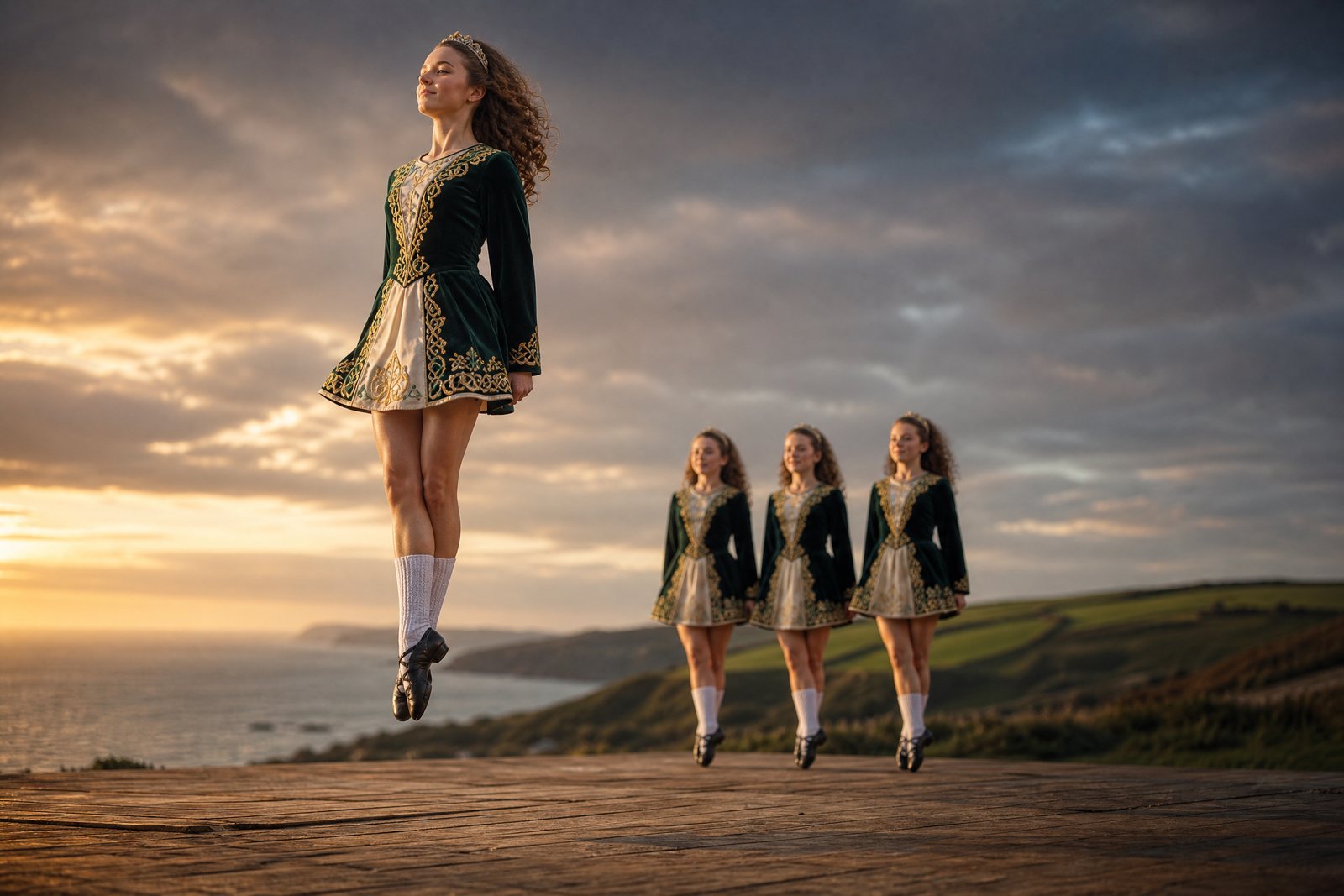
The living version is better than any history. Riverdance did not ask permission. The drums came in, the line of dancers hit the stage as one body, and the hall went from polite to electrified inside a single bar. Bill Whelan’s music did not sound like a folk relic. It sounded like a country that had stopped apologising. By the time it ended the audience was on its feet, and a seven-minute interval act had quietly upstaged the entire competition it was supposed to be padding.
What followed is well documented at Riverdance’s own home: a stage show, then a global phenomenon, then decades of touring that have carried it to tens of millions of people across the world. A throwaway slot became one of the most successful exports a small island has ever produced.
A Teenager in Germany, and a Premonition
I was a boy in Germany when I saw it, and I remember the exact feeling, which is rare. Not “that was good.” Something closer to recognition. A sense, sharp and certain in the way only adolescent certainties are, that my life would somehow take me into the Irish and Anglo-Saxon world, that I belonged out there rather than where I was standing.
People will tell you those premonitions are hindsight dressed up as prophecy. Maybe. But I left Germany in 2000 and never really went back, and across twenty-five years I have lived in Switzerland, England, Malta, the United States, and, yes, in Ireland, which I loved with a completeness I did not expect. I run seminars there to this day. I help people make the same move I once made on instinct. And it all traces, if I am honest, to a feeling that started with a line of dancers and a drumbeat.
There is a deeper Irish truth underneath the Riverdance fairytale, and I say this as someone who advises on these things for a living. The “out of nothing” story is half myth. The music was masterfully composed, the leads were world champions, the whole thing rested on a deep competitive dance tradition most outsiders never see. But the Irish gift is precisely this: to take real craft and wrap it in the shape of a folk tale, so that the triumph feels like luck and grace rather than years of brutal practice. That instinct to tell the story beautifully is itself the culture.
Why the Irish Really Are That Jolly, and That Musical
Here is the part people assume must be marketing. It is not.
The warmth is real. The musicality is real. Walk into a pub in West Cork on a wet Tuesday and there is a fair chance someone will be playing, not for tourists, just because that is what you do. The talk is quick and generous and unguarded. After years of measuring my words in more formal cultures, Ireland felt like exhaling.
And the famous faces are closer than you think. When I lived in Cork, Michael Flatley, the man who had been at the centre of that 1994 stage, was practically my neighbour. He had taken a great Georgian mansion not far from me, the kind of house that comes with its own river and its own legends, and there was something perfectly Irish about that too: the boy of the diaspora, the Irish-American who went home and bought a piece of the old country with money earned by dancing. The story folds back on itself. The emigration inverted into homecoming. You could not write it.
My Daughters, Dancing
I have young daughters who dance, and I think that is why this particular memory came back so hard during a forgettable Eurovision. When I watch them, light on their feet, lost in it, completely unselfconscious, I see the same thing that lifted that Dublin hall out of its seats. Not technique, although the technique is there. Joy that has decided to take a physical form.
That is what Riverdance actually was. Not a dance show. A small nation, long told it was poor and peripheral and on the wrong edge of everything, standing up in front of the world and saying, watch this. My girls do not know any of that history. They just dance. And somehow that is the most Irish thing of all.
The Quiet Reason the Wealthy Keep Coming to Ireland
I would be doing my readers a disservice if I left out the unromantic part, because it is one of the reasons Ireland keeps pulling people in long after the music fades.
Ireland still operates a non-domiciled remittance basis of taxation, and it is one of the most underrated regimes in Europe. In plain terms: if you are tax resident in Ireland but not domiciled there, your Irish income is taxed normally, but your foreign income and foreign gains are taxed only to the extent you actually bring them into the country. Money earned and kept offshore can fall outside the Irish charge entirely. There is no fixed time limit on the status, provided you genuinely retain a connection to your country of domicile, and there are sensible nuances for long-term residents that a good adviser will walk you through. The official framework sits with the Irish Revenue, and the detail rewards proper planning rather than guesswork.
What makes this striking in 2026 is the contrast. The United Kingdom dismantled its own non-dom regime in 2025. Ireland kept its door open. So the same island whose culture conquered the world from a Eurovision interval is now, quietly, one of the more intelligent places in the developed world for an internationally mobile person to live well and structure sensibly. Charm and substance in the same jurisdiction. That combination is rarer than it should be.
None of this is advice for your specific situation, and domicile is a slippery legal concept that deserves real counsel. But the headline is simple. Ireland gives you the warmth and the music, and it does not punish you for having built something elsewhere.
One Shot
I came for a feeling I had as a teenager and stayed for everything underneath it. The pubs and the playing, the green and the rain, the way a country can turn its own heritage into a victory lap, and yes, the cold clean logic of a tax system that respects what you have made.
Life is short and fleeting. One shot. The Irish, of all people, seem to know it, which is why they sing.
Carpe Diem, Sebastian