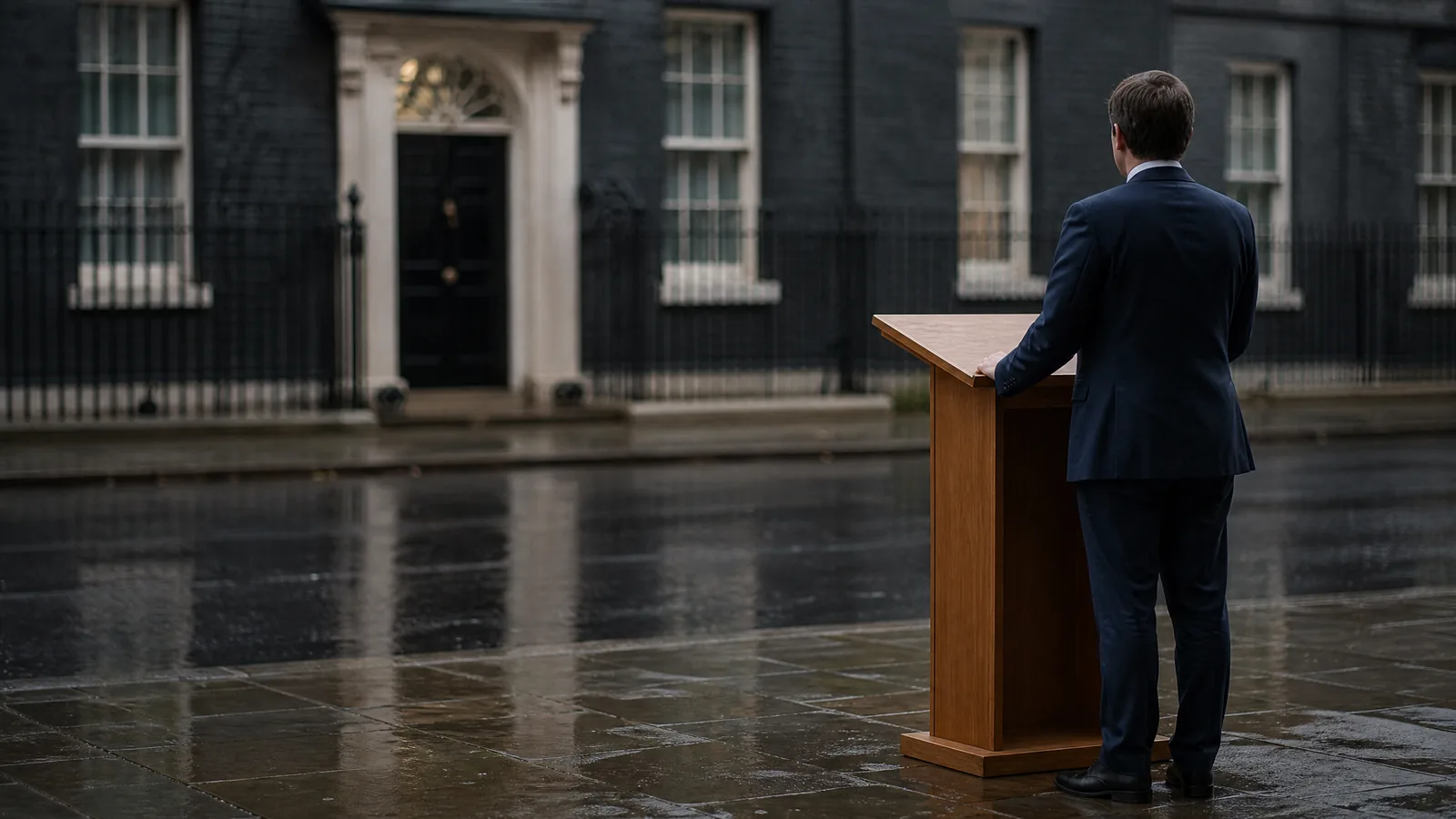
On 20 July 2026, Andy Burnham walked into Downing Street and opened with an unusual admission. He was, in his own words, the seventh Prime Minister since 2016. Seven heads of government in ten years. He promised to make the moment "a circuit breaker for Britain", with a new political model, a new economic model and a ten-year plan to follow later in the year.
Whatever you think of the man or the promise, the change at the top has set off a familiar reaction. Some people who were already uneasy about Britain now feel that the ground has moved under them. Some who liked the previous direction are wondering what comes next. And a steady number of people are asking the same practical question: is this the moment to leave?
The honest answer is that a new Prime Minister is almost never a good reason to move country. It is, however, an excellent reason to get ready. Those are two different decisions, and confusing them is expensive.
What Actually Happened This Summer
Start with the facts, because the facts are narrower than the noise around them.
Andy Burnham returned to the House of Commons as Member of Parliament for Makerfield in June 2026, was elected Leader of the Labour Party on 16 July 2026 and became Prime Minister four days later. Before that he was Mayor of Greater Manchester, first elected in May 2017 and re-elected in 2021 and 2024. John Healey is Chancellor of the Exchequer.
The first tax measure of the new government came the next day. On 21 July, Downing Street announced that VAT on household electricity bills would be cut from 5% to 0% from 1 October, at an estimated cost of around £850 million in 2026-27, paid for by cancelling the Digital ID programme. The same announcement said that any further action, including on funding for longer-term measures, would be taken at the Budget alongside an OBR forecast.
On 31 July the Chancellor wrote to the Treasury Select Committee to confirm that the Budget will be held on 28 October 2026.
That is the list. A change of leader inside the same governing party, one consumption tax cut, a Budget date, and a promise of a longer plan. Nothing in the Prime Minister's first speech named a change to income tax, capital gains tax, inheritance tax or the rules for people who leave. Anyone who tells you what the October Budget will contain is guessing.
Why Politics Is a Poor Trigger for a Move
A move abroad is a long decision triggered by a short event. That mismatch is the problem.
Look at the timescales. The Parliament elected in July 2024 does not have to face voters again until it expires. Under the Dissolution and Calling of Parliament Act 2022, a Parliament dissolves automatically at the fifth anniversary of the day it first met, which puts the latest possible dissolution in the summer of 2029. A Prime Minister can come and go inside that window, as Britain has now shown several times, but the legislative arithmetic in the Commons does not change with the face at the despatch box.
Now compare that with the timescales of a relocation. Selling or letting a house takes months. School years run for twelve. A residence permit abroad usually takes between a few weeks and a year to obtain, and in many countries permanent residence only follows after several years. British tax rules on leaving, as the next section shows, are counted in whole tax years and in tails that last up to a decade.
When you move because of a headline, you are making a five to ten year commitment in response to a political cycle that can turn in months. The event will be old news long before the consequences of your move have played out. People who left in 2016, 2019 and 2022 because of a particular leader have each lived through at least two more since.
There is also a quieter reason. Political anger is a poor filter for destinations. It tells you what you want to get away from. It says very little about where you will actually be better off, which depends on your income, your family, your passport and the tax rules of the place you choose. The case for honest self-selection before any move is made in Who Should Not Emigrate.
The British Exit Rules Are Written in Years, Not Weeks
This is where preparation beats reaction. The rules that decide whether leaving Britain actually works do not care why you left. They care about days, years and records.
Residence is measured by the Statutory Residence Test. HMRC's own RDR3 guidance sets out automatic overseas tests. If you were UK resident in one or more of the previous three tax years, you are automatically non-resident only if you spend fewer than 16 days in the UK in the tax year. If you were not resident in any of the previous three, the threshold is fewer than 46 days. A third test covers full-time work abroad, with fewer than 91 days in the UK and fewer than 31 days on which you work there for more than three hours. Miss the automatic tests and you fall into the ties tests, where family, accommodation, work and days in the UK are weighed against each other.
Leaving and coming back quickly can undo the benefit. The same guidance explains the temporary non-residence rules. If you were solely UK resident in at least four of the seven tax years before you left and your period abroad lasts five years or less, certain income and gains received during your absence can be taxed in the year you return. The period abroad must be longer than five years, "5 years plus one day" in HMRC's phrasing, for the rules to fall away.
Inheritance tax follows you for years. Since 6 April 2025, exposure to UK inheritance tax on worldwide assets depends on whether you are a long-term UK resident. HMRC's guidance defines that as UK tax residence for 10 consecutive years or for at least 10 of the previous 20. After you leave, the status continues for a tail: three years after departure for someone with 10 to 13 years of UK residence, rising year by year up to 10 years for someone who was resident for 20 years. The wider change of that regime, and who still arrives in London under it, is laid out in London After Non-Dom.
Put those three rules side by side and a pattern emerges. A British exit is a multi-year project with a paper trail, and the paper trail is judged by HMRC after the fact. A move made in a hurry, with a flat kept on "just in case", a job that still brings you back for a few days a month and no record of where you actually slept, is precisely the move that fails the tests.
Preparation Is What a Political Shock Is Good For
None of this means you should ignore politics. It means you should use political change for the thing it is actually good at: prompting a sober look at your options while nothing is urgent.
Here is what that preparation looks like in practice, and none of it requires a decision to leave.
Know your current position under the residence rules. Count your UK days for the last three tax years. List your ties. Most people have never done this and are surprised by the answer.
Build the records before you need them. Travel history, tenancy or ownership documents abroad, utility bills, school enrolment for children and evidence of where your work is performed. The case for keeping this file even if you never move was made in The Paper Trail That Saves You.
Map your inheritance tax tail. If you have been UK resident for 15 years, a departure today leaves you inside the UK net for five more years. That is information you want in hand before you choose a jurisdiction, not after.
Understand the right to reside somewhere else. Most attractive destinations require a permit, and many permits take months. An application lodged in a calm year costs far less, in money and in stress, than one lodged under pressure.
Watch the Budget, but read the document. The Budget on 28 October will come with an OBR forecast and published policy costings. Those documents, not the commentary around them, tell you what has changed. If something in them affects you, you will still have time to act, because tax changes rarely take effect on the day they are announced.
The Mood Is Real, the Plan Must Be Too
It is worth taking seriously why so many people feel the way they do. The Prime Minister himself said that "people at home are fed up with politics". Seven Prime Ministers in ten years is not a normal rhythm for a mature democracy, and the frustration it produces is not irrational. The previous turn of that cycle was the subject of Devoured by Their Own in June.
But mood is a bad accountant. A move made to punish a government punishes mainly the person who moves if the paperwork is wrong, the destination is wrong or the timing leaves them inside the UK tax net anyway. A move prepared over a year or two, with the residence tests understood and the documents in order, works whoever is in Downing Street.
So treat the summer of 2026 as a prompt, not a verdict. Count your days. Build your file. Learn what your inheritance tax tail looks like. Explore where you could legally live and what it would take to get there. If the October Budget or the ten-year plan turns out to change your numbers, you will be ready to act in weeks rather than scrambling for months. And if it changes nothing, you will have lost nothing and gained a clear view of your own options.
A plan you can execute calmly is worth more than a move you make angrily. Prime Ministers change. The Statutory Residence Test has outlasted all seven of them.
Work with Sebastian
If you want to know where you stand under the residence tests and what a prepared exit would look like for your family, book a consultation.