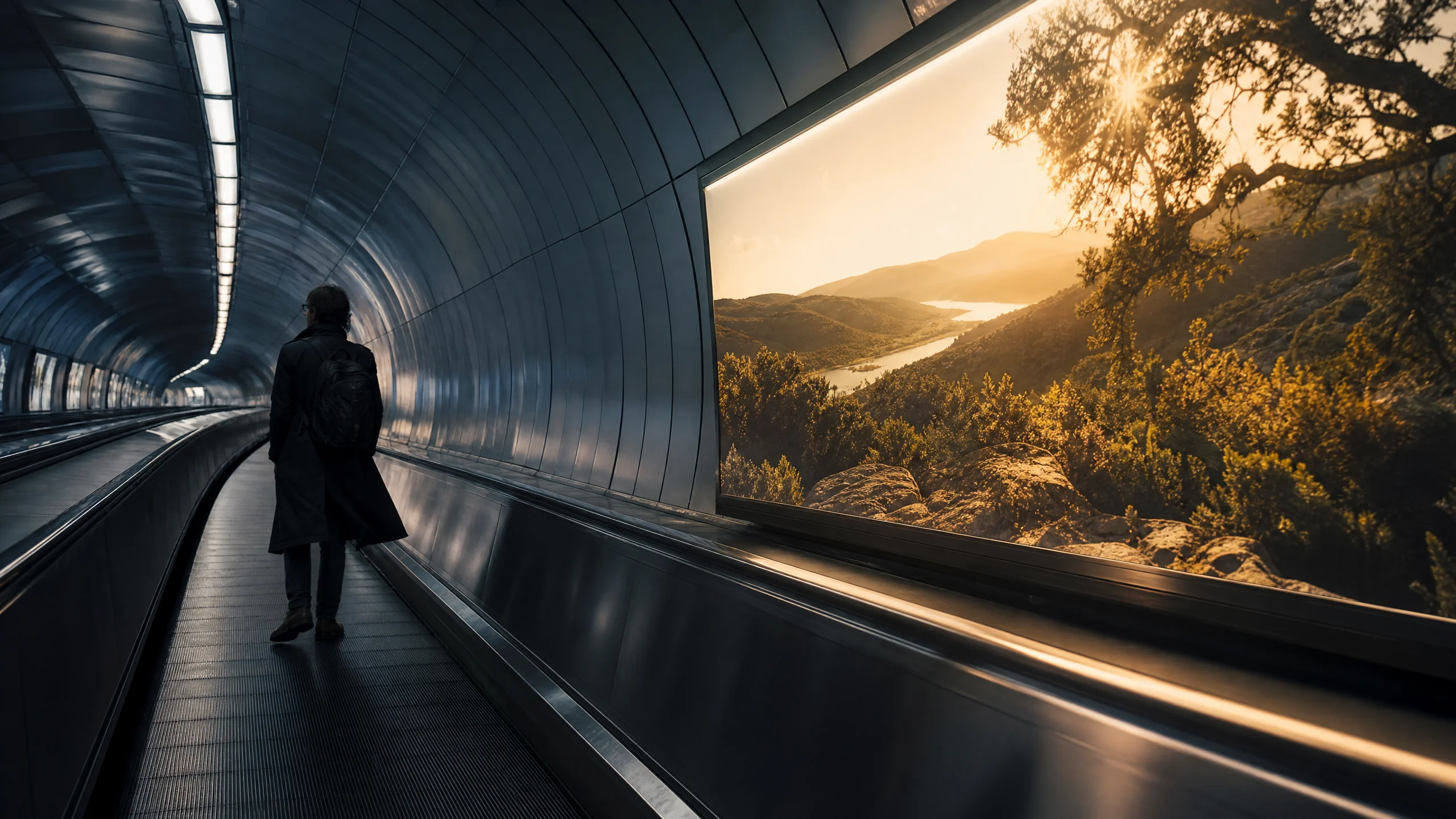
A Texas sunset, three metres wide, glowing on the wall of a London Underground tunnel. A rope bridge strung through a green canopy. A family running into the surf. The word LET'S stretched across the cladding in letters the size of a man, and beneath it, in that confident sans serif, TEXAS. The campaign is everywhere down there this summer, plastered along the long moving walkways that carry commuters between platforms in the older interchange stations: a warm orange wound in the cool blue of the Underground.
The people gliding past it, earbuds in, eyes middle distance, are some of the same fans who flew home from Dallas last week. The poster will not let them forget. Texas has come to London, underground, to whisper an invitation in the ear of the world's most self-assured city.
The backwater that came to town
Here is what makes the poster worth more than a glance. For a great many educated Europeans, Texas is a punchline. It is the shorthand for everything they have been taught to feel superior about: guns, megachurches, pickup trucks, men in hats, an accent to be imitated at dinner parties. A backwater full of rednecks. I have sat through enough Parisian and Londoner conversations to know the script by heart, and to know that almost no one delivering it has ever set foot in the place.
Meanwhile, the reason for the poster is no mystery at all. This is a World Cup summer, and the world has come to North America to watch it. Travel Texas is not buying tunnel walls in London out of vanity. England played in Dallas. Argentina played in Dallas. The Lone Star State is hosting more World Cup football than almost anywhere else on the continent, with Dallas alone staging nine matches, including a semi-final on the 14th of July. So Texas is doing the obvious, confident thing. It is standing in the corridor that European football fans walk through, holding up a picture of itself, and saying: you have heard the stories, now come and see.
And the people who go, the ones I send myself, come back changed.
The numbers Europe would rather not see
Before the human part, the uncomfortable part, because it is the part that gives the rest its weight.
For most of my lifetime, the rich countries of Western Europe and the United States were peers. As recently as the mid 1990s, Germany's GDP per head was a touch higher than America's. That world is gone. The two economies have been pulling apart for two decades, quietly and then suddenly, and the gap is now structural rather than cyclical. By one careful European estimate, the divergence in output per person between the EU and the US widened to roughly eighty percent, to the point where France would slot in below the poorest American state and Germany would sit somewhere around Oklahoma. You can read that analysis, produced not by some American booster but by the Brussels-based European Centre for International Political Economy, and feel the floor tilt.
The instinct, in a Paris drawing room, is to wave this away. That is just the billionaires. Only the top one percent lives well over there. Everyone else is one medical bill from ruin. It is a comforting story, and it is wrong about the thing that matters most: the middle.
The figure to hold onto is not the rich American. It is the ordinary one. According to the US Census Bureau, the median American household income now sits around eighty-four thousand dollars, and that median household commands more square footage, more cars, more cooling, more appliances, more restaurant meals and more sheer retail abundance than a comfortably upper-middle European family on paper-similar money. That is the real gut-punch. Not that rich Texans are rich. But that the American middle now out-consumes much of the European upper-middle, in space, in stuff, in the texture of an ordinary Tuesday. A school teacher and a nurse, in a cul-de-sac outside Austin, with a four-bedroom house, two SUVs, a garden, central air and a youth soccer complex ten minutes away.
None of this means the American model is free of cost. It is not. Europeans buy real things with their lower numbers: a thinner tail of deep poverty, no bankruptcy from a hospital visit, far less gun violence, walkable cities, six weeks of holiday. That trade is rational, and it is honourable. But it is a trade, not a free lunch, and the people making it should at least know the price. Most do not. They believe they are richer. They are, increasingly, not.
What they discover when they actually land
This is where the poster and the spreadsheet meet the ground, and where my own work lives.
Several times a year I bring clients to Austin for a week. Not a brochure tour. A real one. We drive out into the Hill Country, we eat barbecue off butcher paper, we sit on a porch as the heat finally breaks, we talk to people who build things and start things and own things. And I watch the same transformation happen, every single time, on faces that arrived braced for a caricature.
The surprise is almost physical. They expected swagger and found warmth. They expected ignorance and found a waiter, a contractor, a neighbour who, on hearing a European accent, lights up and asks them genuine, curious questions about home. Where in Germany? Have you been to Vienna, I have always wanted to go. My grandfather was from Galway. The friendliness is not performed. It is the default setting of the place, and for a European trained to read openness as either naivety or a sales tactic, it is genuinely disarming.
I will be honest about my own feeling here, because it is sharper than professional detachment. I am embarrassed. Embarrassed by how relentlessly negative the European coverage of America is, how lovingly it curates the homelessness in one Californian district, the worst of the politics, the most lurid statistic, and how completely it omits the prosperous, generous, unremarkable normality where most Americans actually live. And then I watch those same Americans show more open, uncynical interest in Europe than Europe ever extends back. There is a humility gap, and it does not run in the direction my Parisian friends assume.
The distortion machine
So which is it: manipulation, denial, or simple ignorance? Having watched it for years, I think it is all three, braided together.
There is genuine selection bias. Dysfunction is newsworthy and it travels; a quiet, thriving subdivision in the Texas Hill Country is not a headline anywhere. There is identity. A certain European self-image depends on America being the cautionary tale, the place we are wiser than, and facts that threaten that self-image are not weighed, they are deflected. And there is the oldest mechanism of all, the one my own family history taught me to distrust: the comfort of a received narrative, repeated until it feels like knowledge, defended most fiercely by those who have examined it least.
The poster in the Tube is, in its small commercial way, a crack in that narrative. It is Texas declining to argue, choosing instead to simply show its face in the heart of London and trust that the truth survives contact. The genius of it is the restraint. No statistics. No rebuttal. Just a sunset, a rope bridge, a family in the surf, and an open hand.
Let's, then
I keep coming back to that one word on the wall. LET'S. Not visit Texas, not discover Texas. Just let us, an invitation phrased as a shared decision, the most American sentence imaginable.
The European who sneers at it on the way to the platform, and the European who actually books the flight, are looking at the same poster. One of them will be right about how the next twenty years feel. I know which, because I have stood in the arrivals hall and watched the certainty drain out of a skeptic's face within forty-eight hours of landing.
You do not have to take my word for it, and you should not. The whole point is that this is a thing you go and see. Spend a week in Austin. Talk to the people. Walk the suburbs the headlines never show you. Then decide for yourself whether the joke is still funny, and whether it was ever really on Texas.
The wall in the London Underground already knows the answer. It is just waiting, patiently, for the rest of us to catch up.