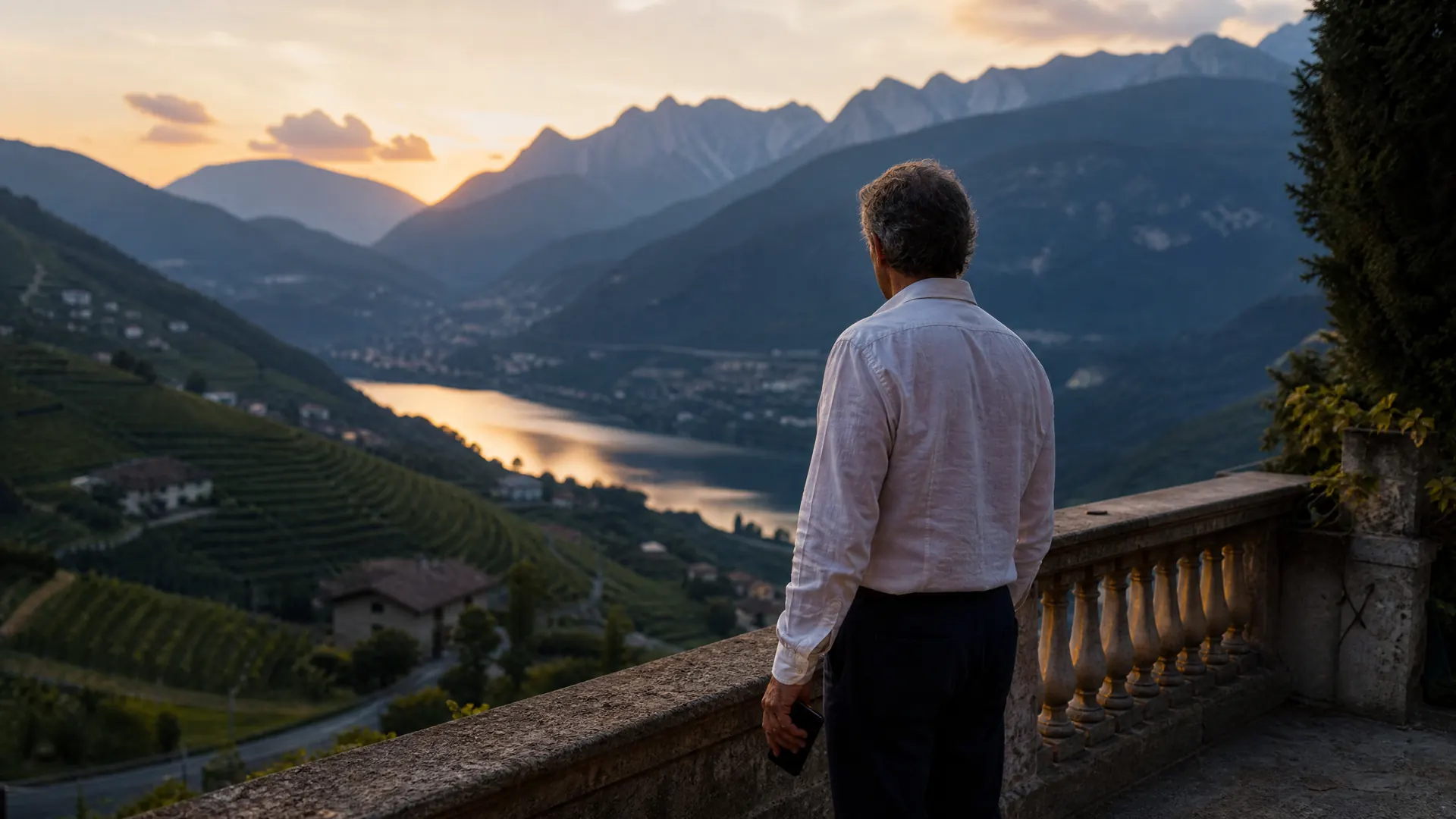
He called me from a terrace in the South Tyrol, where the evening light comes down the valley like something poured rather than shone. Below him, vineyards in their straight green rows. Behind him, mountains that wore Austrian names within living memory and answer to Italian ones now. He is Austrian himself, in the way that matters least to a tax office and most to a man's bones. And on that beautiful terrace, with a glass of something local sweating in his hand, he was afraid.
He had done everything right, or thought he had. He had left Austria for good. Not the half-hearted leaving where you keep an apartment in Vienna for sentiment and a doctor you still see. The real kind. He had moved his official residence to Dubai, collected the visa, opened the accounts, and set off to do the thing he had promised himself for thirty working years: to travel the world with his wife and answer to no flag in particular. The Austrian exit had been clean. His tax adviser there had signed off. That door was shut and bolted.
So why the fear. Italy. Every year he spends roughly ninety days in this house in the hills, more than he spends in any other single country on earth, because everywhere else is a hotel and a suitcase and a moving on. And somewhere he had absorbed a sticky, plausible idea: that if Italy is where he spends the most time, Italy can stand up one morning and announce that Italy is where he lives. That the valley with the Austrian ghosts could quietly become his tax home by default, simply for being his favourite.
It is a very reasonable fear. It is also, almost entirely, the wrong one.
The fallacy of the biggest slice
There is no rule anywhere in the civilised tax world that says your residence is wherever you happen to spend the most days relative to everywhere else. Tax residence is not a plurality contest. Nobody counts up your year, sorts the countries by size, and crowns a winner. A man can spend ninety days in Italy, sixty in Greece, fifty in Thailand and the rest scattered like loose change, and Italy does not win the auction just for holding the largest single pile.
What countries actually have are thresholds and tests, and Italy's headline threshold is a hard line drawn at more than 183 days in the calendar year. Cross it and you are resident on presence alone. Stay under it and that particular door stays closed, no matter how lovingly you have furnished the house behind it. Ninety days is not a near miss. It is not even in the same postcode as the line, even after you account for Italy's habit of counting your arrival and departure days as whole days each. The country he feared most could not touch him on the one test he was most afraid of, and he had been losing sleep over a number that was barely half of what it would need to be. You can read Italy's own framework, reformed and tightened in 2024, straight from the Agenzia delle Entrate, and the line is exactly where I am telling you it is.
The trap he had already walked out of
Italy does have softer tests, and an honest adviser names them rather than waving them away. Beyond raw presence, Italy can claim you through domicile, and since the 2024 reform domicile means the place where your personal and family relationships principally develop, not where your money sits. It can also claim you through habitual abode, the place you actually, ordinarily live.
Here is where my client had quietly saved himself without realising it. There is one fact pattern that turns an Italian holiday home into an Italian tax problem, and it is this: the family stays while the man travels. A wife settled in the house, children in the local school, a life visibly rooted in the valley while the breadwinner commutes in and out of it. That is a centre of personal and family life, and Italy is entitled to point at it.
But his wife travels with him. His children are grown and gone, building their own lives on their own passports. There is no resident family unit in the valley for Italy to gesture toward, because the family is wherever the two of them happen to wake up, and by simple arithmetic that is not Italy for most of the year. The single most dangerous version of his situation was the one that did not apply to him. The domicile theory collapses for want of anyone living the domicile. The lonely holiday home, occupied under half the year by a man with no settled household in it, is a weak foundation for a residence claim, and Italy would be reaching to build on it.
So the verdict on the country he feared is almost dull. He is fine. Under the line, no family anchor, no real foothold. Italy is not the threat.
A flag over an empty room
Now turn the man around on his terrace, away from the valley he was watching, and point him at the desert he thinks he has conquered.
Dubai was supposed to be the solution. It was the flag he planted so he could pull every other flag down. And it is, on paper, immaculate. But a residence is not an address, and a flag flying over a room nobody sleeps in is not sovereignty over your tax life. It is decoration. He is barely ever there.
This matters because of how the machinery actually works. To slam Italy's door, or any door, you do not merely need to have left somewhere. You need to genuinely belong somewhere else, somewhere with a treaty, and to be able to prove it. The UAE will certify you as a tax resident, but it asks for something real in return: either you spend most of the year there, or you clear a shorter day count while genuinely keeping the place as your home. The thresholds, the permanent-home requirement, the certificate that foreign authorities will actually respect, are all set out by the UAE Federal Tax Authority, and a man who is hardly ever in the country is on thin ice with every one of them. A certificate he cannot defend is worth less than no certificate at all, because it invites the question and then fails to answer it.
And so we arrive at the real danger, the one he had not even thought to fear: tax resident nowhere. A man with one fixed, year-round home on the planet, in an Italian valley, a Dubai base that exists more as paperwork than as life, and no genuine residence anywhere that any treaty would honour. He believed he had escaped the gravity of the state. What he had actually done was cut his tether without anchoring to anything new, and a man floating free like that does not stay free. He becomes the most attractive target in the room, because there is no rival country to wave a certificate and say no, he is ours.
If Italy ever did decide to look, the contest would not be Italy against Dubai. It would be Italy against a vacuum. And when authorities run the tiebreaker that decides these things, the chain that starts with where you keep a permanent home and runs through your centre of vital interests, the international logic of it laid out in the OECD Model Tax Convention, every weak link tilts toward the place that is actually, physically, undeniably his. The lake house. The one room on earth that is unmistakably lived in. The empty Dubai flat does not pull back, because nothing happens there to pull with.
What the freedom seeker forgets
I see this often, and it is always the same beautiful mistake. A man spends so much energy escaping that he forgets the second half of the work. Leaving is loud and satisfying. Arriving is quiet and dull and easy to skip. So he flees the cage, throws the door open, and stands in the corridor congratulating himself, never noticing that a corridor is not a home either.
Freedom is not the absence of a country. It is the deliberate choice of one. The whole architecture of going where you are treated best only holds together if you are, somewhere, actually treated as belonging. Otherwise you are not a free man without a state. You are a stateless man without protection, which is a very old and very dangerous thing to be, and no Golden Visa changes its nature.
I told him to stop watching the valley. The lake house was never going to betray him. I told him to make the flag true: to put real life behind the Dubai address, real days, real proof, a residence that could survive a stranger's hard questions, or else to choose with the same seriousness some other country that would have him properly and stand behind him. Plant the flag, then go and live under it often enough that it means something.
He had spent his fear on the country that loved him and would let him go. The country he should have feared was the one he thought he had already won, which had never really been his at all.