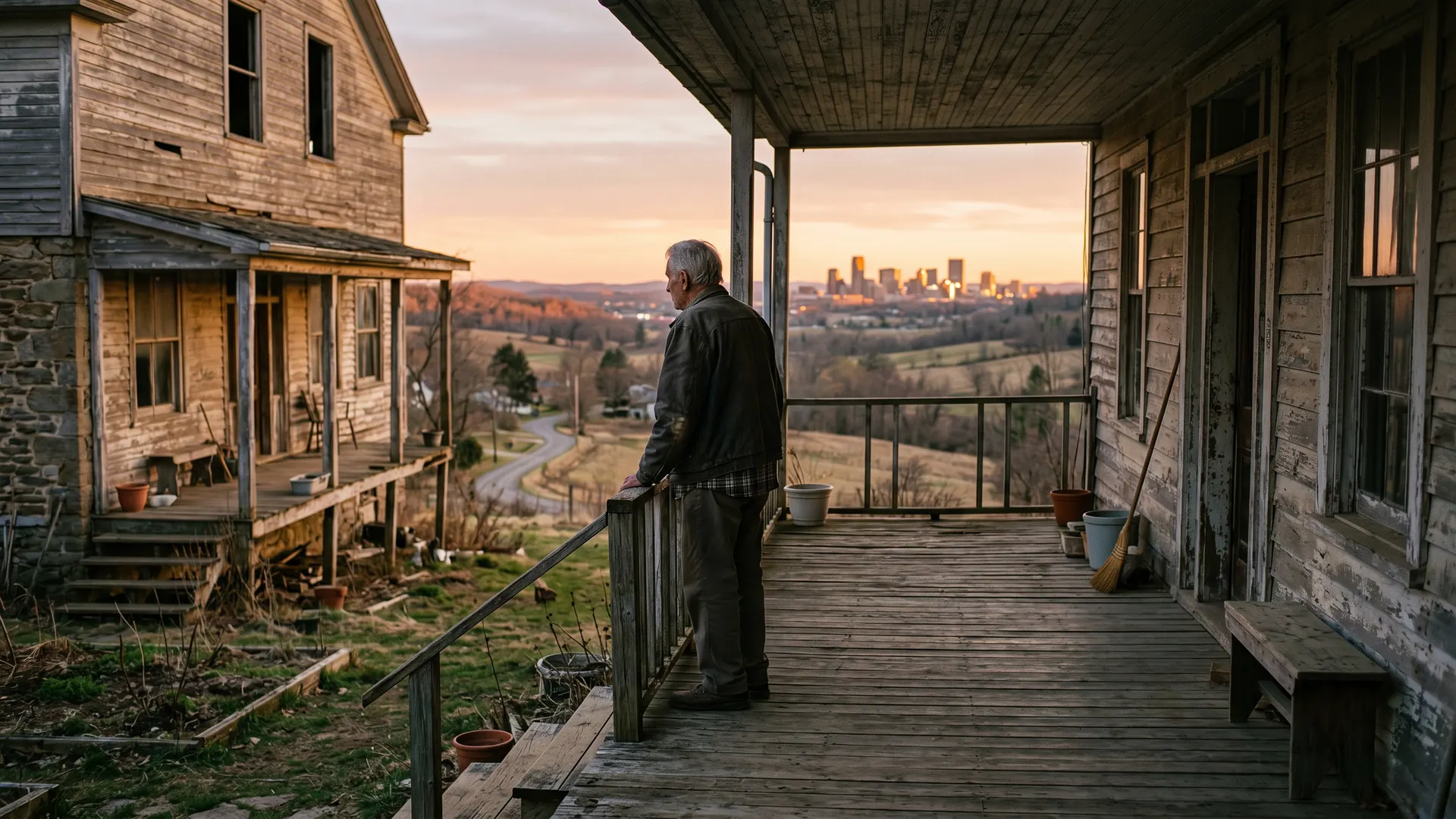
There is a village in the mountains of central Japan where the houses outnumber the people, and the people are old. Life-sized dolls sit on the benches and lean against the fences, stitched together by one of the last residents to fill the seats that the living vacated. A doll waits at the bus stop. A doll bends over the field. You can walk the length of the place and meet more cloth faces than human ones. It is not a horror story. It is just arithmetic, made visible.
I think about that village often, because it is the question made flesh. If the people stop coming, what happens to the houses? And if you zoom out from one Japanese hamlet to the whole developed world, where median ages climb past forty-five and fertility falls below the line that keeps a nation whole, the question gets sharper and more personal. We talk a lot here about where to plant your flags. Zanzibar. Panama. A second passport, a banking relationship in a jurisdiction that does not know your government's phone number. But underneath all of it sits a more fundamental doubt. In a world that is quietly running out of people, is there any point owning real estate at all?
I have been asked this by clients with real money and real fear behind the question. My answer takes a moment, because the honest version is not a yes or a no. It is a redrawing of the map.
The doom thesis is intuitive, and mostly wrong
The simple story goes like this. Fewer babies mean fewer buyers. Fewer buyers mean falling prices. Real estate is a bet on more people wanting the same finite thing, and if the people are disappearing, the bet is broken. It feels obvious. It is also, for the most part, a misreading of how housing actually works.
The first error is counting heads instead of households. Property is not bought by populations, it is bought and occupied by households, and the household has been shrinking for a hundred years. More people live alone. More marriages end. More elderly widows and widowers stay in the family home long after the family has gone. That woman alone in a four-bedroom house is one household holding the space that once held five people. A country can lose population and still form new households for decades, because the way we live keeps fracturing into smaller and smaller units. Demand made of heads falls. Demand made of households is far stickier.
The second error is treating "real estate" as one thing. It is not. Prime city land, suburban family homes, farmland, logistics warehouses, the dying shopping mall, the office tower nobody returned to after the world changed: demographics hit each of these in opposite directions and at different speeds. The moment you stop saying real estate and start naming the specific parcel, the doom story dissolves into a dozen separate stories, some grim, some quietly wonderful.
Japan is not a warning. It is the whole lesson.
Everyone reaches for Japan as the cautionary tale, the rich country that aged first and shows the rest of us our future. They are right to look. They usually draw the wrong conclusion.
Yes, Japan now sits on a staggering inventory of empty homes. The country's vacant-house count has reached around nine million, the highest vacancy rate in three decades, and these akiya have become a global curiosity, houses in the countryside selling for the price of a used car. If that were the entire picture, real estate would indeed be a melting ice cube.
But look at the other half of the same country. Central Tokyo land has recovered powerfully, prime districts command serious money, and well-located property in the great cities holds and grows. One nation, the same demographic curse, and two completely opposite outcomes. The difference is not whether people are vanishing. The difference is where the remaining people choose to be. Shrinking societies do not empty out evenly. They concentrate. The young leave the valley for the city, the capital pulls in everything that still has momentum, and the periphery hollows while the center tightens. Decline and scarcity, side by side, in the same passport.
That is the real lesson. Aging and ultra-low fertility do not destroy real estate. They sort it. They widen the gap between the right parcel and the wrong parcel until it becomes a canyon.
Supply matters more than demand, and migration matters most of all
Here is the part the doom thesis forgets entirely. Housing is priced at the margin, and the desirable margin is choked almost everywhere by zoning, by the neighbor who fights every new building, by land that simply runs out, by the rising cost of pouring concrete. Britain, Canada, Australia, the coastal United States: every one of them runs a brutal affordability crisis despite birth rates well below replacement. The babies are not coming, and the houses still cost a fortune, because you cannot build where people actually want to live.
And then there is the variable that swamps all the others. Fertility is only half of the demographic equation. Migration is the other half, and it routinely wins. A nation that imports people has a completely different property future from one that seals its borders, regardless of what its women are or are not doing in the maternity wards. This is the quiet truth behind every panicked headline. The countries that will keep filling their cities are the ones that let the world in.
Which is exactly why the doom genuinely bites at the closed and shrinking periphery. Rural Italy with its one-euro houses. The hollowed villages of inland Spain. The fading towns of eastern Germany. South Korea, where the birth rate is the lowest in the developed world and the population keeps shrinking even as births tick up, a nation aging at a speed history has never seen. In those places, on that land, the pessimists are simply correct.
China is its own hazard, and it is not like the others
There is one market I treat as a separate category, because it combines every failure mode at once. China's population has now fallen for a fourth consecutive year, births have collapsed to their lowest in modern history, the country admits almost no immigration to offset it, and all of this sits on top of a property sector buried in unfinished towers and developer debt. Aging, closed borders, and a mountain of oversupply, arriving together. That is not the gentle sorting you see in Japan. That is structural impairment. When someone asks me whether real estate is doomed, I sometimes think they are really asking about China without knowing it.
So why do I still buy land?
Because the era that is ending is not real estate. The era that is ending is "buy anything, and population growth will bail you out." That tide is going out, and it is not coming back. What replaces it is a market where selection is everything, and where the right asset arguably becomes more valuable, not less.
Think about what an aging, over-indebted, low-birth state actually does. It does not balance its books. It cannot. Its pension promises and its healthcare bills climb while its workforce thins, and the pressure release valve is always the same: it debases the money. In that world, well-located land in a stable jurisdiction is not a relic. It is a hedge against the very policy your home country is about to be forced into. Real assets are how the prudent have always sat out the printing.
So when we talk about flags, about Panama and Zanzibar and the architecture of a serious Plan B, real estate still belongs in the design. It simply has to earn its place. Favor the magnets, the places that import people, that protect property rights, that constrain supply and receive the world's fleeing capital. Avoid the periphery of the closed and graying societies. Treat China-style oversupply as a different animal entirely. And buy the parcel, never the asset class.
The doll village in the mountains is real, and it is coming for a great deal of the map. But it is not coming for all of it. The future of real estate is not collapse. It is sorting, and ruthless selectivity, and a widening gulf between the land that fills and the land that empties. Your job is no longer to own property. Your job is to stand on the right side of that line.
Life is short. The map is being redrawn while we argue about it. Make sure your flags are planted where the people, and the money, are still arriving.