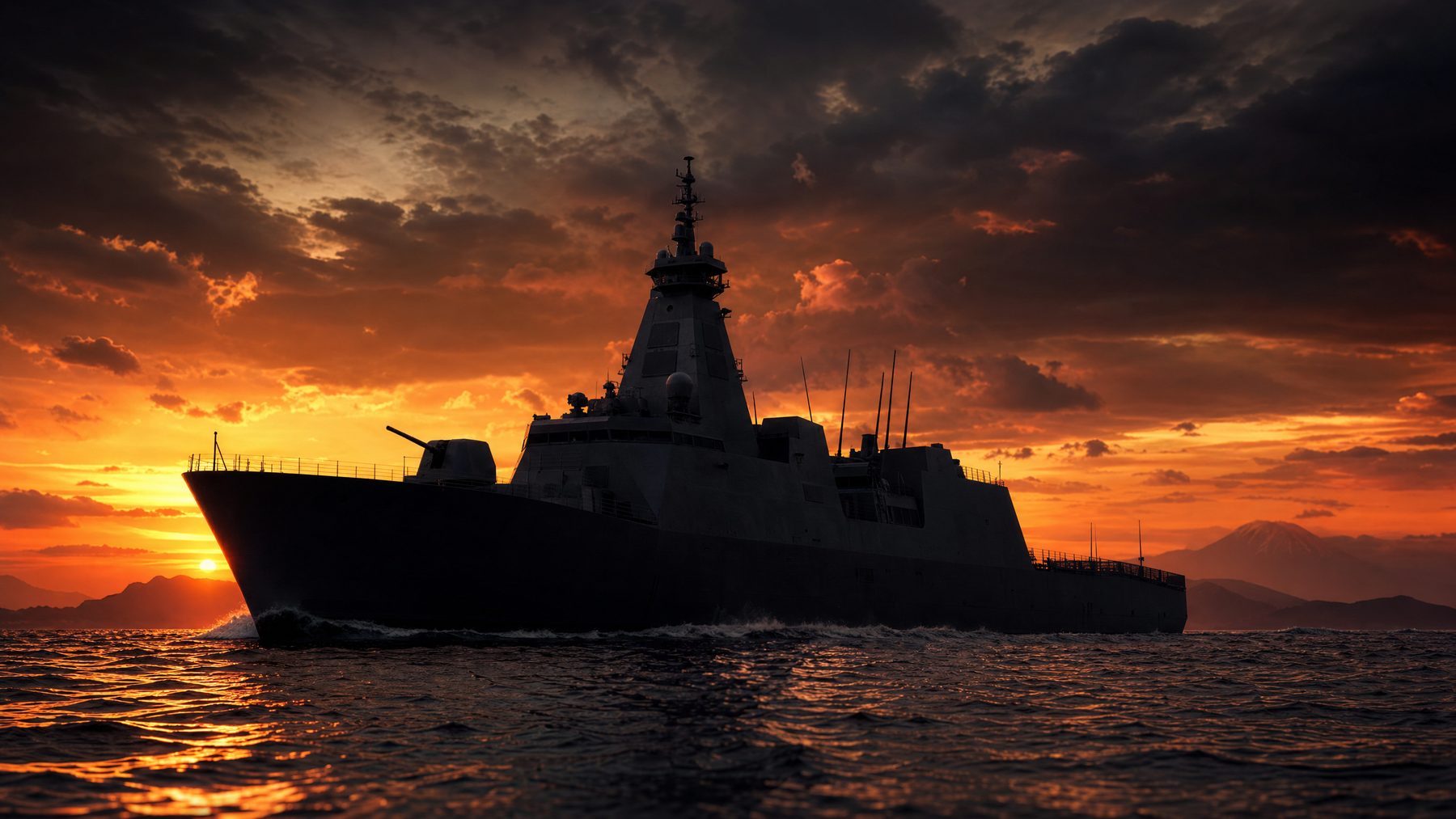
Japan's cabinet approved a record defence budget plan this month exceeding 9 trillion yen — almost 50 billion euros — for the coming year. The country is on track to become the world's third-largest military spender. It is deploying cruise missiles and unmanned arsenals. It is building what Prime Minister Takaichi has called a genuine strike-back capability.
This is remarkable. And almost nobody in Western Europe is treating it with the seriousness it deserves.
Japan spent eighty years as a constitutional pacifist. Its post-war constitution, written under American occupation in 1947, contained Article 9, which renounced war as a sovereign right and prohibited the maintenance of war potential. For eight decades, Japan interpreted that article to mean it could maintain self-defence forces but not a military capable of offensive operations.
That interpretation is now being abandoned. Rapidly, deliberately, and with broad domestic political support.
The world that produced that constitution no longer exists. Japan has understood this. Most of Europe has not.
Why Japan Is Doing This
The answer is China. And North Korea. And the lesson of Ukraine.
China's military modernisation over the past twenty years has been extraordinary in its scale and ambition. The People's Liberation Army of 2025 bears little resemblance to the force of 2000. It has developed anti-ship missile capabilities designed specifically to push American carrier groups beyond effective operating range of Taiwan. It has built a blue-water navy. It has developed hypersonic weapons, space-based intelligence assets, and cyber warfare capabilities that are genuinely competitive with the best in the West.
The Taiwan strait is the flashpoint that concentrates minds. If China moves against Taiwan — and Xi Jinping has made clear that reunification is not a matter of if but when, on his terms or through force — Japan is geographically and strategically incapable of staying out of the conflict. The US bases on Japanese soil, the logistics of any American response, the shipping lanes through which Japan receives essentially all its energy imports — all of these make Japan a direct party to any Taiwan conflict whether Tokyo wants to be or not.
Japan has therefore concluded that it needs to be able to impose genuine costs on any aggressor, not merely to rely on American protection.
This is rational. It is also a fundamental change to the post-war order.
The Ukraine Lesson
The other driver is Ukraine. The lesson that Japan — and Poland, and the Baltic states, and increasingly Germany — has drawn from Ukraine is simple: the guarantee of American protection is not unconditional, and the capacity to resist aggression independently matters.
Trump's pressure on Zelensky, his suggestion that Ukraine did not have the cards to win, his temporary halt of weapons shipments — these sent a message to every American ally that contingency planning for a world with less reliable American support is not paranoid. It is prudent.
Japan has been listening.
So has Japan's neighbour South Korea, which has its own rearmament programme and its own anxieties about North Korea's nuclear development and China's regional ambitions.
What This Means for Global Order
The post-war global order was built on two foundations: American military primacy and the assumption that the major powers would resolve disputes through international institutions rather than force.
Both foundations are cracking.
American military primacy is not gone, but it is no longer unchallenged. China is a genuine peer competitor in certain domains. Russia has demonstrated that it can sustain a major land war in Europe despite Western opposition. Iran has nuclear capabilities that approach breakout threshold despite American and Israeli strikes.
And international institutions — the UN Security Council, the WTO, the international financial system — have been progressively undermined, either through deliberate action by the US itself or by their inability to constrain great power behaviour.
What is replacing this order is not yet clear. What is clear is that it will be more multipolar, more contested, and more dangerous than what it is replacing.
Countries and individuals that built their security on the assumption of a stable, American-led order are going to need to rethink those assumptions.
The Practical Investment and Planning Implications
For my clients, the Japanese rearmament story has several practical implications.
The defence sector globally is in a structural upswing that will continue for years. European defence companies — Rheinmetall, Leonardo, BAE Systems, Thales — are beneficiaries of an environment in which every significant democracy is increasing its defence spending. This is not a political observation. It is a business cycle observation.
More broadly, the geopolitical uncertainty that Japan's rearmament reflects is one more argument for the approach I always advocate: assets across multiple jurisdictions, income streams that do not depend entirely on the stability of any single region, and personal structures that give you optionality when the world shifts in ways that are difficult to predict.
Japan itself is not an easy jurisdiction for foreign entrepreneurs. Its language, its bureaucracy, its cultural closedness, and its immigration policy make it one of the harder developed countries to operate in as a foreigner. But its businesses, its technology, and its capital markets are increasingly relevant to anyone thinking seriously about Asia.
The world is reorganising around competing power centres. The people who understand this earliest are the ones who will navigate it best.
Work with Sebastian
If the shifting global order is prompting you to think harder about the resilience of your geographic and financial positioning, this is precisely the kind of strategic conversation I have with clients. Let's talk. Book a consultation.