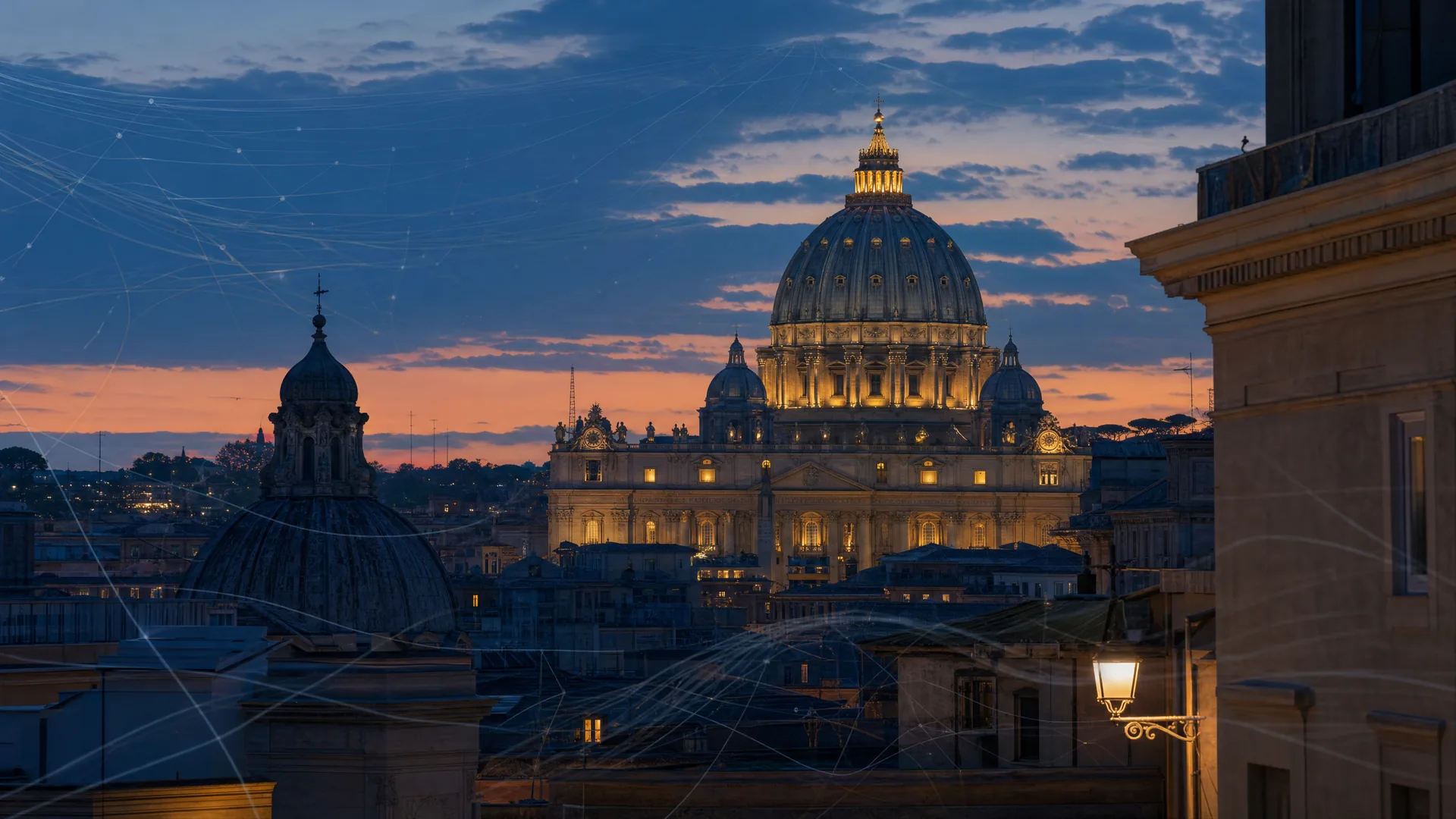
Monday night in Zurich. The conference opened the next morning, so we did what we always do the evening before. We found a small Italian place a few streets from the venue, pushed two tables together, ordered too much, and let the evening run long. Our team, a few of the external speakers, candlelight, a couple of bottles of something red, the easy noise of people who genuinely enjoy each other’s company. Nine of us around the table.
Somewhere between the antipasti and the second bottle, I started counting. Not on purpose. It is a habit you pick up after enough of these dinners. One of us was Irish. Two of us, including me, were from Baden-Württemberg. And six were Ossis. Six East Germans.
Six out of nine. Sit with that for a moment.
A Sample Size of Nine
I know what a statistician would say. Nine people at a dinner is not a survey. It is an anecdote with wine. Point taken.
Except it is not just the dinner. I see the same skew when I look out from the stage at our events. I see it in who books the VIP table, who stays late asking the sharp questions, who has already moved money, already secured a second residence, already built the exit they hope never to need. The accents in that room lean east far more than the map of Germany would predict. Baden-Württemberg and Saxony do not have remotely the same populations, yet the people in the southwest who think this way and the people in the east who think this way turn up in roughly equal number. Per capita, the east is wildly overrepresented.
When a pattern keeps repeating, you stop calling it a coincidence and start asking what it is made of.
My answer is simple. The East Germans have the best antennas in the room. They feel the weather changing before the rest of us have looked up. And they will have none of it.
The People Who Have Already Seen This Film
To understand the antenna, you have to understand what built it.
For forty years, the German Democratic Republic ran one of the most thoroughly surveilled societies that has ever existed. The Ministry for State Security, the Stasi, employed roughly 91,000 full-time officers. On top of that sat an informant network that, by most serious estimates, numbered somewhere between 170,000 and 190,000 unofficial collaborators at its height. Ordinary citizens reporting on ordinary citizens, in a country of about sixteen and a half million people. No state in history had ever watched its own population so closely.
And here is the part the documentaries often skip. The genius of the system was not the midnight arrest. That was the old, clumsy kind of tyranny. The Stasi preferred something quieter, a method they called Zersetzung, decomposition. They did not always jail the troublesome citizen. They rearranged his life. A lost promotion. A rumour planted with a spouse. A child mysteriously denied a university place. A career that simply stopped advancing for reasons no one would ever name. The target was meant to break softly, to feel the walls close in without ever being able to point at the hand doing the closing.
Anyone who lived through that learned a lesson in their bones that no university seminar can teach. You learn that the state does not need to kick down your door to own you. It only needs to know enough about you, and to hold enough of the levers around you, that it never has to. You learn to read the soft signals. You learn that the warm, reasonable, well-documented announcement is often the most dangerous one of all.
Wir Sind das Volk
Here is the second thing about the East Germans, and it is the part that earns them the word in my title.
They did not just suffer the system. They broke it.
In the autumn of 1989, it was not West Germans marching. It was the people of Leipzig, of Dresden, of a dozen other eastern cities, walking out of the Nikolaikirche and into the streets on Monday after Monday, candles in hand, chanting Wir sind das Volk. We are the people. They did it without weapons, without a foreign army, without any guarantee they would not be shot. Many of them genuinely expected to be. They went anyway, and they brought down a regime that had every gun and every file and every informant on its side.
So when I call them the heroes of freedom, I am not being sentimental. I mean it as a matter of historical record. These are not theorists of liberty. They are practitioners of it. They have the receipts. They have done the one thing most people only talk about: they looked an actual police state in the face, refused it peacefully, and won.
You do not forget how that felt. And you do not raise your children to forget it either.
The Antenna
Put those two experiences together, the lived intimacy with soft control and the memory of having beaten it, and you get something rare. You get an instinct.
A West German who has known nothing but a comfortable, functional, rule-of-law democracy hears a phrase like “harmonised European asset register” and pictures administrative tidiness. A man who grew up watching his father lower his voice when he walked past the telephone hears the same phrase and feels the hair stand up on his neck. He is not paranoid. He is calibrated. He has a reference point the Wessi simply does not possess.
This is why the comforting line “it could never happen here” lands so flatly in the east. They know it can happen here, because it did happen here, within living memory, to them. The unthinkable is only unthinkable to people who have not lived through it.
What They Are Smelling Now
So what is the antenna picking up in 2026?
Look at what is being built, and notice that none of it, taken on its own, sounds sinister. That is precisely the point.
There is the EU’s new biometric border regime, the Entry/Exit System and the travel authorisation scheme arriving alongside it, which means that every crossing of an external border, every entry and every exit, is now recorded biometrically and stored centrally. Sold as security and efficiency. It is also, quietly, a permanent map of the movements of every traveller.
There is the feasibility study the EU has commissioned on a Europe-wide wealth tax, and the asset registries being quietly assembled to make such a thing enforceable. You cannot tax what you cannot see, so first you build the machine that sees everything. Sold as fairness. It is also a complete inventory of who owns what, held centrally, waiting.
There is the automatic exchange of your financial data across borders, now reaching into crypto as well as bank accounts. Sold as closing loopholes. It is also the quiet end of the idea that any part of your financial life is yours alone.
And there is the steady push toward digital identity and a cashless economy. Each step reasonable. Each step convenient. Each step removing one more place a citizen could stand that the system cannot reach.
Now let me be precise, because precision is what separates a serious argument from a hysterical one. The European Union is not the GDR. Brussels has no Stasi, no Wall, no church full of people praying they will not be arrested on the way home. I am not claiming equivalence, and the East Germans at my table were not claiming it either. Anyone who flattens that distinction is not worth your time.
The point is narrower, and I think far more unsettling. It is about architecture. A surveillance state does not require an ideology. It requires infrastructure: comprehensive visibility into where you go, what you own, and what you move, held centrally, automatically, by default. Build that infrastructure for the best reasons in the world, and you have still built it. The reasons can change overnight. The infrastructure stays. Tools are dual-use, and the people most alert to that fact are exactly the ones who once watched a benign-sounding bureaucracy curdle into something else.
The Ossi at the dinner does not need a position paper to explain this to him. He grew up inside the finished product. He recognises the smell of the foundations being poured.
The Southwest, and an Irish Memory
Which brings me back to the rest of the table.
Why were two of the nine from Baden-Württemberg, and why was one of them me?
The southwest has its own quiet tradition of not asking permission. It is the land of the Swabian tinkerer and the family Mittelstand, of people who built world-beating companies in village workshops and answered to no committee while they did it. My Zurich keynote this week is built around exactly such a man, the founder of Bosch, the kind of independent builder the region has always produced, and a man who understood that integrity sometimes means working quietly against the regime of the day rather than with it. That instinct, the refusal to outsource your judgement to the authorities, is its own kind of antenna.
Let me add a personal note, because it explains why I, a Württemberger, ended up doing this work at all. My great-grandfather, Nikolaus Ehlen, was a Catholic philosopher and journal publisher, a man of conscience whom the Nazi regime imprisoned and silenced with a Redeverbot, a ban on speaking in public. That memory runs through my family like a watermark. When you carry a story like that, nobody needs to lecture you on how a civilised country can decide that certain people ought to be quieter. You inherit the antenna.
And the Irishman? Ireland is a nation with one of the longest memories in Europe of being governed by a distant power it never consented to, of censorship, of emigration as the escape hatch when home grew too small. He fit the table perfectly. Almost everyone there came from a people who carry, in their marrow, the knowledge of what it is to be governed against your will, and the instinct to keep one foot near the door.
That, in the end, is what the dinner was. Not a statistical curiosity. A gathering of people from traditions of earned skepticism, who recognise the present moment because their grandparents described it to them, or because they lived it themselves.
Do Not Wait to Be Proven Right
Here is the uncomfortable thing about a good antenna. By the time the signal it picked up has become obvious to everyone else, it is usually too late to act on it cheaply.
The East Germans understand this better than anyone, because they remember how fast the door can close, and how many people stood beside it telling themselves there was still time, that things surely would not get that bad, that it was rude to overreact. There is a reason the people who plan their exit early, who build the second residence and the second structure and the Plan B long before they need it, are so disproportionately the ones who have already watched a system fail in real time.
You do not have to share their history to borrow their instinct. You only have to be willing to trust it before it becomes fashionable.
The heroes of freedom at that table are not waiting for permission, and they are not waiting for proof. They are already moving. The only real question, at this point in the evening and at this point in Europe, is whether you will move with them, or whether you will be one of the people still explaining, years from now, that you honestly did not see it coming.