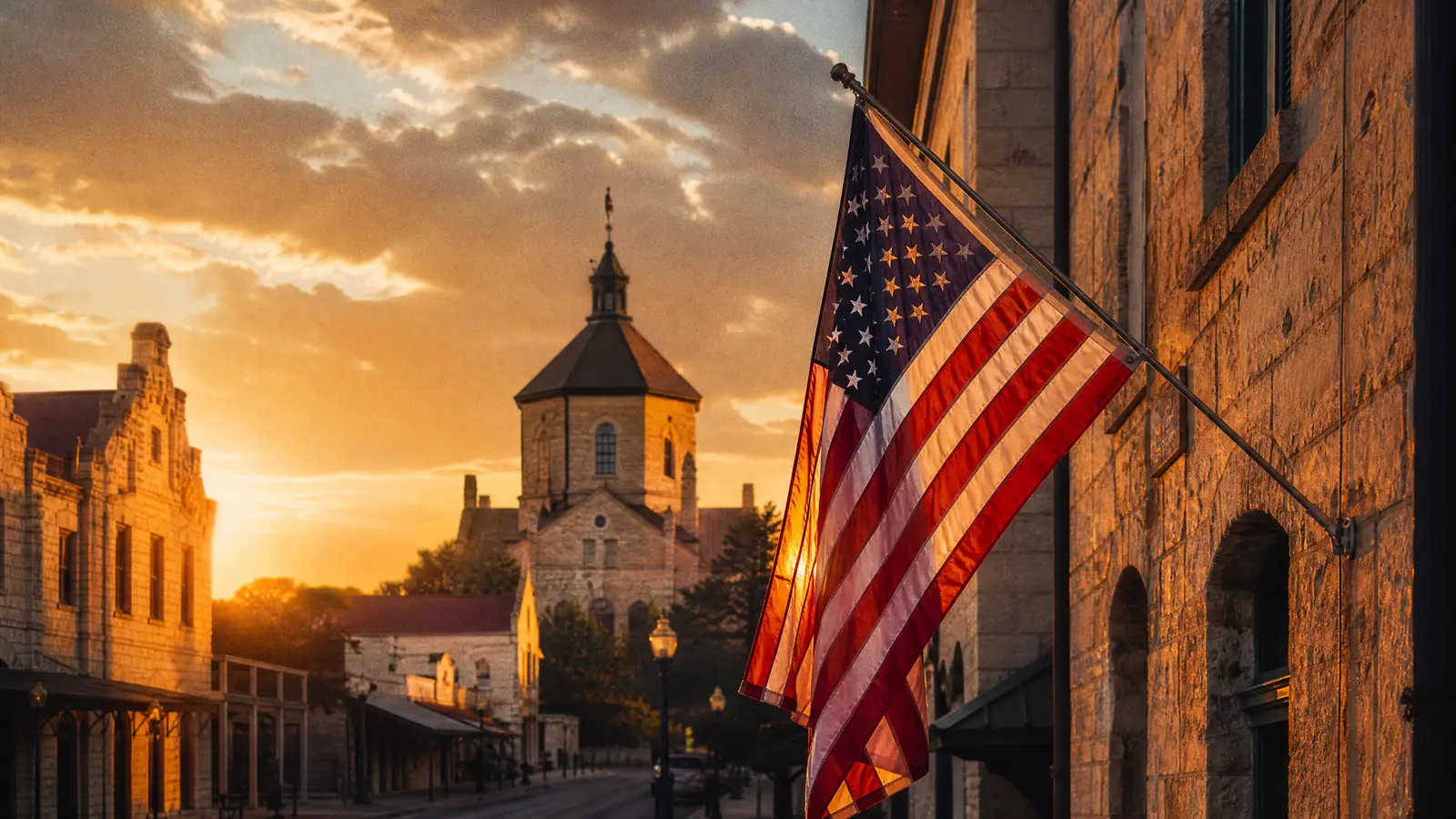
Today, America turns 250.
Two and a half centuries since a group of men in Philadelphia signed their names under a sentence that would change the world: that all men are created equal, endowed with life, liberty and the pursuit of happiness. They signed it knowing it could cost them everything. Their fortunes. Their families. Their necks.
I want to mark this anniversary not with fireworks, but with a story. A story most Germans have never heard, even though it is their story. A story I stumbled into by accident, on a dusty county road east of Austin, Texas.
It is the story of farmers who read a letter in a newspaper, sold everything they owned, and bet their lives on America.
A Letter That Started a Fever
In the early 1830s, a German farmer named Johann Friedrich Ernst settled in a place called Industry, Texas. Today it is a village of 250 souls halfway between Austin and Houston. Back then, it was the edge of the known world, in a young republic that had just torn itself free from Mexico and was not yet part of the United States.
Ernst did something simple. He wrote letters home.
He described a land of impossible space. Fertile soil. No princes, no censors, no conscription officers. In one letter he wrote that Texas was the most beautiful country he had ever seen, a place where any hard-working man could acquire land and live free.
German newspapers printed those letters. And something ignited that historians still call the Texas fever.
Understand what those words meant to the people reading them. Germany in the 1830s and 1840s was not free. It was a patchwork of small principalities with censorship, restricted press, endless bureaucracy and long compulsory military service. The population was exploding, farms were being divided into slivers too small to feed a family, and early industrialization was destroying the old trades. Millions of people looked at their future and saw a wall.
And then, in the newspaper, a voice from across the ocean: here, every free man can own land.
In the course of the 19th century, 5.5 million Germans emigrated to the United States. For a time, they were the largest immigrant group in America. Hundreds of thousands of them came to Texas, settling the triangle between San Antonio, Austin and the Hill Country, a region people still call German Texas.
Migration worked then exactly as it works now. Someone leaves. Someone tells the story. Others listen. A movement is born. Today it happens through YouTube, podcasts and social media. Then, it happened through letters printed in newspapers. The medium changes. The human hunger for freedom does not.
The Price of the Ticket
It is easy to romanticize this. It should not be.
In 1842, a group of German noblemen founded the Adelsverein, the Society for the Protection of German Immigrants in Texas. The plan was breathtaking in its ambition: to plant entire German colonies in the new world. The execution was a catastrophe.
The society bought land from speculators, a vast tract called the Fisher-Miller Grant. On paper it looked magnificent. In reality it lay deep in Comanche territory, without roads, without supplies, without any infrastructure at all.
Thousands of German families paid the society for passage and the promise of prepared settlements. To pay for it, they sold everything: houses, farms, tools, entire existences. They said goodbye to parents they would never see again. Then they boarded sailing ships for a crossing that took weeks.
Many landed at a Gulf Coast port called Indianola. And there, for many, the real nightmare began. Too few wagons. Too little food. No organization. Thousands stranded on the coast while disease and chaos spread through the camps. Historians speak openly today of fraud, or at the very least of catastrophic incompetence.
Sit with that for a moment. These people had no Plan B. No safety net. No state waiting to catch them if they fell. If the experiment failed, everything was lost.
And still they came.
The Baron Who Burned His Title
Into this disaster stepped one of the most remarkable figures in Texas history.
His name was Baron Otfried Hans Freiherr von Meusebach, born 1812 in Dillenburg, son of a distinguished legal scholar who corresponded with the Brothers Grimm. He had studied law, finance and natural sciences in Bonn and Halle, served as a judge and a mayor, and moved in the liberal intellectual circles that dreamed of a freer Germany.
In 1845 the Adelsverein sent him to Texas to salvage the wreckage.
And here he did something that tells you everything about what America meant to these people. On arrival, he declared he would never return to Germany. He renounced his noble title and became, simply, John O. Meusebach. Not a baron. A citizen.
Contemporaries described him as an imposing figure, tall, red-haired, long-bearded, with a natural authority that won the settlers' trust. He reorganized the colonists and led a wagon train from New Braunfels into the Hill Country, toward a new settlement in the west.
Today you drive that route, roughly 110 kilometers, in an hour and a half. The settlers needed two weeks, hacking paths through brush country, fording rivers, dragging wagons across broken terrain, deep in the territory of the most formidable horse warriors on the continent.
Then Meusebach did something almost without precedent on the American frontier. He rode out and negotiated a peace treaty with the Comanche. It stands to this day as one of the very few treaties between European settlers and a Native American nation that was genuinely honored by both sides, permanently.
Under the protection of that peace, the settlers founded a town.
They called it Fredericksburg.
A German Town in the Heart of Texas
Fredericksburg became the beating heart of German culture in Texas. For generations, German was spoken on its streets. There were German schools, German newspapers, German churches. In the center of town still stands the Vereinskirche, the reconstructed meeting church of the first settlers.
One of the sons of these immigrants was a boy named Chester W. Nimitz, grandson of a German hotel keeper on Main Street. He grew up to command the United States Pacific Fleet in the Second World War. His story, and the story of the war he helped win, fills the National Museum of the Pacific War in Fredericksburg today. Think about that arc: from persecuted emigrants to the admiral who helped save the free world, in three generations. Only in America.
I was there again just last week. I have visited Fredericksburg many times, but this visit was special. I had brought a group of German entrepreneurs to Texas, and Fredericksburg was the final day and the high point of our trip. We walked together down Main Street, past the wine bars and the biergartens and the shops with German names, in a town that is now the second most popular wine destination in the United States after Napa Valley.
And standing there, I thought: every German who is thinking about emigrating should see this place once in their life.
What Remains, Beyond the Postcards
I emigrated to the USA in 2008 and spent many years of my life in Texas. For a time I even owned a ranch there, not in a big city but out in the country, in Bastrop County east of Austin, in a small community called Rockne. When I moved there, I had no idea I had landed in the middle of one of the most fascinating German emigration stories ever told.
Rockne is not a postcard town like Fredericksburg. It is a small rural community. But that is exactly why it matters. In the church hang old pictures with German inscriptions. Families still carry the same German surnames they carried 150 years ago. The community keeps a red book in which families can trace their ancestry, a practical necessity in a place where the same families have intermarried for generations. And until the Second World War, the everyday language of Rockne was German.
Fredericksburg preserves German Texas like an open-air museum. Rockne simply lives it, quietly, without tourists. Both are proof of the same thing: the people who came here did not just survive. They built something that outlasted them by two centuries.
The Lesson for July 4th, 2026
Here is what I want you to take from this story on America's 250th birthday.
Germans were, for centuries, a people of emigrants. Millions left for America, for South America, for Russia, for Africa. They founded cities, built farms, created companies. They did not wait for a government to solve their problems. They made a decision. They went. And they built.
Emigration is not weakness. It is courage, self-responsibility and entrepreneurial spirit in their purest form.
The farmers who boarded those sailing ships in Bremen and Hamburg were not fleeing. They were choosing. Choosing space over confinement, opportunity over stagnation, freedom over the suffocating hand of small princes and their censors and their conscription lists.
And I will be honest with you. When I read the news from Germany today, the economic decline, the political tension, the growing appetite of the state for control, I sometimes think of those letters from Texas appearing in German newspapers. The mood in the country was not optimistic then either. And the answer, for hundreds of thousands, was not to wait for permission.
America is not perfect. It never was. The story you just read contains fraud, disease, and graves at Indianola. But 250 years after Philadelphia, this country still runs on the same fuel that drew Johann Friedrich Ernst and John O. Meusebach across an ocean: the radical idea that a free person, with land under their feet and no lord above their head, can build anything.
Fredericksburg still exists. New Braunfels still exists. Rockne still exists.
The men and women who built them had no Plan B, no safety net, and no guarantee. They had a ship, a letter, and a decision.
Happy 250th birthday, America. You were worth the crossing then. You are worth it now.