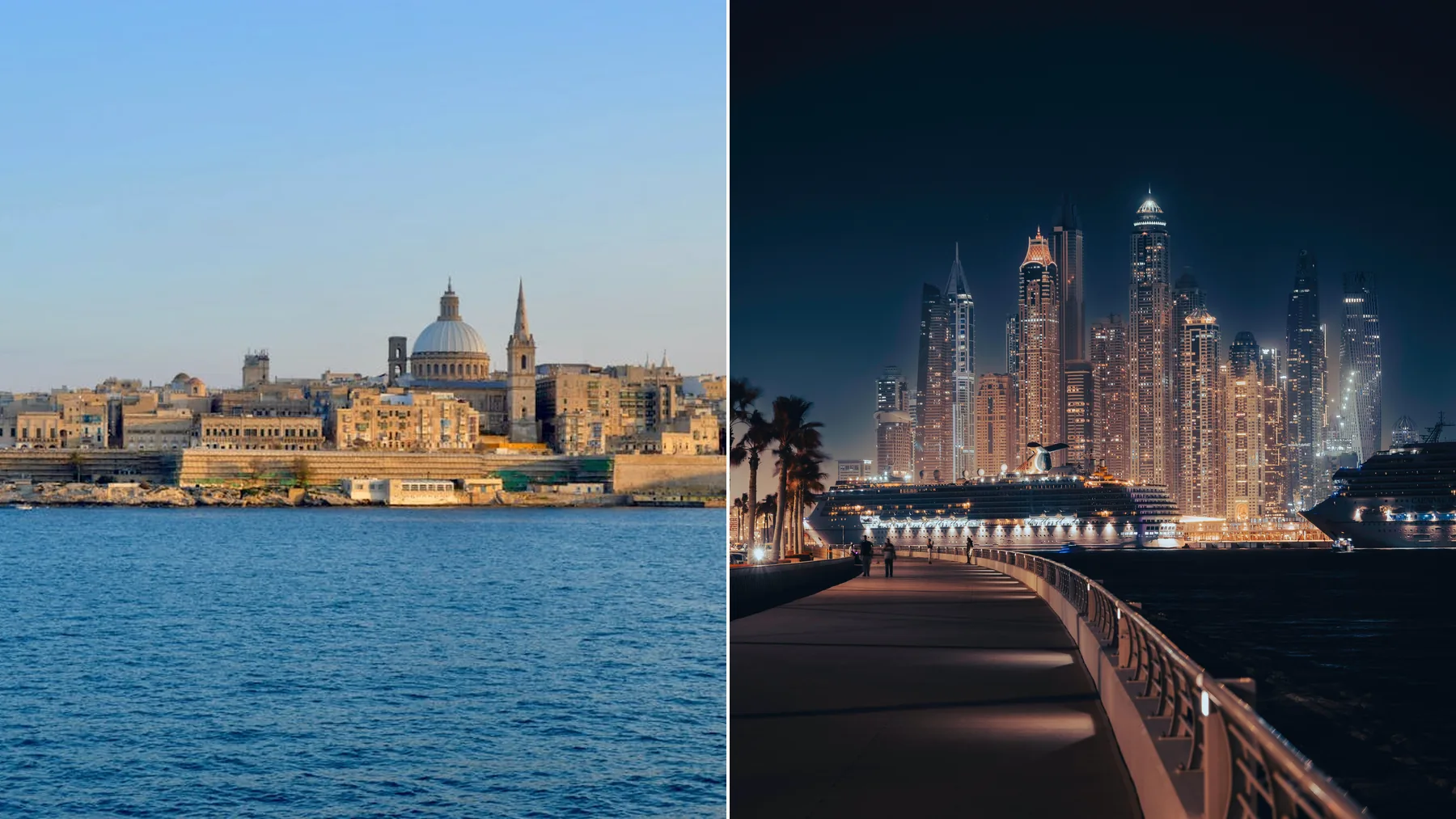
The two jurisdictions that come up most often when high-net-worth individuals from Britain, Ireland, Australia, and Scandinavia are making a residency decision are Malta and the UAE. They are both presented as “low tax.” They are both English-friendly. They are both warm. Beyond that, they are almost completely different propositions.
This is the comparison nobody writes honestly, because most advisers either sell Malta or sell Dubai. We sell neither — we help clients find the right fit. Here is the unfiltered truth.
The Tax Case
UAE: Personal income tax is zero. Capital gains tax is zero. There is no minimum tax payment. There is no condition on what you do with your money or where you keep it. VAT is 5% on goods and services. Corporate tax was introduced in 2023 at 9% on business profits above AED 375,000 (approximately €93,000).
Malta: Zero tax on foreign capital gains (even if remitted). 15% on foreign income remitted under GRP/TRP. Zero tax on foreign income kept abroad. No inheritance tax, no wealth tax, no property tax. Corporate tax at 35% with refunds reducing effective rate to 5% for trading income.
The honest comparison: On pure personal tax numbers, the UAE wins. Zero is lower than 15%. If you are judging purely on the tax rate for personal income, Dubai beats Malta.
But the comparison does not end there.
The EU factor: Malta is an EU member state. That means EU banking, SEPA payments, free movement of goods and capital within the single market, EU passporting for financial services, and an internationally recognised legal system. The UAE is not in the EU. For entrepreneurs running businesses that serve EU clients, holding EU company structures, or operating in regulated EU industries — this is not a minor point. It can be the deciding factor.
Banking: Maltese banking is strict and slow but ultimately part of the EU financial system — IBAN accounts, SEPA, no questions from counterparties about where your bank is based. UAE banking is improving but many European counterparties, law firms, and financial institutions apply enhanced due diligence to UAE-based accounts. The FATF greylisting of the UAE (lifted in 2024, but the reputational memory lingers) created friction that some clients are still experiencing.
The foreign-earned income exclusion for Americans: US citizens pay US tax on worldwide income regardless of where they live. Neither Malta nor the UAE changes this fundamentally. But the structures available in each jurisdiction — and the treaty networks — differ. Get US-specific advice.
The Lifestyle Reality
UAE: Dubai is a world-class city. Infrastructure is extraordinary. Restaurants, retail, healthcare — all first-rate. The weather is excellent from October through April. May through September is 40°C+ and essentially unliveable outdoors. The cultural environment is tolerant but not liberal in the Western sense — alcohol is available, but the social framework is Islamic. There is no democratic political system.
Malta: A small island. Traffic is a problem. Construction is constant in parts. The dining and retail scene is pleasant but does not compare to Dubai. The weather is excellent nine months of the year, hot but manageable in summer. The culture is Catholic, Western, democratic. The social framework is familiar to anyone from Britain, Ireland, or Australia.
The scale question: If you need a world city — global connections, a cosmopolitan social scene, a major airport hub, extraordinary infrastructure — Dubai delivers and Malta does not. If you want a home — a community, a sense of place, a culture you recognise, a Mediterranean village, children who grow up knowing their neighbours — Malta delivers and Dubai does not.
Most of our clients who have tried both end up telling us the same thing: Dubai is impressive but not somewhere they could imagine growing old. Malta is somewhere they could.
Children and Education
UAE: Excellent international schools. British curriculum, American curriculum, IB — all available. Dubai is genuinely child-friendly in terms of infrastructure and safety.
Malta: Good private and church schools. English-medium. Less choice than Dubai at the elite international school level, but for families with Catholic values, the church school system is hard to beat anywhere in Europe. Full education guide here.
Residency and Permanence
UAE: The UAE Golden Visa (10-year renewable) provides long-term residency without a minimum stay requirement. It can be obtained through property investment (AED 2 million+) or through professional or business criteria.
Malta: The MPRP provides permanent residency — not renewable, permanent — with no minimum stay requirement, within the EU and Schengen area. The GRP provides annual renewable residency with Schengen access.
The key difference: Malta gives you EU permanent residency. The UAE gives you UAE long-term residency. They are categorically different in terms of what they unlock geographically and institutionally.
The Safety and Stability Question
Both Malta and the UAE are safe — low crime, stable political environments. But they are stable in very different ways.
Malta is a 58-year-old democracy, a member of the EU and NATO’s Partnership for Peace, governed by elected parliaments, with an independent judiciary and press freedom. Its stability is structural — built into its institutions.
The UAE is a federation of seven absolute monarchies. It is stable because of effective governance and oil wealth — but that stability is personal and political rather than institutional. For most practical purposes this does not matter. For families thinking about a multi-generational base — where their children and grandchildren will live — it is a different kind of calculation.
The Summary Comparison
| Factor | Malta | UAE (Dubai) |
|---|---|---|
| Personal income tax | 15% (remitted, under GRP) | 0% |
| Capital gains tax | 0% (even if remitted) | 0% |
| EU membership | Yes | No |
| EU banking/SEPA | Yes | No |
| Schengen access | Yes | No |
| Minimum stay requirement | No (but 183-day cap elsewhere) | No |
| Lifestyle | Mediterranean village/city | World metropolis |
| Catholic culture | Yes | No |
| Political system | Democracy | Absolute monarchy |
| Climate (summer) | Hot but manageable | Extreme heat |
| Language | English official | English widely spoken |
| Long-term residency | EU permanent (MPRP) | 10-year renewable |
The decision: If your primary driver is the absolute minimum personal tax rate and you want a large global city, Dubai wins. If your primary driver is a legitimate EU base, EU institutional access, a Western democratic culture, and a home that feels like a home — Malta wins.
Most of our clients who ask the question end up in Malta. The tax rate difference — 15% vs 0% on remitted income — is real but manageable, particularly when the EU access, banking quality, and lifestyle factors are weighted properly.
Book a consultation to work through which jurisdiction actually fits your life.