Considering a move to Bulgaria?
Book a Strategy SessionContents
- 1. Bulgaria: Country Overview
- 2. Putting Bulgaria on the Map
- 3. What Others Say About Bulgaria
- 4. Tax Benefits: What Bulgaria Has to Offer
- 5. Tax Rates at a Glance
- 6. Tax Residency: What Triggers It
- 7. Double Tax Agreements
- 8. Avoid Remaining Tax Resident at Home
- 9. Tax Considerations When Leaving Your Home Country
- 10. Company Setup & Corporate Tax
- 11. Who Should (and Shouldn't) Move to Bulgaria
- 12. Visas and Residence Permits
- 13. Path to Citizenship
- 14. Banking in Bulgaria
- 15. What Makes Bulgaria Genuinely Attractive
- 16. Cost of Living in Bulgaria
- 17. Buying Real Estate in Bulgaria
- 18. Retiring in Bulgaria
- 19. US Citizens: What You Need to Know
- 20. Correct Preparation
- 21. Automatic Exchange of Information (OECD CRS)
- 22. Further Relocation Formalities
- 23. How We Help With Your Move to Bulgaria
I.
Bulgaria: Country Overview
Bulgaria is an EU member state in southeastern Europe, bordered by Romania, Serbia, North Macedonia, Greece, and Turkey, with a Black Sea coastline to the east. The capital, Sofia, is a city of 1.3 million people, situated at the foot of Vitosha Mountain. Bulgaria joined the European Union in 2007 and uses the Bulgarian lev, which is pegged to the euro at a fixed rate of BGN 1.95583 per euro. Bulgaria adopted the euro on 1 January 2026 at the fixed conversion rate of 1 EUR = 1.95583 BGN, becoming the 21st member of the Eurozone and eliminating the BGN/EUR currency risk that previously affected cross-border investors and businesses.
Bulgaria introduced a 10% flat income tax in 2008 — the lowest in the European Union — and has maintained it ever since. Corporate income tax is also 10%, the joint lowest in the EU alongside Cyprus. Dividends are taxed at 5%. The combination of EU membership, a flat tax system, and a cost of living that is among the lowest in Europe makes Bulgaria one of the most underrated tax-efficient jurisdictions in the world.
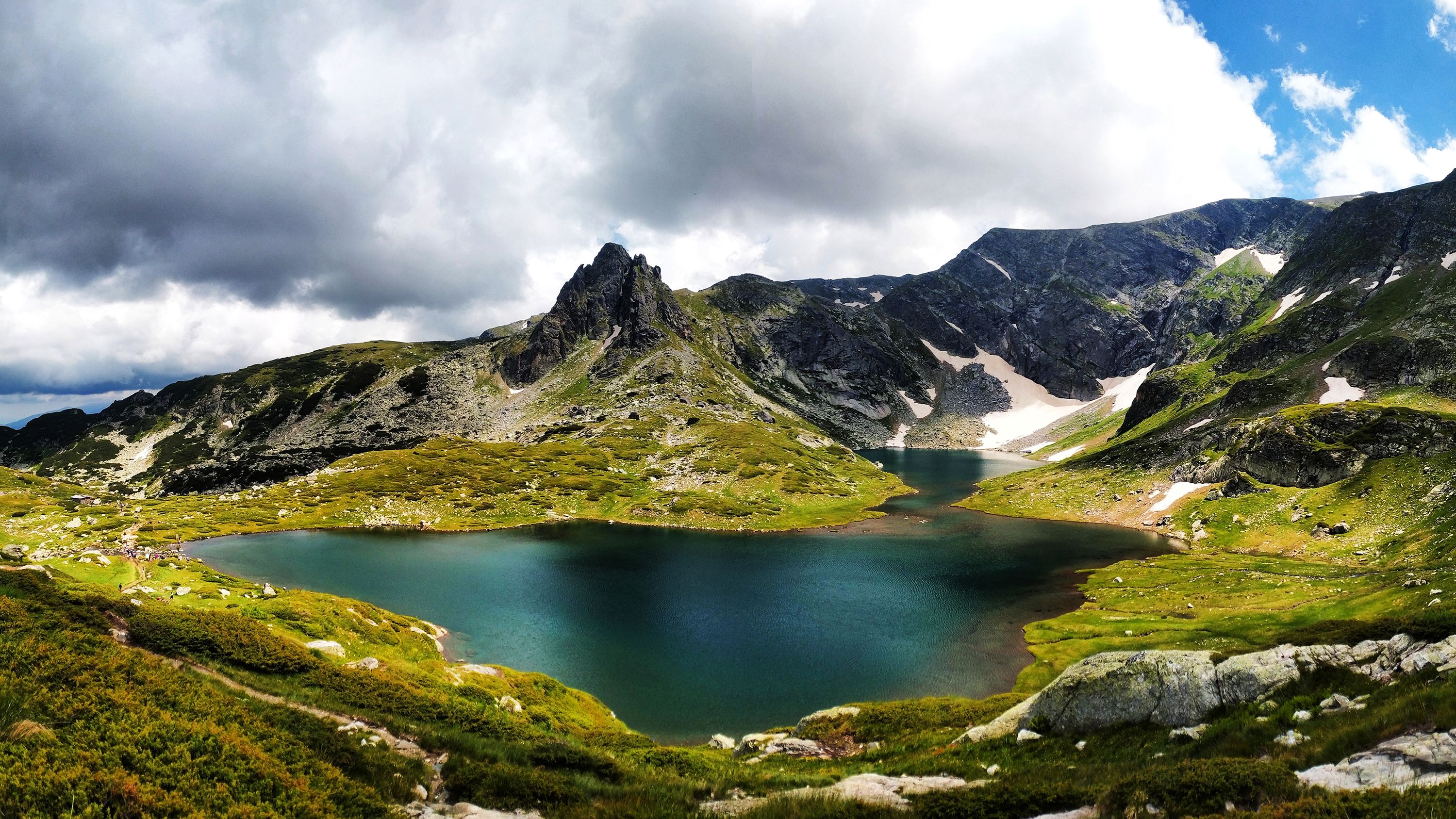
The country has a well-educated, English-speaking workforce, a growing tech sector centred on Sofia, and a quality of life that is often surprising to first-time visitors. The Rila and Pirin mountain ranges offer world-class skiing in winter, and the Black Sea coast provides a long summer season. Plovdiv, Bulgaria's second city, was European Capital of Culture in 2019 and has a thriving arts and restaurant scene.
What to be aware of: Bulgaria is not a zero-tax jurisdiction. The 10% flat rate is the lowest in the EU, but it is not zero. Social contributions are payable on employment income and can add significantly to the effective rate. VAT is 20%. The legal and bureaucratic system can be slow and opaque. Corruption remains a concern at institutional level, though it rarely affects the daily lives of foreign residents. The country is not yet in the Schengen Area, though accession is expected.
Putting Bulgaria on the Map
Bulgaria — Southeastern Europe, EU member state since 2007
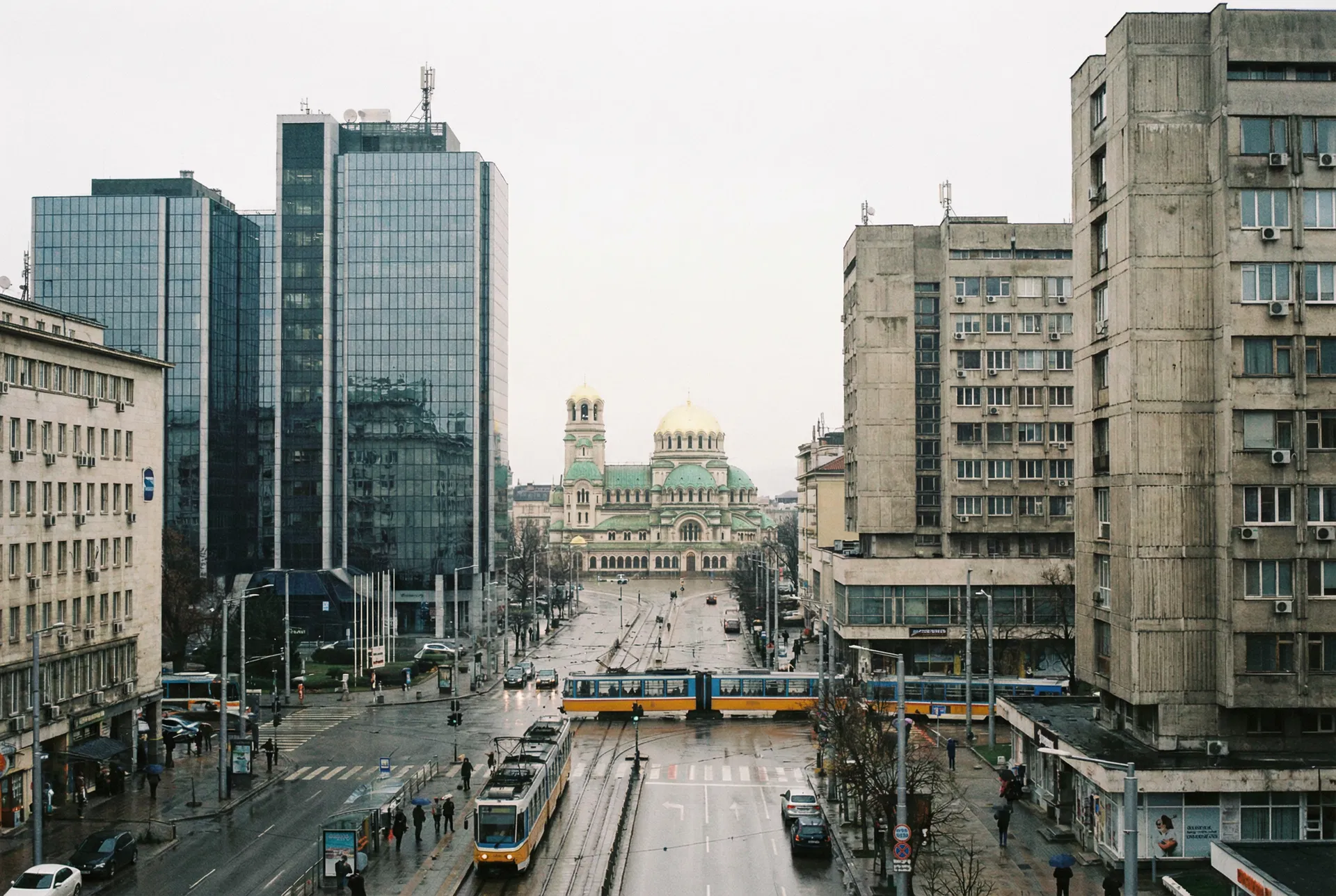
Sofia sits in a broad valley at 550 metres above sea level, with the Vitosha Mountain rising to 2,290 metres directly to the south of the city. On a clear day, the mountain is visible from almost anywhere in Sofia — a reminder that you are not in an ordinary European capital. The city has a slightly Soviet-era character in its wider districts, but the centre — particularly the area around the National Palace of Culture, Vitosha Boulevard, and the old town — has a genuine European quality, with good restaurants, cafés, and cultural institutions.
Plovdiv, 150 kilometres southeast of Sofia, is Bulgaria's most charming city. The old town, built on three hills above the Maritsa River, is a UNESCO World Heritage Site, with Roman ruins, Ottoman architecture, and Bulgarian National Revival houses. The city has a creative, cosmopolitan character that has grown significantly since its stint as European Capital of Culture.
The Black Sea coast stretches for 378 kilometres, from the Romanian border in the north to the Turkish border in the south. Varna and Burgas are the main coastal cities; the resort areas of Sunny Beach, Golden Sands, and Sozopol attract millions of tourists each summer. The sea is warm from June to September, and the beaches are long and well-maintained. Outside the peak tourist season, the coast is quiet and genuinely beautiful.
Vienna is 2 hours by plane. London is 3 hours. Istanbul is 1 hour. Bulgaria is well-connected to the rest of Europe, with Sofia Airport offering direct flights to most major European cities.
III.
What Others Say About Bulgaria
"Bulgaria is a fascinating, beautiful, difficult country, and I fell in love with it."
"Bulgaria, I reflected as I walked back to the hotel, is not a country; it's a near-death experience."
"Bulgaria is fascinating. Because it had been a Communist country until the mid-80s, so it had just recently transitioned. And there were still the police towers on the street corners."

IV.
Tax Benefits: What Bulgaria Has to Offer
Bulgaria adopted the euro on 1 January 2026, completing its transition from candidate to full Eurozone member at the fixed conversion rate of 1 EUR = 1.95583 BGN. The country retains the simplest tax structure in the EU — a 10% flat rate on both personal and corporate income, a 5% dividend tax, and no progressive brackets. Headline rates are unchanged for 2026, though several technical updates apply: cryptocurrency is now expressly within the taxable financial assets list, bank deposit interest dropped from 10% to 8%, and Pillar Two introduces a 15% domestic minimum top-up tax for MNEs with revenues of €750M or more.
- ›10% flat personal income tax — the lowest top rate in the EU alongside Romania. The same rate applies to all earned income with no progressive brackets, and to capital gains realised by Bulgarian tax residents.
- ›10% flat corporate income tax — also among the lowest in the EU. The OECD Pillar Two 15% domestic minimum top-up tax applies only to multinational groups with annual global revenues of €750 million or more in two of the last four years; ordinary trading companies and SMEs are not affected.
- ›5% dividend tax — for distributions to individuals from Bulgarian companies (a proposal to raise this to 10% was discussed but not adopted). Dividends from EU/EEA subsidiaries received by a Bulgarian holding company are generally exempt under the participation exemption.
- ›0% capital gains on listed securities — gains from the sale of shares of public companies on the Bulgarian Stock Exchange or on EU/EEA regulated markets are exempt; from 1 January 2026 the SME growth markets exemption (previously temporary since 2021) became permanent.
- ›Capital gains exemption on real estate — one residential property per year held for more than 3 years, plus up to two other properties held for more than 5 years, can be sold tax-free for individuals.
- ›0% wealth tax, 0% inheritance tax for direct family, 0% gift tax for spouses and direct relatives — Bulgaria has no wealth tax, and inheritance and gift taxes do not apply to transfers between spouses, parents and children.
- ›Cryptocurrency clarified from 2026 — virtual currencies are expressly within the taxable financial assets list from 1 January 2026, taxed at 10% with a 10% statutory deduction allowance for investment-related costs.
- ›70+ double tax treaties including with all major EU economies, the US, UK, Canada, China, and most G20 countries.
- ›Eurozone member from 1 January 2026 — Bulgaria adopted the euro at the fixed rate of 1 EUR = 1.95583 BGN, eliminating currency conversion friction with EU trading partners and bringing all tax filings into euro-denominated reporting.
V.
Tax Rates at a Glance
The most important tax rates in Bulgaria are as follows. Note that these have been simplified and should be used as general guidance only.
| Tax | Rate | |
|---|---|---|
| Personal Income Tax | 10% flat | No progressive brackets; no tax-free threshold for general income |
| Capital Gains Tax (general) | 10% flat | With 10% statutory deduction allowance for transactions in financial assets |
| Capital Gains on listed securities (BSE / EU regulated markets / SME growth markets) | 0% | SME growth markets exemption made permanent from 1 January 2026 |
| Capital Gains on residential real estate | 0% | One property per year held >3 years; up to two further properties held >5 years |
| Cryptocurrency disposal gains | 10% | With 10% statutory deduction allowance; expressly within taxable financial assets from 1 January 2026 |
| Dividend Tax (individuals) | 5% | Unchanged for 2026 |
| Bank deposit interest | 8% | Reduced from 10% effective 2026 |
| Corporate Income Tax (general) | 10% flat | Lowest in the EU |
| OECD Pillar Two DMTT | 15% | Only for MNE groups with annual global revenues ≥€750M (Directive (EU) 2022/2523) |
| VAT | 20% standard / 9% reduced | VAT registration threshold lowered to EUR 51,130 (BGN 100,000) from 1 April 2025 |
| Wealth Tax | 0% | None |
| Inheritance Tax (spouses, direct relatives) | 0% | Exempt |
| Inheritance Tax (other relatives) | 0.4%–6.6% | Varies by municipality |
| Social Security (combined employee + employer) | ~32.7% | Capped at EUR 2,111.64/month insurable income (2026 transitional) |
Cryptocurrency and Crypto Assets
Bulgaria taxes cryptocurrency gains as income from the sale of financial assets, subject to a flat 10% personal income tax. A 10% expense deduction may apply, reducing the effective rate slightly. There is no dedicated crypto legislation — general tax principles apply. Crypto-to-crypto exchanges may or may not trigger a taxable event depending on interpretation. Bulgaria's flat 10% rate is low by European standards, making it a reasonable jurisdiction for crypto investors.
VI.
Tax Residency in Bulgaria: What Triggers It
Under Bulgarian law, an individual is considered a tax resident if they meet one of the following criteria:
- ›183-day rule: You spend more than 183 days in Bulgaria in any calendar year.
- ›Permanent address: You have a permanent address (registered domicile) in Bulgaria and your centre of vital interests is in Bulgaria.
- ›Centre of vital interests: Your personal and economic ties are stronger with Bulgaria than with any other country.
Bulgarian tax residents are taxed on their worldwide income at the flat 10% rate. Non-residents are taxed only on Bulgarian-source income. The key advantage of Bulgarian tax residency is the flat 10% rate on all income — employment, self-employment, dividends, interest, rental income, and capital gains are all taxed at the same rate.
Key point: Bulgarian tax residency is relatively easy to establish — 183 days in the country, or a registered address with genuine ties. The flat 10% rate then applies to all worldwide income.
VII.
Double Tax Agreements (DTAs)
Bulgaria has an extensive network of double tax agreements (DTAs) with over 70 countries, including all major EU member states, the United States, the United Kingdom, Switzerland, and most of Eastern Europe. This network is one of Bulgaria's most significant advantages over pure offshore jurisdictions — it allows Bulgarian residents to receive income from foreign sources with reduced withholding taxes at source.
Key DTAs include agreements with Germany (5%/15% dividend withholding), the United Kingdom (5%/10%), France (5%/15%), the United States (10%), Switzerland (5%/15%), and Austria (0%/5%). The specific rates depend on the type of income and the shareholding percentage. In each case, the Bulgarian resident pays the lower of the treaty rate and the Bulgarian domestic rate.
The DTA network makes Bulgaria particularly attractive for those with income flowing from multiple European countries — the combination of low domestic rates and treaty protection can result in a very low effective tax rate on foreign-source income.
VIII.
Avoid Remaining Tax Resident at Home
Relocating to Bulgaria does not automatically end your tax obligations elsewhere. The critical question is whether you have genuinely severed tax residency in your country of origin — and this is determined not by where you have registered an address, but by where you actually live, where your ties are, and how your life is organised.
Most countries use a combination of objective tests to determine tax residency: the number of days you spend on their territory, where your family lives, where your habitual abode is, where your business is managed, and where your social and economic life is centred. If you spend more than 183 days in your home country, maintain a family home there, or continue to manage a business from there, you may remain fully tax resident — regardless of what your Bulgarian residence registration says.
What a genuine relocation to Bulgaria looks like: Your primary residence is in Bulgaria. You spend the majority of the year there. Your family has moved with you. You have deregistered from your previous country of residence. Your economic and social life has genuinely shifted.
A sham relocation — registering an address in Bulgaria while continuing to live, work, and maintain your life elsewhere — does not achieve tax freedom. It creates legal risk. We only work with clients who are serious about making a real move to Bulgaria.
IX.
Tax Considerations Before You Leave Your Home Country
Before you relocate to Bulgaria, you need to understand what tax consequences arise in your current country of residence at the point of departure. These rules vary significantly by country and must be assessed individually.
- ›Germany — Applies an exit tax on unrealised gains in shareholdings of 1% or more under §6 AStG. A ten-year look-back period can apply even after departure.
- ›United States — The expatriation tax under IRC §877A treats long-term residents and citizens as having sold all worldwide assets at fair market value on the day they relinquish citizenship or residency.
- ›France — Exit tax applies to unrealised gains on securities and company rights above €800,000 when a French tax resident relocates abroad.
- ›United Kingdom — Temporary non-residence rules: if you leave the UK and return within 5 years, certain income and gains realised during the absence are taxed on return.
- ›Austria — Exit tax applies to unrealised gains on business assets and shareholdings when an Austrian tax resident relocates to a non-EU/EEA country.
A tax consultation before you move is not optional — it is essential. The cost of getting this wrong is almost always greater than the cost of getting proper advice upfront.
X.
Company Setup & Corporate Tax in Bulgaria
Bulgaria's 10% flat corporate income tax is the joint lowest in the EU. Setting up a Bulgarian company is straightforward and inexpensive. The main corporate structure is the OOD (Дружество с ограничена отговорност) — the Bulgarian equivalent of a limited liability company — which can be incorporated with a minimum share capital of BGN 2 (approximately €1).
- ›OOD (Limited Liability Company) — the standard structure for most businesses. 10% corporate income tax on profits. Dividends distributed to individual shareholders are subject to an additional 5% withholding tax.
- ›AD (Joint Stock Company) — used for larger businesses and those seeking external investment. More complex governance requirements.
- ›ET (Sole Trader) — for individual entrepreneurs. Income is taxed at 15% (with a 25% cost deduction, resulting in an effective rate of approximately 11.25%).
- ›Freelancer registration — self-employed individuals can register as freelancers and pay income tax at 10% on net income (after a 25% standard deduction).
The total tax burden on profits extracted as dividends from a Bulgarian OOD is approximately 14.5% (10% corporate tax + 5% dividend withholding on the remaining 90%). This is the lowest combined rate on business profits in the EU.
Is a local company always the right answer?
Not necessarily. For many internationally mobile entrepreneurs, the local company is not the most efficient operating vehicle. A local company is useful when you have local staff, local premises, local customers, or regulated local activity. If your business earns income internationally, an international structure may be cleaner.
- ›US LLC — often suitable for non-US owners with non-US income who need simple administration and good payment access.
- ›Singapore company — useful where banking reputation, Asian counterparties, and strong legal infrastructure matter.
- ›UAE company — useful for zero-tax or low-tax operating structures when substance, management, and banking can be handled properly.
Learn more about our company setup services →
Permanent establishment risk matters. A foreign company is not magic. If management, staff, or sales activity are actually in your country of residence, local tax authorities may still tax the profits. Structure follows substance.
XI.
Who Should (and Shouldn't) Move to Bulgaria
Section 11 is where the relocation decision becomes practical. Bulgaria can be an excellent fit for some profiles and a poor fit for others; the decisive question is whether the tax rules, lifestyle, residence requirements, banking, healthcare, and family situation point in the same direction.
Good Fit
- ›International entrepreneurs and investors whose income structure actually benefits from Bulgaria’s tax and residence rules.
- ›Remote professionals and business owners who can move their centre of life genuinely, not merely change an address on paper.
- ›Families or individuals who value Bulgaria’s lifestyle, geography, safety profile, and cost structure as part of the overall decision.
- ›People willing to handle local banking, residency, healthcare, and administration properly rather than improvising after arrival.
- ›Those who understand that relocation is a full tax-residency project, not a holiday with a lower tax rate.
Poor Fit
- ×Those who cannot genuinely spend enough time in Bulgaria to support a defensible tax-residence position.
- ×People who need a zero-friction, Western-European administrative environment from day one.
- ×US citizens who expect the move to eliminate US tax filing, FBAR, FATCA, or citizenship-based taxation.
- ×Those with income, companies, or family ties that keep them clearly taxable in their previous Bulgaria.
- ×Anyone choosing the jurisdiction only because it sounds attractive online, without testing housing, banking, healthcare, and lifestyle fit.
XII.
Visas and Residence Permits in Bulgaria
EU and EEA nationals have the right to live in Bulgaria without a visa or residence permit for any length of time. Non-EU nationals have the following main options:
- ›D-Visa (Long-Stay Visa) — allows a stay of up to one year in Bulgaria. Can be obtained for various purposes including employment, business, study, or family reunification. Can be converted into a temporary residence permit.
- ›Temporary Residence Permit — granted for up to one year, renewable. Available for those who have established a company in Bulgaria, are employed in Bulgaria, or have other qualifying ties.
- ›Permanent Residence Permit — available after 5 years of continuous temporary residence in Bulgaria.
- ›Digital Nomad Visa — introduced in 2025, this visa allows non-EU remote workers to reside in Bulgaria while working for foreign employers, providing a structured route into one of the lowest-tax jurisdictions in the EU.
- ›Investment Residence — non-EU nationals who invest BGN 1 million (approximately €500,000) in Bulgarian government bonds or BGN 2 million in a Bulgarian company can obtain permanent residence.
XIII.
Path to Citizenship in Bulgaria
Bulgarian citizenship can be obtained by naturalisation after 5 years of continuous permanent residence in Bulgaria, provided the applicant demonstrates language proficiency, has no criminal record, and has renounced or is willing to renounce their previous citizenship (dual citizenship is not generally permitted under Bulgarian law, with some exceptions).
Bulgarian citizenship is an EU citizenship, granting the right to live and work in any EU member state, travel visa-free to over 180 countries, and access EU consular protection worldwide. For non-EU nationals, Bulgarian citizenship is one of the most accessible routes to EU citizenship, given the relatively short naturalisation period and the straightforward residence requirements.
Bulgaria also has an investment citizenship programme (though this has been under review following EU pressure), and citizenship by descent is available for those who can demonstrate Bulgarian ancestry.
XIV.
Banking in Bulgaria
Bulgaria has a well-developed banking sector, with a mix of domestic banks and subsidiaries of major European financial institutions. The Bulgarian National Bank (BNB) regulates the sector, and deposits are protected up to €100,000 under the EU deposit guarantee scheme. Opening a personal bank account as a Bulgarian resident is straightforward for most nationalities.
Major banks operating in Bulgaria include UniCredit Bulbank, DSK Bank, First Investment Bank (FIB), Raiffeisenbank Bulgaria, and OTP Bank Bulgaria. Most major banks offer online banking in English and international wire transfer services.
Where to hold your main accounts
For most internationally mobile clients, the primary banking relationship should not automatically sit in the new country of residence. Local accounts are useful for rent, utilities, daily spending, and domestic administration, but your main wealth and operating accounts should usually remain in stronger international banking centres.
- ›Switzerland — private banking, wealth custody, and long-term capital preservation.
- ›Singapore — strong Asian banking, excellent reputation, and robust multi-currency infrastructure.
- ›United States — practical for USD payments, brokerage access, cards, and global business counterparties.
- ›Georgia (Caucasus) — useful as an accessible banking backup for entrepreneurs and mobile residents.
Important: not all banks are compatible with all residencies. Some Swiss and Singaporean private banks have restrictions on clients resident in certain jurisdictions, and compliance requirements vary. Residency status, income profile, source of wealth, and business type all affect which institutions will accept you and on what terms. We help clients navigate this before they commit to any banking structure.
XV.
What Makes Bulgaria Genuinely Attractive
Bulgaria is attractive when it is judged as a complete relocation platform, not as a slogan. The point is not that Bulgaria is perfect for everyone. The point is that, for the right person, the combination of tax position, residence practicality, lifestyle, geography, banking, language, and long-term stability can produce a genuinely coherent base.
- Lowest-cost serious EU tax platform. Bulgaria is attractive because it offers a 10% flat personal income tax and 10% corporate tax inside the European Union. That combination is rare: low tax, EU law, EU banking, and Schengen-adjacent geography.
- The lifestyle case is not cosmetic. Sofia, Plovdiv, Varna, and Bansko offer a practical lifestyle at a cost far below Western Europe. Mountains, Black Sea coast, Orthodox culture, and good food make the country more liveable than its reputation suggests.
- It can function as a real operating base. It works well as a European operating base for founders, consultants, software businesses, and holding structures that need EU substance without Western European overhead.
- It rewards the right profile. The best fit is the cost-sensitive entrepreneur who wants EU access and a simple tax regime without paying Vienna, Munich, or Amsterdam prices.
- The attraction has to be handled honestly. Administration can be rough, English is uneven outside business circles, and the country is not glamorous. The attraction is efficiency, not prestige.
XVI.
Cost of Living in Bulgaria
Bulgaria remains one of the lower-cost EU options, especially outside Sofia. The useful comparison is not with rural Bulgaria, but with the standard expected by a foreign entrepreneur or retiree who wants good housing, private healthcare and international travel access.
Typical monthly costs for an internationally mobile professional or family in Bulgaria (2026 planning ranges):
| Category | BGN/month | GBP/month | USD/month |
|---|---|---|---|
| 1-bed apartment, desirable area | BGN 1,360–2,650 | £600–1,150 | $750–1,450 |
| 2-bed apartment / small house | BGN 2,750–5,470 | £1,200–2,350 | $1,550–3,050 |
| International school (annual per child) | BGN 4,460–13,680 | £1,950–5,950 | $2,500–7,600 |
| Private health insurance (annual individual) | BGN 810–2,590 | £350–1,100 | $450–1,450 |
| Restaurant meal, mid-range (per person) | BGN 40–100 | £0–50 | $0–50 |
| Monthly groceries, single person | BGN 580–1,270 | £250–550 | $300–700 |
| Utilities and internet, apartment | BGN 260–690 | £100–300 | $150–400 |
Comfortable single professional (no children): BGN 3,240–5,760/month (£1,400–2,500 / $1,800–3,200)
Family of four with private schooling: BGN 8,100–14,400/month (£3,500–6,250 / $4,500–8,000)
These figures are planning ranges, not promises. The actual budget in Bulgaria depends heavily on housing quality, neighbourhood, school choice, healthcare needs, car ownership, travel frequency, and whether you are trying to live like a local or maintain a Western expatriate standard.
XVII.
Buying Real Estate in Bulgaria
Buying real estate in Bulgaria can be useful for lifestyle, residence planning, and long-term anchoring, but it should not be treated as a simple shortcut to tax residence. Property is a factual tie; it can support a relocation story when used properly, but it can also create tax, inheritance, financing, and exit issues if bought before the wider plan is clear.
For internationally mobile buyers, the main points in Bulgaria are:
- ›Ownership rules: Foreigners can buy buildings and apartments directly, while land ownership by non-EU nationals may require a Bulgarian company or other structure.
- ›Transaction costs: Acquisition costs include transfer tax, notary fees, registration fees, and agency commission, usually still modest compared with Western Europe.
- ›Market and rental profile: Sofia, Plovdiv, Varna, Burgas, and ski resorts such as Bansko have very different rental and resale profiles.
- ›Residence and tax angle: The main due-diligence issues are land status, building permits, condominium management, old construction quality, and whether the property is suitable for actual year-round living.
The practical approach is to decide first whether the property is primarily for living, residence support, rental yield, asset protection, or lifestyle. Those are different purchases. A good real estate decision in Bulgaria begins with title due diligence, tax-residence planning, inheritance review, and a realistic exit strategy — not with glossy developer brochures.
Transaction cost table (Bulgaria)
| Cost item | Typical amount | Notes |
|---|---|---|
| Transfer tax | 2–3% | Varies by municipality |
| Notary fees | ~0.1–1.5% | Based on purchase price scale |
| Legal / registry costs | ~0.5–1% | Typical due-diligence and registration allowance |
| Typical total buyer costs | ~4–6% | Excluding financing costs |
XVIII.
Retiring in Bulgaria
Retiring in Bulgaria can make sense for the right profile, but it should not be reduced to a simple tax headline. The real question is whether the country gives you the right combination of residence security, pension treatment, healthcare access, cost of living, climate, and day-to-day comfort. A retirement move is harder to reverse than a business relocation, so practical quality of life matters as much as tax.
For retirees considering Bulgaria, the main points are:
- ›Residence route: The practical route is usually the EU citizens can register residence; non-EU retirees usually rely on long-stay residence based on pension income and accommodation. This should be confirmed before making property commitments or moving assets, because a pleasant destination is not useful if the residence basis is weak.
- ›Pension income: Foreign pension income may be taxable in bulgaria unless treaty rules allocate taxing rights elsewhere; bulgaria’s flat-tax system can still be attractive. The decisive point is often not only local tax, but whether the pension-paying country continues to tax the pension at source.
- ›Healthcare: Private healthcare in sofia, plovdiv, and varna is affordable, while public healthcare quality varies. Retirees should arrange private insurance or a clear local healthcare pathway before arrival, especially where pre-existing conditions are involved.
- ›Cost of living and lifestyle: Low cost of living, mountains, black sea coast, and a slower pace than western europe. The country can work well where the retiree’s lifestyle expectations match the local rhythm rather than an imagined expatriate brochure.
- ›Climate and practical fit: Four distinct seasons, with hot summers, cold winters, and milder conditions on the black sea coast. Climate, language, bureaucracy, transport, and access to family often decide whether the move remains attractive after the first year.
Bulgaria should therefore be assessed as a full retirement platform, not merely as a tax jurisdiction. The best candidates are retirees who have stable foreign income, good health coverage, a realistic view of local bureaucracy, and a clear plan for where they will live, how they will receive care, and how their pension will be taxed both locally and at source.
XIX.
US Citizens: What You Need to Know
US citizens and long-term green card holders are taxed by the United States on their worldwide income, regardless of where they live. Relocating to Bulgaria does not end US tax obligations — it changes the picture, but does not eliminate it.
Key considerations for US citizens in Bulgaria:
- ›Foreign Earned Income Exclusion (FEIE): US citizens who qualify as bona fide residents of Bulgaria or pass the physical presence test can exclude a significant amount of foreign earned income from US federal income tax. This applies to wages and self-employment income — not passive income such as dividends, interest, capital gains, pensions, or rental income.
- ›Foreign Tax Credit: Income tax paid in Bulgaria can generally be credited against US tax on the same income, reducing or eliminating double taxation. The credit is particularly important for income not covered by the FEIE and for taxpayers whose income exceeds the annual FEIE threshold.
- ›Treaty position: Treaty relief between the United States and Bulgaria is limited or fact-dependent. Before relying on any treaty position, US citizens should confirm the current treaty status and the exact income category with a qualified US international tax adviser. A treaty does not automatically remove US filing obligations, and most treaties contain savings-clause rules that preserve US taxation of citizens.
- ›FBAR: US persons with bank accounts in Bulgaria exceeding $10,000 in aggregate must file FinCEN Form 114 (FBAR) annually. Failure to file can carry severe penalties, even when no tax is due.
- ›FATCA: US citizens may also need to report foreign financial assets on Form 8938. Banks in Bulgaria may separately identify US account holders under FATCA procedures and report account information through the relevant channels.
- ›Social Security and self-employment tax: The FEIE reduces income tax but does not automatically eliminate US self-employment tax. Whether US Social Security tax applies depends on employment status, entity structure, and any applicable totalization agreement.
US citizens considering Bulgaria should work with a qualified US international tax adviser alongside local counsel. The interaction between US tax law and Bulgaria tax law is manageable, but it requires careful planning before the move, not after the first filing deadline arrives.
XX.
Correct Preparation
Before your move to Bulgaria, a number of important questions need to be answered. The following section addresses the most common ones.
When is the right time to move to Bulgaria?
From a Bulgarian tax perspective, there is no specific year-end deadline. Bulgaria uses a calendar year for its tax year, and you become a Bulgarian tax resident once you have spent more than 183 days in Bulgaria in a calendar year, or have established your centre of vital interests there. The critical timing question is your departure from your home country — that is where exit tax and residency rules apply.
Do I need a visa to live in Bulgaria?
EU and EEA nationals have the right to live in Bulgaria without a visa. Non-EU nationals can apply for a D-visa (long-stay visa) for stays of up to one year, which can be converted into a temporary residence permit. Bulgaria also has a Digital Nomad Visa for remote workers. We walk through the options in a personal consultation.
What happens to my existing company when I move to Bulgaria?
A relocation to Bulgaria has consequences for your existing business. A limited company can generally continue to operate, potentially with a new director. If you were self-employed, continuation is not straightforward. Discuss the best structure with your adviser — and if you are considering selling the business, it is better to complete the sale before you leave your home country.
Do I need to set up a new company in Bulgaria?
Not necessarily. If you generate income as a private investor or from passive sources, a new Bulgarian entity is not required. However, a Bulgarian OOD (the equivalent of a limited company) with a 10% corporate tax rate can be an efficient structure for active business income. We discuss the options in a personal consultation.
What happens to my current home?
To genuinely shift your centre of life to Bulgaria, giving up your home in your previous country is non-negotiable. This step is essential for your tax liability in your previous country of residence to be extinguished. Retaining an available dwelling — owned or rented — in your home country is one of the most common triggers for continued tax residency there.
Should I rent a place in Bulgaria before the official move?
Yes — it makes sense. Sofia has a well-developed rental market, and renting before committing to a purchase gives you time to understand which neighbourhood suits your lifestyle. The Black Sea coast and Plovdiv are also worth exploring as alternatives to Sofia.
What do I need to prepare for my family?
The move to Bulgaria should work for the whole family. Key questions: Is Sofia the right city, or would Plovdiv, Varna, or Burgas suit your lifestyle better? Are international schools accessible? How important is proximity to Western Europe? The answers depend on your specific situation.
Deregistering from your home country
The final step is a proper deregistration — both with the residents' register and with the tax authority in your home country. If you want to be thorough, you can request a tax clearance certificate after settling all outstanding liabilities. This document confirms that all claims have been settled and provides a clean break.
XXI.
Automatic Exchange of Information (OECD CRS)
Bulgaria participates in the OECD Common Reporting Standard (CRS), the global framework for automatic exchange of financial account information between tax authorities. Bulgaria has been exchanging information with partner jurisdictions since 2017.
In practical terms, this means: if you hold bank accounts or financial assets in Bulgaria, the financial institution in Bulgaria will report your account details — balance, income, and identifying information — to the local tax authority, which will then automatically share this information with the tax authority of your country of tax residence.
The key point is that CRS follows tax residence, not nationality or citizenship. For example, a Swedish citizen who has genuinely become tax resident in Bulgaria is treated, for CRS purposes, as a tax resident of Bulgaria — not as a Swedish reportable person merely because of the passport. The same principle applies to any non-US nationality: the account should be reported to the country of tax residence, not automatically to the country of citizenship.
CRS does not create a tax liability — it creates transparency. If you are properly tax resident in Bulgaria and have correctly severed residency in your home country, CRS reporting simply confirms what should already be declared. The risk arises when individuals attempt to maintain dual residency, leave old tax-residence indicators unresolved, or claim Bulgaria residency without genuinely living there.
US citizens are different. The United States does not participate in CRS in the same way. Americans are affected by FATCA instead: banks outside the United States generally identify US persons and report their account information through FATCA channels to the US authorities, regardless of whether the person is tax resident in Bulgaria or anywhere else.
Key point: CRS is not a problem for those who have relocated correctly. It is a problem for those who have not. Proper tax residency planning — with genuine physical presence and documented ties to Bulgaria — is the only sustainable approach. CRS follows tax residence, not citizenship; FATCA follows US-person status.
XXII.
Further Relocation Formalities
Upon establishing residence in Bulgaria, you will need to obtain a Bulstat / personal identification number from the competent local authority. This is required for most financial and legal transactions in Bulgaria, including opening bank accounts, signing contracts, registering with tax authorities, and dealing with public offices.
You will also need to obtain or complete the relevant Bulgarian residence card or EU registration certificate process once your residence status has been approved. This document or registration record becomes your practical proof of residence in Bulgaria and is usually required for banking, telecom contracts, utilities, leases, property transactions, and day-to-day administrative matters.
- ›Driving licences from most countries are accepted only for a limited period after arrival. Once you become resident in Bulgaria, you should verify whether your licence can be exchanged directly or whether a local medical certificate, translation, theory test, or practical test is required.
- ›Health insurance should be arranged before arrival unless you are immediately covered by a local public system. In many cases, private international cover is the safest bridge solution while residence, employment, or social-security registration is still being completed.
- ›Importing personal effects should be planned before shipping anything to Bulgaria. Household goods may qualify for relief when imported shortly after taking up residence, but customs paperwork, inventory lists, timing rules, and vehicle-import duties can make late or informal shipping expensive.
- ›Proof of address and banking are often linked. Banks, telecom providers, and government offices may require a lease, utility bill, local address certificate, or residence registration before they will open an account or complete onboarding.
- ›Ongoing local compliance should not be treated as an afterthought. Calendar reminders for residence renewals, tax registrations, local filings, health-insurance renewals, and address updates help prevent administrative problems that can later undermine the tax-residency position.
XXIII.
How We Help With Your Move to Bulgaria
We offer comprehensive tax and legal support for your relocation to Bulgaria. We follow a proven process — and where Bulgaria requires specialist local input, we involve appropriately qualified local tax, legal, immigration, and banking advisers on the ground, while remaining responsible for overall coordination.
The results speak for themselves: we have helped over 100 entrepreneurs and business owners significantly reduce their tax burden through carefully planned relocations. Careful planning, thorough advice, and comprehensive support are our standard. Legally sound structuring within the framework of international tax law is our highest priority.
Our services typically include one or more of the following:
- → Tax advice on the consequences of relocating to Bulgaria: analysis, projections, assessments
- → Clarifying location questions for your business in Bulgaria based on factors such as market access, available workforce, and public subsidies — in collaboration with local experts
- → Recommendations for local estate agents experienced with international clients, for both rental and purchase in Bulgaria
- → Referrals to specialist immigration lawyers for Bulgarian residency and permit matters
- → Introductions to local tax advisers who handle the opening of bank accounts for both the company and you personally in Bulgaria
- → Ongoing tax and administrative management of your Bulgarian company
- → Tax-efficient structuring and restructuring of assets via foreign companies, holding structures, and trusts
Our fees are generally billed on a time basis; fixed prices apply for certain services such as company formation.
As a first step, we recommend booking a consultation to discuss your plans — by phone, Zoom, or Signal. Together we find the best approach and establish contact with our local partner. As project coordinator, we keep all the threads in hand that are necessary for the successful implementation of your plans.
Key Facts
Compare Countries