Considering a move to Armenia?
Book a Strategy SessionContents
- 1. Armenia: Country Overview
- 2. Putting Armenia on the Map
- 3. What Others Say About Armenia
- 4. Tax Benefits: What Armenia Has to Offer
- 5. Tax Rates at a Glance
- 6. Tax Residency: What Triggers It
- 7. Double Tax Treaties
- 8. Avoid Remaining Tax Resident at Home
- 9. Tax Considerations When Leaving Your Home Country
- 10. Company Setup & Corporate Tax
- 11. Who Should (and Shouldn't) Move to Armenia
- 12. Visas and Residence Permits
- 13. Path to Citizenship
- 14. Banking in Armenia
- 15. What Makes Armenia Genuinely Attractive
- 16. Cost of Living in Armenia
- 17. Buying Real Estate in Armenia
- 18. Retiring in Armenia
- 19. US Citizens: What You Need to Know
- 20. Correct Preparation
- 21. Automatic Exchange of Information (OECD CRS)
- 22. Further Relocation Formalities
- 23. How We Help With Your Move to Armenia
I.
Armenia: Country Overview
Armenia is a landlocked republic in the South Caucasus, bordered by Turkey to the west, Georgia to the north, Azerbaijan to the east, and Iran to the south. It covers 29,743 km² — roughly the size of Belgium — and has a population of approximately three million. The capital, Yerevan, is home to more than a third of the country's population and is its undisputed economic, cultural, and administrative centre.
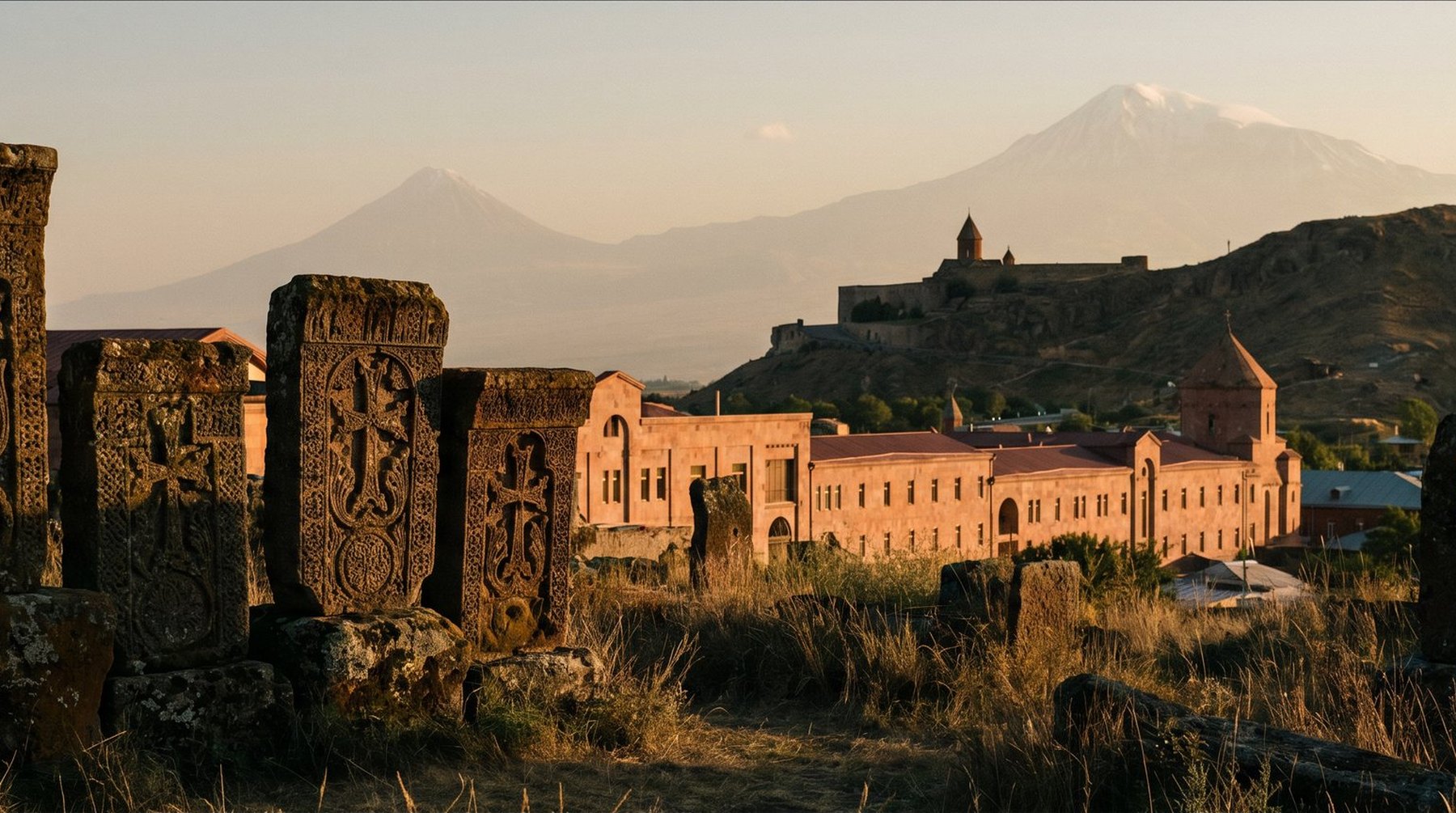
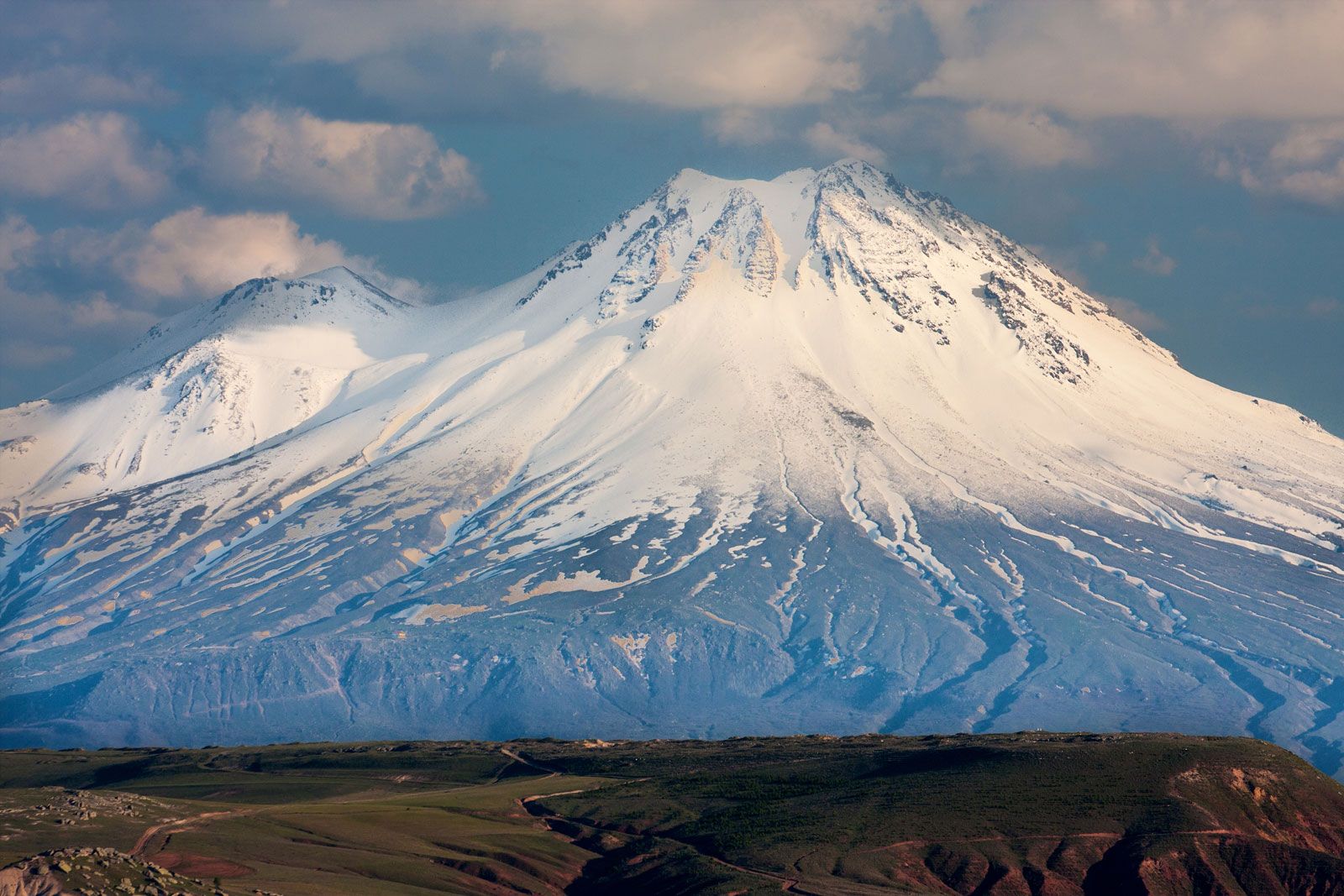
Yerevan is built from tuff — a volcanic stone that ranges from pale pink to deep rose — which gives the city its nickname: the Pink City. The architecture is a mix of Soviet neoclassical grandeur and modern glass towers, with a café culture that would not be out of place in Vienna or Tbilisi. The climate is continental: hot, dry summers and cold winters, with over 300 days of sunshine per year. Mount Ararat — the national symbol of Armenia, now across the border in Turkey — is visible from Yerevan on clear days, a snow-capped presence that dominates the skyline and the national imagination.
On the tax side, Armenia is one of the most competitive jurisdictions in the region. A flat 20% income tax applies to all personal income. Corporate tax is 18% on profits, with a simplified 5% turnover tax available for smaller businesses. There is no inheritance tax, no wealth tax, and no gift tax. Free Economic Zones offer 0% corporate tax, 0% VAT, and 0% customs duties for qualifying activities. For entrepreneurs, investors, and digital nomads, the combination of low taxes, low cost of living, and a rapidly developing tech ecosystem makes Armenia an increasingly serious option.
What to be aware of. Armenia is not a zero-tax jurisdiction. The 20% flat income tax applies to worldwide income for residents, and capital gains are taxed at the same rate. The country is geopolitically complex — the unresolved conflict with Azerbaijan over Nagorno-Karabakh has created regional instability, and the borders with Turkey and Azerbaijan remain closed. The large influx of Russian and Ukrainian nationals since 2022 has pushed Yerevan property prices significantly higher. These are real considerations that must be weighed against the genuine tax and lifestyle advantages.
II.
Putting Armenia on the Map
Armenia — South Caucasus, at the crossroads of Europe, Russia, and the Middle East
Armenia arrives in the smell of lavash baking on a hot stone, in the weight of an apricot — the fruit the Romans called prunum Armeniacum, the Armenian plum — in the way a stranger at a roadside stall presses a glass of homemade wine into your hand before you have said a word. This is one of the oldest continuously inhabited places on earth, a country that has been civilised for so long that its ruins have ruins.
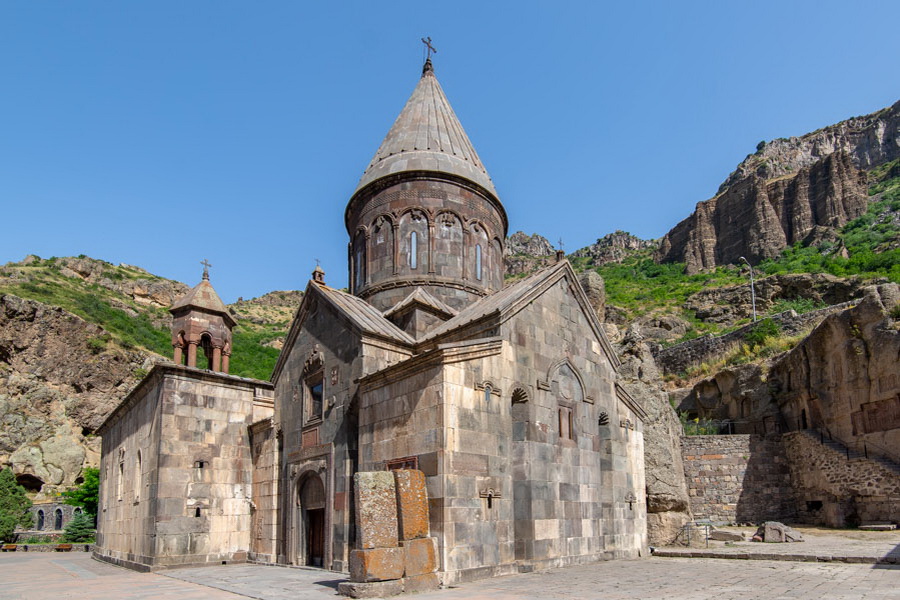
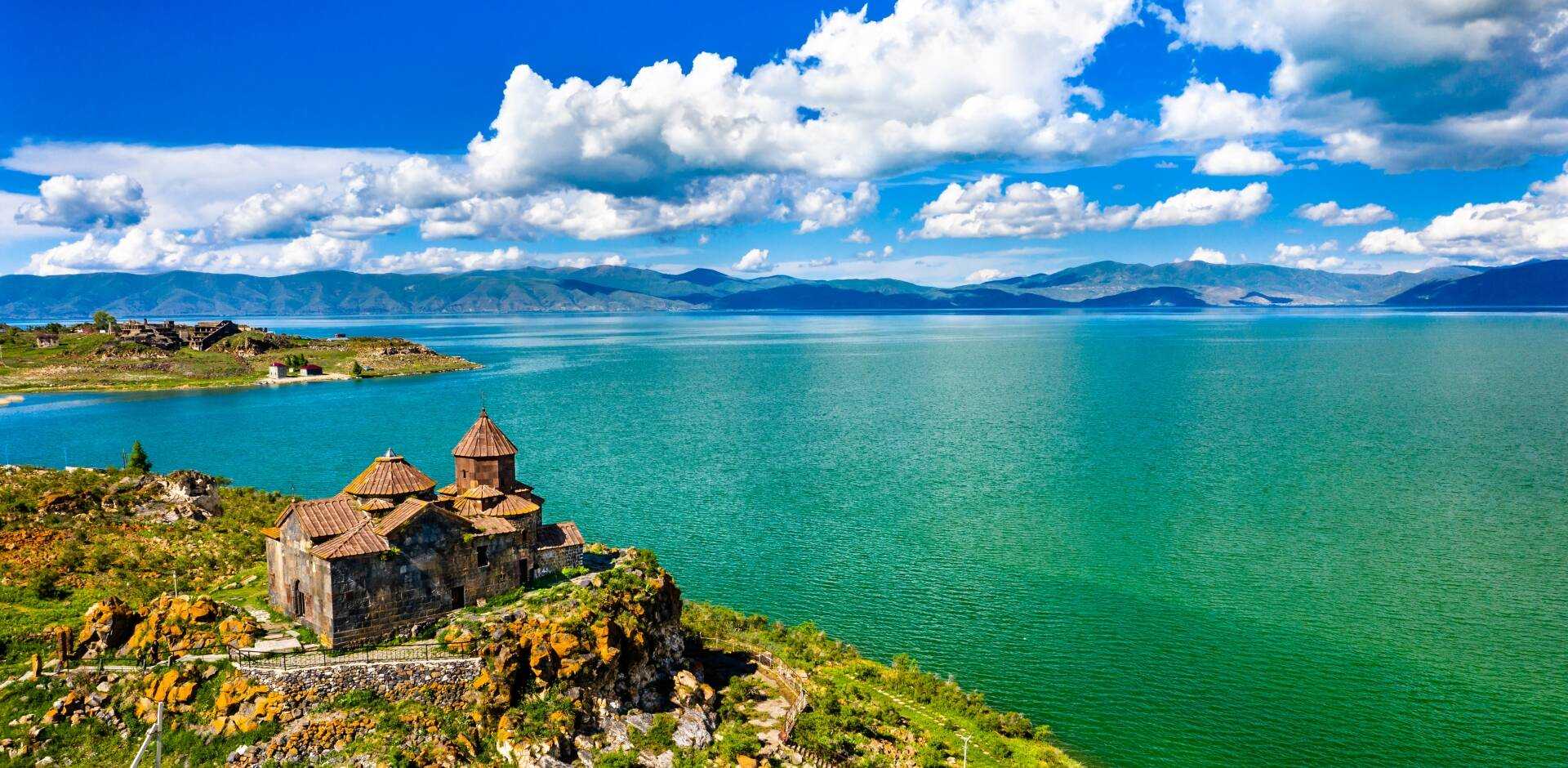
The country sits in a high volcanic plateau, ringed by mountains. Lake Sevan, one of the world's largest high-altitude lakes, lies at 1,900 metres above sea level — its water an improbable blue, its shores lined with ancient khachkars, the carved stone crosses that are Armenia's most distinctive art form. Dilijan, in the north, is called "Little Switzerland" — forested, cool, full of artists and monasteries. Geghard Monastery, carved partly into a cliff face in the Azat River gorge, is a UNESCO World Heritage Site that dates to the fourth century. The Garni Temple, a Hellenistic pagan temple from the first century AD, stands on a basalt promontory above a river canyon — the only surviving pre-Christian structure in Armenia.
And then there is Ararat. The mountain stands in Turkey now, separated from Armenia by a closed border and a century of grief, but it belongs to Armenia in every other sense — on the coat of arms, on the brandy label, in the dreams of the diaspora. On a clear morning in Yerevan, when the smog has lifted and the light is right, it rises above the city like a promise that has not yet been kept. You do not forget it.
Yerevan itself is a city that rewards patience. The first impression is Soviet — wide boulevards, monumental buildings, a certain grey seriousness. But the second impression is something else entirely: the outdoor cafés of the Northern Avenue, the covered market of the GUM, the jazz bars of the Cascade district, the extraordinary food — dolma, khorovats, manti, ghapama — and the wine, which is not a recent affectation but a tradition six thousand years old. The city is young in spirit and ancient in memory, and that combination is rarer than it sounds.
III.
What Others Say About Armenia
"I should like to see any power of the world destroy this race, this small tribe of unimportant people, whose wars have all been fought and lost, whose structures have crumbled, literature is unread, music is unheard, and prayers are no longer answered. Go ahead, destroy Armenia. See if you can do it. Send them into the desert without bread or water. Burn their homes and churches. Then see if they will not laugh, sing and pray again."
"Armenia is one of those countries that gets under your skin. The food, the wine, the warmth of the people — and then you discover the tax system, and you realise it gets under your wallet too, in the best possible way."
"Yerevan surprised me completely. I expected a post-Soviet city and found a Mediterranean one — outdoor cafés, beautiful women, extraordinary food, and a startup scene that reminded me of Berlin in 2010."
IV.
Tax Benefits: What Armenia Has to Offer
Armenia is not a zero-tax jurisdiction, but it is a genuinely low-tax one. The combination of a flat 20% income tax, low corporate rates, the absence of inheritance and wealth taxes, and the availability of Free Economic Zones with 0% corporate tax makes it one of the most competitive fiscal environments in the region.
- ›Flat 20% income tax — a single rate applies to all personal income, regardless of amount. No progressive brackets.
- ›No inheritance tax — wealth transfers between generations are free of duty.
- ›No wealth tax — there is no net-worth or net-wealth levy of any kind.
- ›No gift tax — gifts between individuals are not subject to a separate gift duty.
- ›Low corporate tax — 18% on profits, with a 5% simplified turnover tax available for businesses with annual turnover under AMD 115 million (approximately $290,000).
- ›Free Economic Zones — companies operating in Armenia's FEZs (including the Alliance FEZ in Yerevan) pay 0% corporate tax, 0% VAT, and 0% customs duties. Qualifying activities include IT, high technology, pharmaceuticals, and industrial production.
- ›IT sector incentives — Armenian IT companies certified under the High-Tech Industry Support programme pay a reduced 10% income tax rate for employees and a reduced 5% corporate tax rate.
- ›Dual citizenship permitted — Armenia allows dual citizenship, so you do not need to renounce your existing nationality to naturalise.
V.
Tax Rates at a Glance
The most important tax rates in Armenia are as follows. Note that these have been simplified and should be used as general guidance only.
Cryptocurrency and Crypto Assets
Armenia is one of the most crypto-friendly jurisdictions in the world for individual investors. Capital gains from standard crypto trading are taxed at 0% for non-entrepreneur individuals. Mining and staking rewards are subject to a modest 1% income tax. The country adopted a formal Law on Crypto-Assets in May 2025, providing a clear regulatory framework while preserving its attractive tax incentives. For crypto-focused relocation, Armenia is a serious option.
VI.
Tax Residency: What Triggers It
Under Armenian tax law, an individual is considered a tax resident of Armenia if they meet any one of the following criteria:
- ›183-day rule: You spend 183 or more days in Armenia during a calendar year. Days of arrival and departure are both counted.
- ›Principal place of residence: Armenia is your primary place of abode, regardless of the number of days spent there.
- ›Centre of vital interests: Your personal and economic ties are stronger to Armenia than to any other country.
Tax residents of Armenia are subject to income tax on their worldwide income at the flat 20% rate. Non-residents are taxed only on Armenian-source income, also at 20% (withheld at source for most categories).
Armenia does not impose a minimum physical presence requirement for maintaining tax residency once established — but the 183-day rule is the most straightforward way to establish it in the first place. The State Revenue Committee (SRC) is the competent authority and can issue tax residency certificates on request, which are useful for invoking double tax treaty protection.
Establishing tax residency in Armenia requires more than registering an address. You must be able to demonstrate, if challenged, that your principal home or principal place of stay is genuinely in the country. Documentation — lease agreements, utility bills, bank statements, travel records — matters.
VII.
Double Tax Treaties
Armenia has concluded over 40 double tax agreements (DTAs) that are currently in force — an unusually extensive network for a country of its size, reflecting its Soviet-era inheritance and subsequent diplomatic activity. These treaties reduce or eliminate withholding taxes on dividends, interest, and royalties, and provide mechanisms for resolving residency conflicts between Armenia and treaty partners.
Key treaty partners include:
- ›Austria
- ›Belgium
- ›Canada
- ›China
- ›Czech Republic
- ›Finland
- ›France
- ›Georgia
- ›Germany
- ›Greece
- ›Hungary
- ›India
- ›Iran
- ›Ireland
- ›Italy
- ›Kazakhstan
- ›Latvia
- ›Lithuania
- ›Luxembourg
- ›Netherlands
- ›Poland
- ›Romania
- ›Russia
- ›Slovakia
- ›Spain
- ›Sweden
- ›Switzerland
- ›Tajikistan
- ›Thailand
- ›Ukraine
- ›United Kingdom
- ›United States (via former USSR treaty)
The US–Armenia DTA is the old US–USSR treaty, which the United States has continued to apply to successor states including Armenia. It provides for reduced withholding rates on dividends (5%/15%), interest (0%), and royalties (0%) — and is particularly relevant for US citizens and businesses with Armenian operations.
The existence of a DTA does not automatically resolve all tax conflicts. The treaty must be invoked correctly, residency must be properly established, and the specific provisions of each treaty must be reviewed for your income type and circumstances. We recommend taking specific advice before relying on any treaty position.
VIII.
Avoid Remaining Tax Resident at Home
Relocating to Armenia does not automatically end your tax obligations elsewhere. The critical question is whether you have genuinely severed tax residency in your country of origin — and this is determined not by where you have registered an address, but by where you actually live, where your ties are, and how your life is organised.
Most high-tax countries have rules that can keep you taxable at home even after you have physically left. The most common triggers are:
- ›Available dwelling: Any long-term residence that remains available for your use — a flat you own, a property you rent on an ongoing basis, even a room in a family home — is sufficient to maintain a taxable domicile in many countries. The dwelling does not need to be your primary home; it only needs to be available. Surrendering it before departure is a precondition of a clean exit in Germany, Austria, Switzerland, and many other jurisdictions.
- ›Centre of vital interests: If your family, your business, your social connections, and your financial affairs remain in your home country, most tax authorities will argue that your centre of life has not genuinely moved — regardless of where you have registered.
- ›183-day rule (home country): Spending more than 183 days in your home country in a calendar year will typically trigger residency there, overriding any claim to Armenian residency for that year.
- ›Extended unlimited tax liability (Germany): Germany's erweiterte unbeschränkte Steuerpflicht can keep you taxable in Germany for up to ten years after departure if you move to a low-tax country and retain significant ties. This is separate from the exit tax and applies to ongoing income.
A genuine relocation to Armenia requires that you actually live there — that your home is there, your daily life is there, and that you can demonstrate this with documentation. A registered address and a bank account are not sufficient.
The test is not where you are registered. The test is where you live. Tax authorities in Germany, Austria, the UK, and Switzerland are experienced at identifying sham relocations and have the legal tools to challenge them. Proper advice before you move — not after — is essential.
IX.
Tax Considerations Before You Leave Your Home Country
Before you relocate, you need to understand what tax consequences arise in your current country of residence at the point of departure. These rules vary significantly by country and must be assessed individually — there is no universal answer.
Many countries impose an exit tax or deemed disposal charge when a tax resident leaves. This typically applies to unrealised capital gains on shares, business interests, real estate, or other assets — taxing you as if you had sold everything on the day you departed. The rules differ widely: some countries apply this to all assets above a threshold, others only to substantial shareholdings or business interests. Some have look-back periods that can catch you even after you have left.
Among the countries that levy a meaningful exit tax or deemed-disposal charge:
- ›Germany — Applies an exit tax on unrealised gains in shareholdings of 1% or more under §6 AStG. A ten-year look-back period can apply even after departure.
- ›United States — The "expatriation tax" under IRC §877A treats long-term residents and citizens as having sold all worldwide assets at fair market value on the day they relinquish citizenship or residency. There is no escape for covered expatriates.
- ›France — Exit tax applies to unrealised gains on securities and company rights above €800,000 when a French tax resident relocates abroad.
- ›Netherlands — Deemed disposal applies to substantial shareholdings (5% or more) at the point of emigration. A deferral mechanism exists for moves within the EU.
- ›Australia — Departing residents are treated as having disposed of most assets at market value on the date they cease to be Australian tax residents.
- ›Canada — The "departure tax" deems most property to have been disposed of at fair market value on the date of emigration, triggering capital gains on unrealised appreciation.
- ›Denmark — Applies exit taxation on shares and other securities held at the time of departure, with deferred payment options for moves to other EU/EEA states.
Beyond exit tax, you may remain subject to limited tax liability in your home country after the move — for example, on rental income from property you continue to own there, on dividends from domestic companies, or on pension payments. Severing tax residency does not necessarily sever all tax obligations.
The timing of your departure, the structure of your assets, and the sequence of any business disposals all have material consequences. In some cases, restructuring assets before departure — or deferring the move by a few months — can make a significant difference to the tax outcome.
X.
Company Setup & Corporate Tax
Armenia offers several corporate structures, each with distinct tax implications. The most common for foreign entrepreneurs and investors are:
- ›LLC (Closed Joint Stock Company / ՓԲԸ): The standard vehicle for most businesses. Minimum share capital is AMD 10,000 (approximately $25). Corporate tax is 18% on net profits. Can be 100% foreign-owned. Registration takes 1–3 business days.
- ›Simplified tax regime (turnover tax): Businesses with annual turnover under AMD 115 million (~$290,000) can opt for a 5% turnover tax instead of the standard 18% profit tax. This is a significant advantage for smaller operations.
- ›Free Economic Zone (FEZ) company: Companies operating within an FEZ pay 0% corporate tax, 0% VAT, and 0% customs duties. The Alliance FEZ in Yerevan is the primary option, focused on IT, high technology, and industrial production. FEZ status requires a minimum investment and compliance with zone regulations.
- ›High-Tech Industry certification: IT companies certified under the government's high-tech support programme benefit from a 10% income tax rate for employees and a 5% profit tax rate. This makes Armenia highly competitive for software development, SaaS, and digital services companies.
Dividends paid by Armenian companies to resident individuals are subject to a 5% withholding tax. Dividends paid to non-residents are also 5%, subject to treaty reduction. There is no participation exemption for holding structures, but the low dividend withholding rate makes Armenia attractive for profit extraction.
Company registration is straightforward and can be completed remotely with a local representative. The State Register of Legal Entities processes applications quickly, and the overall bureaucratic burden is low by regional standards.
XI.
Who Should (and Shouldn't) Move to Armenia
Section 11 is where the relocation decision becomes practical. Armenia can be an excellent fit for some profiles and a poor fit for others; the decisive question is whether the tax rules, lifestyle, residence requirements, banking, healthcare, and family situation point in the same direction.
Good Fit
- ›International entrepreneurs and investors whose income structure actually benefits from Armenia’s tax and residence rules.
- ›Remote professionals and business owners who can move their centre of life genuinely, not merely change an address on paper.
- ›Families or individuals who value Armenia’s lifestyle, geography, safety profile, and cost structure as part of the overall decision.
- ›People willing to handle local banking, residency, healthcare, and administration properly rather than improvising after arrival.
- ›Those who understand that relocation is a full tax-residency project, not a holiday with a lower tax rate.
Poor Fit
- ×Those who cannot genuinely spend enough time in Armenia to support a defensible tax-residence position.
- ×People who need a zero-friction, Western-European administrative environment from day one.
- ×US citizens who expect the move to eliminate US tax filing, FBAR, FATCA, or citizenship-based taxation.
- ×Those with income, companies, or family ties that keep them clearly taxable in their previous Armenia.
- ×Anyone choosing the jurisdiction only because it sounds attractive online, without testing housing, banking, healthcare, and lifestyle fit.
XII.
Visas and Residence Permits
Armenia is unusually open to visitors. Citizens of over 60 countries — including all EU member states, the United States, the United Kingdom, Canada, Australia, and most CIS states — can enter visa-free for up to 180 days per year. No prior application is required; entry is on presentation of a valid passport.
For those wishing to establish longer-term residency, the main routes are:
- ›Property ownership: Purchasing any residential or commercial property in Armenia makes you eligible for a Temporary Residence Permit (TRP) valid for one year, renewable annually. There is no minimum property value. This is the most accessible route for most Western nationals.
- ›Investment route: A minimum investment of $50,000 in an Armenian legal entity qualifies for a TRP of 1–3 years. The investment must be maintained for the duration of the permit.
- ›Employment / business: A work permit and TRP are available for those taking up employment or establishing a business in Armenia. The employer typically sponsors the work permit application.
- ›Family reunification: Spouses and dependent children of Armenian residents or citizens are eligible for a TRP on family grounds.
- ›Permanent Residence Permit (PRP): Available after 3 years of TRP. Also available for investors and individuals of exceptional merit under a new 2026 reform that introduced immediate permanent status for qualifying applicants.
There is no minimum physical stay requirement for TRP renewal — unlike many countries, Armenia does not require you to spend a minimum number of days per year in the country to maintain your permit. This makes it genuinely flexible for internationally mobile individuals.
Visa and permit rules can change. Always verify current requirements with the Armenian Embassy or consulate in your country of residence before making any plans. We can assist with the preparation of documentation and coordination with local authorities as part of our relocation service.
XIII.
Path to Citizenship
Armenia allows dual citizenship — a significant advantage over many countries in the region. You do not need to renounce your existing nationality to acquire Armenian citizenship.
The standard path to Armenian citizenship through naturalisation requires:
- ›3 years of legal permanent residence (PRP) in Armenia
- ›Armenian language proficiency — a basic language test is required
- ›Lawful income — you must demonstrate a legal source of income sufficient to support yourself
- ›No criminal record — a clean criminal record from your home country is required
For members of the Armenian diaspora — those of Armenian descent — special provisions apply. Ethnic Armenians can apply for citizenship through a simplified procedure that does not require the standard 3-year residency period. This is a significant draw for the large Armenian diaspora communities in Russia, France, the United States, and elsewhere.
There is currently no citizenship by investment programme in Armenia. Citizenship can only be acquired through naturalisation (residency + language) or through ethnic Armenian heritage provisions.
An Armenian passport provides visa-free or visa-on-arrival access to approximately 60 countries, including Russia, CIS states, and several Middle Eastern and Asian countries. It does not provide EU visa-free access or an EU passport.
XIV.
Banking in Armenia
Armenia's banking sector is well-developed and accessible to foreigners. The country has approximately 17 commercial banks, with the largest being Ameriabank, Ardshinbank, ACBA Bank, Evocabank, Converse Bank, and IDBank.
- ›Non-residents can open accounts at most Armenian banks with a passport only — no residence permit required. This is a significant advantage over many jurisdictions.
- ›Multi-currency accounts are available at all major banks, typically in AMD, USD, EUR, and RUB. This is particularly useful for internationally mobile clients with income in multiple currencies.
- ›Online banking is well-developed, with most banks offering full-featured mobile apps and internet banking platforms.
- ›SWIFT transfers are available at all major banks, allowing international wire transfers in all major currencies.
- ›Armenia is not blacklisted by FATF and is not on any EU or OECD grey list. This means Armenian bank accounts are generally accepted by correspondent banks and do not trigger automatic compliance flags.
The account opening process is straightforward — typically one to two business days in person. Some banks offer remote account opening for non-residents, though in-person visits are generally preferred for the initial setup.
Important: not all banks are compatible with all residencies. Some Swiss and Singaporean private banks have restrictions on clients resident in certain jurisdictions, and compliance requirements vary. Residency status, income profile, source of wealth, and business type all affect which institutions will accept you and on what terms. We help clients navigate this before they commit to any banking structure.
XV.
What Makes Armenia Genuinely Attractive
Armenia is attractive when it is judged as a complete relocation platform, not as a slogan. The point is not that Armenia is perfect for everyone. The point is that, for the right person, the combination of tax position, residence practicality, lifestyle, geography, banking, language, and long-term stability can produce a genuinely coherent base.
- Underrated low-cost entrepreneur base. Armenia combines a territorial-feeling practical environment for many foreign clients with low operating costs, accessible company administration, and a tax system that can be highly efficient when structured correctly.
- The lifestyle case is not cosmetic. Yerevan offers café culture, safety, mountains, strong food culture, and a surprisingly sophisticated urban life at a fraction of Western European cost. The country feels old, serious, and civilisational rather than generic.
- It can function as a real operating base. For founders, consultants, developers, and investors, Armenia is practical: fast internet, a growing tech scene, accessible banking, and a time zone that works with Europe, the Gulf, and parts of Asia.
- It rewards the right profile. It is strongest for independent entrepreneurs, digital operators, and families who value cost efficiency and cultural depth more than polished Western comfort.
- The attraction has to be handled honestly. The country is not for those who require EU-style infrastructure or geopolitical insulation. Residency, banking, and tax residence must be documented properly, and the regional security context cannot be ignored.
XVI.
Cost of Living in Armenia
Armenia remains inexpensive by Western standards, especially outside the most desirable parts of Yerevan. For internationally mobile clients, the question is not survival cost but the budget required for Western-level housing, private healthcare, travel and family comfort.
Typical monthly costs for an internationally mobile professional or family in Armenia (2026 planning ranges):
| Category | AMD/month | GBP/month | USD/month |
|---|---|---|---|
| 1-bed apartment, desirable area | AMD 229,000–466,000 | £450–950 | $600–1,200 |
| 2-bed apartment / small house | AMD 464,000–963,000 | £950–1,950 | $1,200–2,450 |
| International school (annual per child) | AMD 751,000–2,408,000 | £1,500–4,800 | $1,950–6,200 |
| Private health insurance (annual individual) | AMD 136,000–456,000 | £250–900 | $350–1,150 |
| Restaurant meal, mid-range (per person) | AMD 8,000–21,000 | £0–50 | $0–50 |
| Monthly groceries, single person | AMD 98,000–223,000 | £200–450 | $250–550 |
| Utilities and internet, apartment | AMD 44,000–122,000 | £100–250 | $100–300 |
Comfortable single professional (no children): AMD 546,000–1,014,000/month (£1,100–2,050 / $1,400–2,600)
Family of four with private schooling: AMD 1,365,000–2,535,000/month (£2,750–5,050 / $3,500–6,500)
These figures are planning ranges, not promises. The actual budget in Armenia depends heavily on housing quality, neighbourhood, school choice, healthcare needs, car ownership, travel frequency, and whether you are trying to live like a local or maintain a Western expatriate standard.
XVII.
Buying Real Estate in Armenia
Buying real estate in Armenia can be useful for lifestyle, residence planning, and long-term anchoring, but it should not be treated as a simple shortcut to tax residence. Property is a factual tie; it can support a relocation story when used properly, but it can also create tax, inheritance, financing, and exit issues if bought before the wider plan is clear.
For internationally mobile buyers, the main points in Armenia are:
- ›Ownership rules: Foreigners may generally buy apartments, houses, and commercial property, but agricultural land ownership is restricted and usually requires local structuring or leasing.
- ›Transaction costs: Transaction costs are modest by European standards, with notary, cadastral, registration, and agent fees being the main items.
- ›Market and rental profile: Yerevan dominates the serious property market; outside the capital, liquidity can be thin and resale timing uncertain.
- ›Residence and tax angle: Property can be useful for demonstrating genuine residence, but title checks, construction quality, utilities, and building permits should be reviewed carefully.
The practical approach is to decide first whether the property is primarily for living, residence support, rental yield, asset protection, or lifestyle. Those are different purchases. A good real estate decision in Armenia begins with title due diligence, tax-residence planning, inheritance review, and a realistic exit strategy — not with glossy developer brochures.
Transaction cost table (Armenia)
| Cost item | Typical amount | Notes |
|---|---|---|
| Stamp duty | 0% | No stamp duty on ordinary property purchases |
| Notary fees | ~0.5% | Approximate transaction value basis |
| Title registration | Low fixed fee | Handled by the State Cadastre; typically a few business days |
| Annual property tax | ~0.3% | Of cadastral value, phased in between 2024 and 2026 |
XVIII.
Retiring in Armenia
There is no specific retiree visa in Armenia. Retirees typically enter on the standard visa-free arrangement (up to 180 days per year) or establish residency through property purchase or investment.
For retirees with foreign pension income, the tax treatment depends on whether Armenia has a double tax agreement with the pension-paying country. Under most DTAs, pension income is taxable in the country of residence — meaning Armenian residents would pay the flat 20% Armenian income tax on their pension. However, some DTAs allocate taxing rights on government pensions to the source country, which may result in a lower effective rate. Specific advice is essential.
The combination of low cost of living, good private healthcare, warm summers, and a rich cultural environment makes Armenia an attractive retirement destination for those who value quality of life over beach weather. Yerevan's café culture, its proximity to ancient monasteries and mountain landscapes, and the extraordinary food and wine tradition are genuine draws for retirees seeking something beyond the standard Mediterranean retirement.
The climate is continental — hot, dry summers (30–35°C) and cold winters (−5 to −10°C in Yerevan, colder in the mountains). Those who prefer year-round warmth should consider this carefully.
XIX.
US Citizens: What You Need to Know
US citizens and long-term green card holders are taxed by the United States on their worldwide income, regardless of where they live. Relocating to Armenia does not end US tax obligations — it changes the picture, but does not eliminate it.
Key considerations for US citizens in Armenia:
- ›Foreign Earned Income Exclusion (FEIE): US citizens who qualify as bona fide residents of Armenia or pass the physical presence test can exclude up to approximately $126,500 (2024, indexed annually) of foreign earned income from US tax. This applies to wages and self-employment income — not passive income such as dividends, interest, or capital gains.
- ›Foreign Tax Credit: Armenian income tax paid (20%) can generally be credited against US tax on the same income, reducing or eliminating double taxation. The credit is particularly useful for income not covered by the FEIE.
- ›US–Armenia DTA: The old US–USSR treaty continues to apply to Armenia. It provides for reduced withholding rates on dividends (5%/15%), zero withholding on interest, and zero withholding on royalties. It also contains a tie-breaker provision for residency conflicts. Consult a qualified US international tax adviser before relying on any treaty position.
- ›FBAR: US persons with Armenian bank accounts exceeding $10,000 in aggregate must file FinCEN Form 114 (FBAR) annually. Failure to file carries severe penalties.
- ›FATCA: Armenia has an Intergovernmental Agreement (IGA) with the United States under FATCA. Armenian financial institutions report US account holders to the Armenian tax authority, which exchanges the information with the IRS.
- ›Social Security: There is no totalization agreement between Armenia and the United States. Self-employed US citizens in Armenia may owe US self-employment tax (15.3%) on their net earnings, in addition to Armenian income tax.
US citizens considering Armenia should work with a qualified US international tax adviser alongside local Armenian counsel. The interaction between US and Armenian tax law is manageable but requires careful planning.
XX.
Correct Preparation
Before your move to Armenia, a number of important questions need to be answered. The following section addresses the most common ones.
Do I need to give up my home country property?
To genuinely shift your centre of life to Armenia, giving up your principal residence at home is non-negotiable. Retaining a home that is available for your long-term use — even if you do not live there — can be sufficient to maintain tax residency in your country of origin. This step is essential for your tax liability in your previous country of residence to be extinguished.
How do I establish residency in Armenia?
The most straightforward route is purchasing property — this makes you eligible for a Temporary Residence Permit immediately. Alternatively, a minimum investment of $50,000 in an Armenian entity qualifies you for a 1–3 year TRP. Once you have a TRP, you can apply for permanent residency after 3 years. A new fast-track programme announced in 2026 offers immediate permanent status for qualifying investors.
How quickly can I open a bank account?
Non-residents can open accounts at most Armenian banks with a passport only — no residence permit required. Residents need a passport and residence permit. Multi-currency accounts (AMD, USD, EUR) are available at all major banks. The process typically takes one to two business days in person.
What happens to my existing company?
A relocation abroad has consequences for your existing business. A limited company can generally continue to operate, potentially with a new director. If you were self-employed, continuation is not straightforward. Discuss the best structure with your adviser — and if you are considering selling the business, it is better to complete the sale before you leave.
Do I need to set up a new company in Armenia?
Not necessarily. If you generate income as a private investor or from foreign sources, a local entity is not required. However, Armenia's low corporate tax rates (18% standard, or 5% simplified for turnover under AMD 115 million) and Free Economic Zone options make local incorporation worth considering for active business income.
What is the language situation?
The official language is Armenian, which uses its own unique script. Russian is widely spoken, especially among the older generation. English is increasingly common in Yerevan's business and tech community. For daily life in Yerevan, English is sufficient. Outside the capital, Russian is more useful than English.
How much money should I transfer in advance?
You can transfer unlimited funds to an Armenian bank account before you officially relocate. At the time of transfer, your tax domicile is still in your home country — so the transfer itself is not a taxable event in Armenia. If you have substantial capital, transferring a larger sum in advance gives you a solid financial foundation from day one.
Deregistering from your home country
The final step is a proper deregistration — both with the residents' register and with the tax authority. If you want to be thorough, you can request a tax clearance certificate after settling all outstanding liabilities. This document confirms that all claims have been settled and provides a clean break.
XXI.
Automatic Exchange of Information (OECD CRS)
Armenia participates in the OECD Common Reporting Standard (CRS), the global framework for automatic exchange of financial account information between tax authorities. Armenia has been exchanging information with partner jurisdictions since 2018.
In practical terms, this means: if you hold bank accounts or financial assets in Armenia, the financial institution in Armenia will report your account details — balance, income, and identifying information — to the local tax authority, which will then automatically share this information with the tax authority of your country of tax residence.
The key point is that CRS follows tax residence, not nationality or citizenship. For example, a Swedish citizen who has genuinely become tax resident in Armenia is treated, for CRS purposes, as a tax resident of Armenia — not as a Swedish reportable person merely because of the passport. The same principle applies to any non-US nationality: the account should be reported to the country of tax residence, not automatically to the country of citizenship.
CRS does not create a tax liability — it creates transparency. If you are properly tax resident in Armenia and have correctly severed residency in your home country, CRS reporting simply confirms what should already be declared. The risk arises when individuals attempt to maintain dual residency, leave old tax-residence indicators unresolved, or claim Armenia residency without genuinely living there.
US citizens are different. The United States does not participate in CRS in the same way. Americans are affected by FATCA instead: banks outside the United States generally identify US persons and report their account information through FATCA channels to the US authorities, regardless of whether the person is tax resident in Armenia or anywhere else.
Key point: CRS is not a problem for those who have relocated correctly. It is a problem for those who have not. Proper tax residency planning — with genuine physical presence and documented ties to Armenia — is the only sustainable approach. CRS follows tax residence, not citizenship; FATCA follows US-person status.
XXII.
Further Relocation Formalities
Upon arrival in Armenia, the administrative requirements are relatively light. You will need to register your place of residence with the local authorities within 3 days of arrival if staying longer than 30 days — this is typically handled by your landlord or hotel for the initial period.
Driving licences from EU countries and most Western nations are valid in Armenia for up to one year. After one year of residence, you will need to exchange your licence for an Armenian one — a straightforward administrative process.
Healthcare: Armenia has a public healthcare system, but the quality varies significantly. Most expatriates use private clinics and hospitals in Yerevan, which offer good standards at reasonable cost. Private health insurance is strongly recommended.
Schools: Yerevan has several international schools offering English-language education, including the Yerevan International School and the QSI International School. These are the primary options for expatriate families with school-age children.
XXIII.
How We Help With Your Move to Armenia
We offer comprehensive tax and legal support for your relocation to a tax-efficient country. We follow a proven process — and where the country requires it, we involve our local partner firm on the ground, while remaining responsible for overall coordination.
The results speak for themselves: we have helped over 100 entrepreneurs and business owners significantly reduce their tax burden. Careful planning, thorough advice, and comprehensive support are our standard. Legally sound structuring within the framework of international tax law is our highest priority.
Our services typically include one or more of the following:
- → Tax advice on the consequences of relocating abroad: analysis, projections, assessments
- → Clarifying location questions for your business abroad based on factors such as market access, available workforce, and public subsidies — in collaboration with local experts
- → Recommendations for local estate agents experienced with international clients, for both rental and purchase
- → Referrals to specialist immigration lawyers for residency and visa matters
- → Introductions to local tax advisers who handle the opening of bank accounts for both the company and you personally
- → Ongoing tax and administrative management of your company
- → Tax-efficient structuring and restructuring of assets via foreign companies, holding structures, and trusts
Our fees are generally billed on a time basis; fixed prices apply for certain services such as company formation.
As a first step, we recommend booking a consultation to discuss your plans — by phone, Zoom, or Signal. Together we find the best approach and establish contact with our local partner. As project coordinator, we keep all the threads in hand that are necessary for the successful implementation of your plans.
Key Facts
Compare Countries