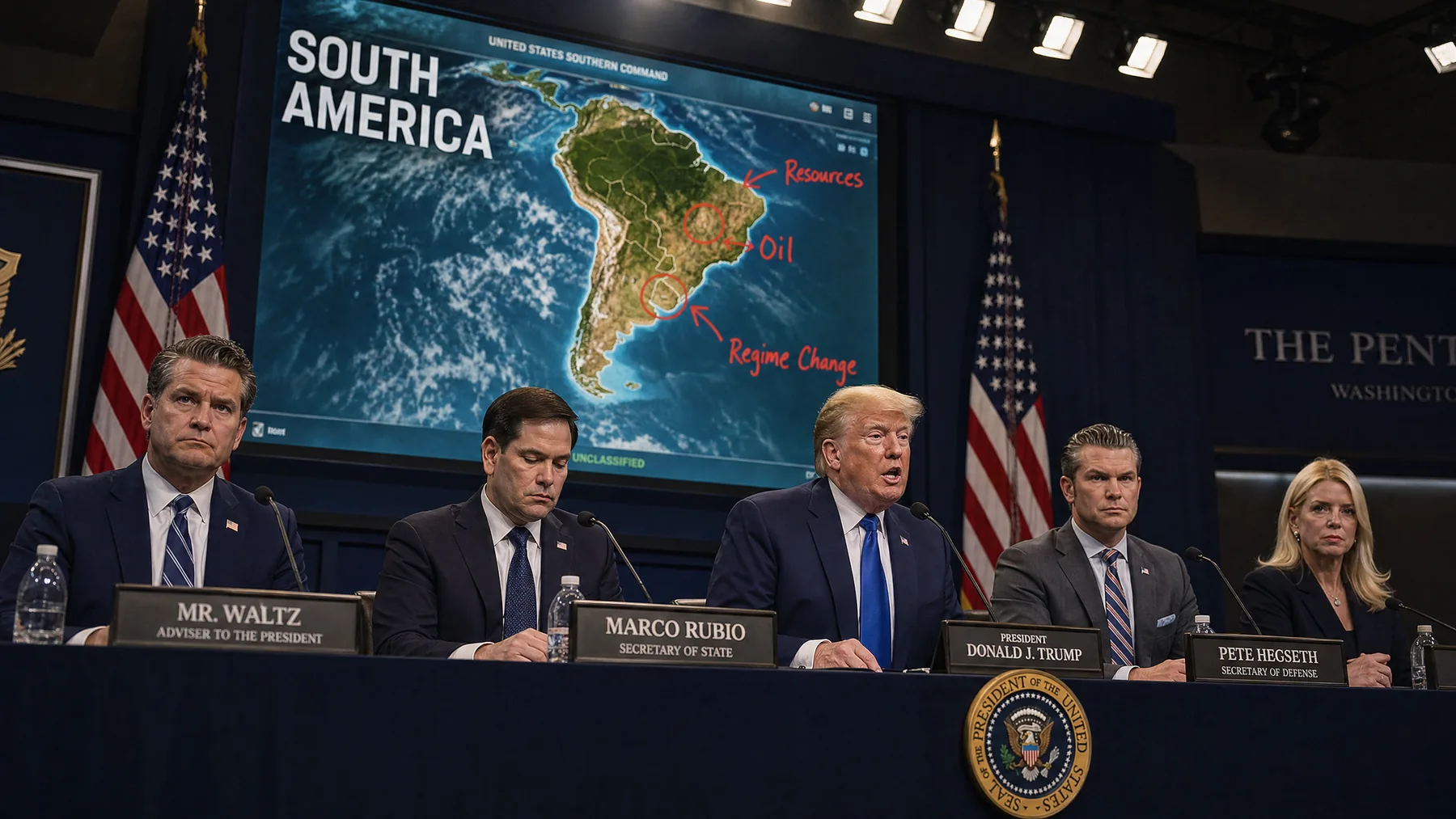
Secretary of State Marco Rubio told the Senate this week that he could not rule out further military intervention in Venezuela. The Pentagon has already sunk at least five boats in the Caribbean and Pacific in operations related to the Venezuela situation, killing at least eight people. The US State Department is urging Americans to leave Venezuela immediately.
This is, to put it mildly, significant. And it is receiving a fraction of the coverage that the situation warrants.
What Is Actually Happening
The Maduro government in Venezuela has been slowly losing control for years. The country's economic collapse — the most dramatic peacetime economic contraction in modern Latin American history, with GDP falling by roughly two-thirds between 2014 and 2021 — has hollowed out the state's capacity to function and its legitimacy to govern.
What has sustained Maduro is the loyalty of the military, the support of Cuba, and the backing of Russia and China, who have financial and geopolitical interests in a non-aligned Venezuela that resists US influence.
The Trump administration's posture toward Venezuela is significantly more aggressive than its predecessors. The ideology is partly anti-socialist, partly energy-focused — Venezuela sits atop the world's largest proven oil reserves, currently being extracted at a fraction of their potential by a government that has systematically destroyed the oil industry — and partly about Florida politics, where Venezuelan exiles are a significant voting bloc.
The combination of these pressures has brought the situation to an inflection point.
Why Latin America Matters More Than Europeans Think
My clients are mostly European. Latin America features in their thinking primarily as a source of territorial tax opportunities — Paraguay, Panama, Uruguay, the Dominican Republic — or occasionally as a market for specific industries.
What is happening in Venezuela should expand that frame.
Latin America as a whole is in significant political flux. Argentina under Milei is conducting the most dramatic economic restructuring experiment in the world, with results that are being watched by economic liberals everywhere. Brazil under Lula has returned to a left-populist model that is straining its fiscal position. Colombia and Mexico are navigating left-wing governments with complicated relationships to rule of law. And now Venezuela is approaching a potential transition that could, if managed well, unlock one of the world's largest hydrocarbon reserves and create significant investment opportunities.
The region is not stable. But instability and opportunity are often the same thing, viewed from different angles.
The Paraguay Context
For clients who have established or are considering establishing a base in Paraguay, the Venezuelan situation is relevant context. Paraguay shares the Mercosur trading bloc with Argentina and Brazil, and its political and economic environment is shaped by what happens in its larger neighbours.
The Venezuelan situation, if it results in a transition to a more market-oriented government, could also produce a significant flow of Venezuelan professionals and capital into other Latin American countries — some of whom would find Paraguay's territorial tax regime and low regulatory burden attractive.
I am not predicting an imminent Venezuelan democratic transition. I am noting that the probability of change is higher now than at any point since 2002, and that the downstream effects of such a change would ripple through the region in ways that are worth thinking about in advance.
Work with Sebastian
If Latin America is part of your jurisdictional thinking — as a base, an investment market, or a source of planning opportunities — let's make sure your picture of the region is current. The situation is moving quickly. Book a consultation.