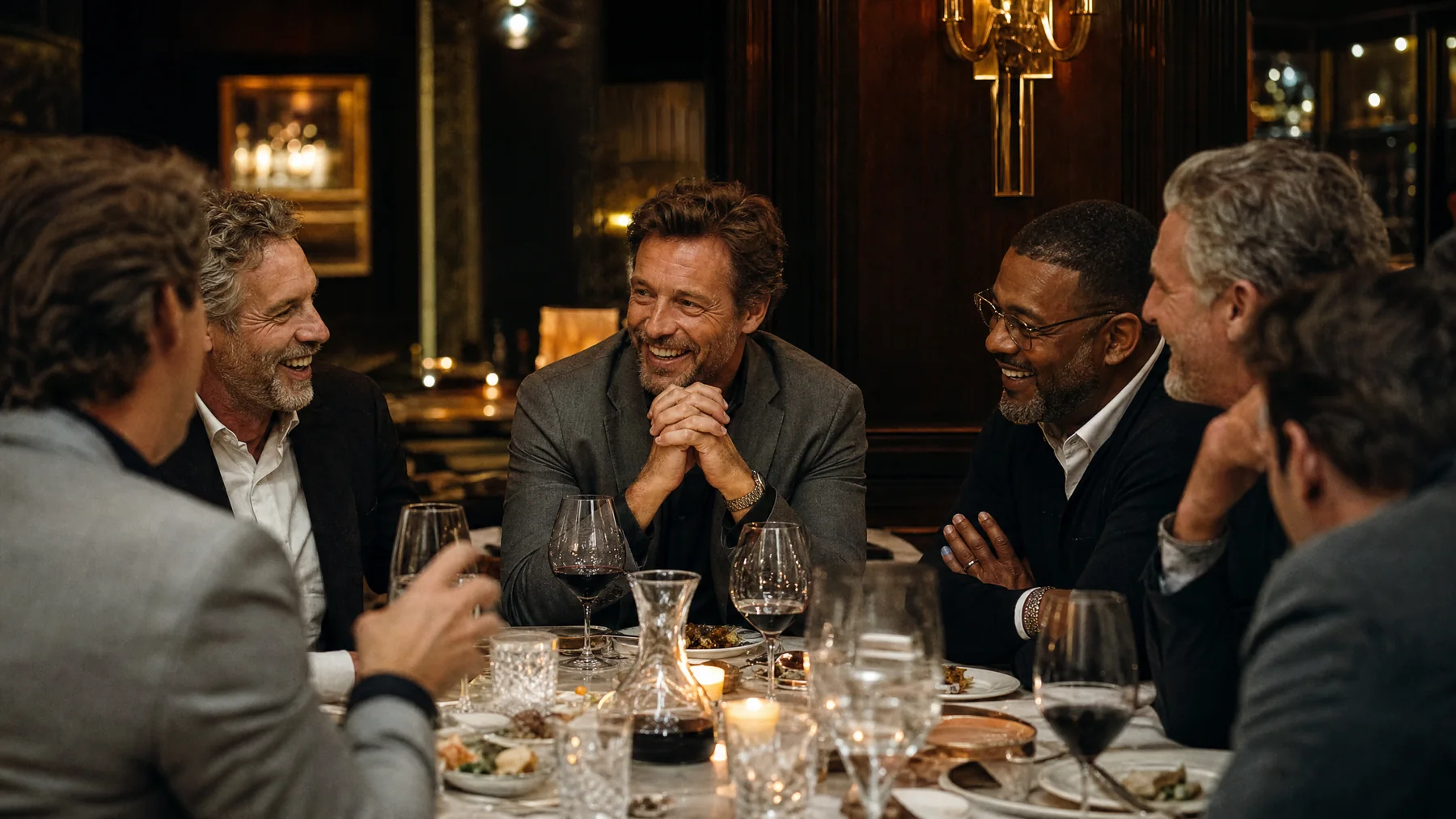
I have just returned from Tallinn. Five days — my brothers, a brother-in-law, and some of their grown-up sons. The annual boys trip that I have come to value more each year, partly because it becomes harder to arrange as everyone's lives grow more complicated, and partly because the particular quality of time spent with men you have known your whole life is irreplaceable.
We also did a day trip to Helsinki by ferry. Two capitals in one week. Neither of which I had visited before.
Tallinn
Tallinn's Old Town is the best-preserved medieval city centre in northern Europe. That is not marketing copy — it is simply accurate. Walking through the old town is like stepping into the fourteenth century in a way that is impossible in London, or even in Prague, which has been so thoroughly adapted to mass tourism that the medieval surface feels like a stage set.
In Tallinn it does not feel like a stage set. The buildings are genuinely old. The streets genuinely narrow. The city genuinely small enough that you can walk its historic core in an hour and feel that you have understood its shape.
We had dinner on the first night at Restaurant 180 — a fine dining restaurant run by a German chef, which tells you something about the particular German-Baltic cultural connection that runs through this part of the world like a thread through time. The food was exceptional. The wine list thoughtful. The service the kind that has been trained to disappear.
I ate well and talked a great deal and was entirely happy.
Helsinki
The day trip to Helsinki by ferry — two and a half hours across the Gulf of Finland — gave us a different city entirely. Where Tallinn is intimate and medieval, Helsinki is grand and rationalist: the Finnish National Museum, the Cathedral, the Market Square, the particular quality of Finnish design that has been influencing the rest of the world for a century without most of the world noticing where its clean lines and functional beauty came from.
What struck me about Finland is the combination of prosperity and modesty. Finland is one of the richest countries in the world by almost any measure. It is also one of the least ostentatious. The wealth does not announce itself. The streets are clean. The public spaces are generous. The infrastructure simply works, without comment or drama.
I thought about this in relation to Germany, where I grew up. Finland has a fraction of Germany's population and a fraction of its industrial base, and it has produced a public sphere that, in certain important ways, functions better.
What Tallinn Made Me Feel
I felt close to the place. Closer than I expected.
Part of it is the German connection, which goes back a thousand years. The Baltic Germans — the Teutonic Knights, the merchants of the Hanseatic League, the Deutsch-Balts who dominated the social, economic, and cultural life of Estonia and Latvia for seven centuries — left a mark on Tallinn that is still visible in the architecture, the street names, and the particular quality of the civic culture.
Walking through the old town, I was walking through a city that Germans built and administered for hundreds of years. There is something in the layout — the rationalism of the street grid, the ambition of the merchant houses, the insistence on stone over wood — that feels familiar in a way that has nothing to do with language and everything to do with culture.
My family are German. My formation is German. However many decades I have lived in Britain and America, that formation runs deeper than any passport. Standing in Tallinn, I felt it.
What Would Be Lost
Estonia is the eastern frontier of the European world — literally. It shares a 294-kilometre border with Russia. It was occupied by the Soviet Union for fifty years. It regained independence in 1991 and has spent the thirty-five years since building one of the most digitally advanced, educationally excellent, and economically dynamic small states on earth.
What would be lost if Estonia were overrun by Russia again — as it was in 1940, as it has been in various forms throughout its history — is not primarily a geopolitical abstraction. It is this: the old town in Tallinn. The Restaurant 180. The ferry to Helsinki. The particular civilisation that has been built, painstakingly, on the eastern edge of Europe, and that Russia has demonstrated repeatedly it is willing to destroy.
Estonia spends 3.2% of its GDP on defence. It has universal military service. It has pre-positioned NATO reinforcements. It takes the threat seriously in a way that Germany, which shares Estonia's history lesson by proxy, took decades to begin to acknowledge.
I felt close to Tallinn because I recognise what it is. A place that knows the cost of freedom because it has paid it, and that is determined not to pay it again.
I will go back.
Work with Sebastian
If the Baltic states — Estonia, Latvia, Lithuania — are part of your thinking as a base, investment destination, or European headquarters, let's talk. These are underappreciated jurisdictions with genuinely interesting characteristics for the right profile. Book a consultation.