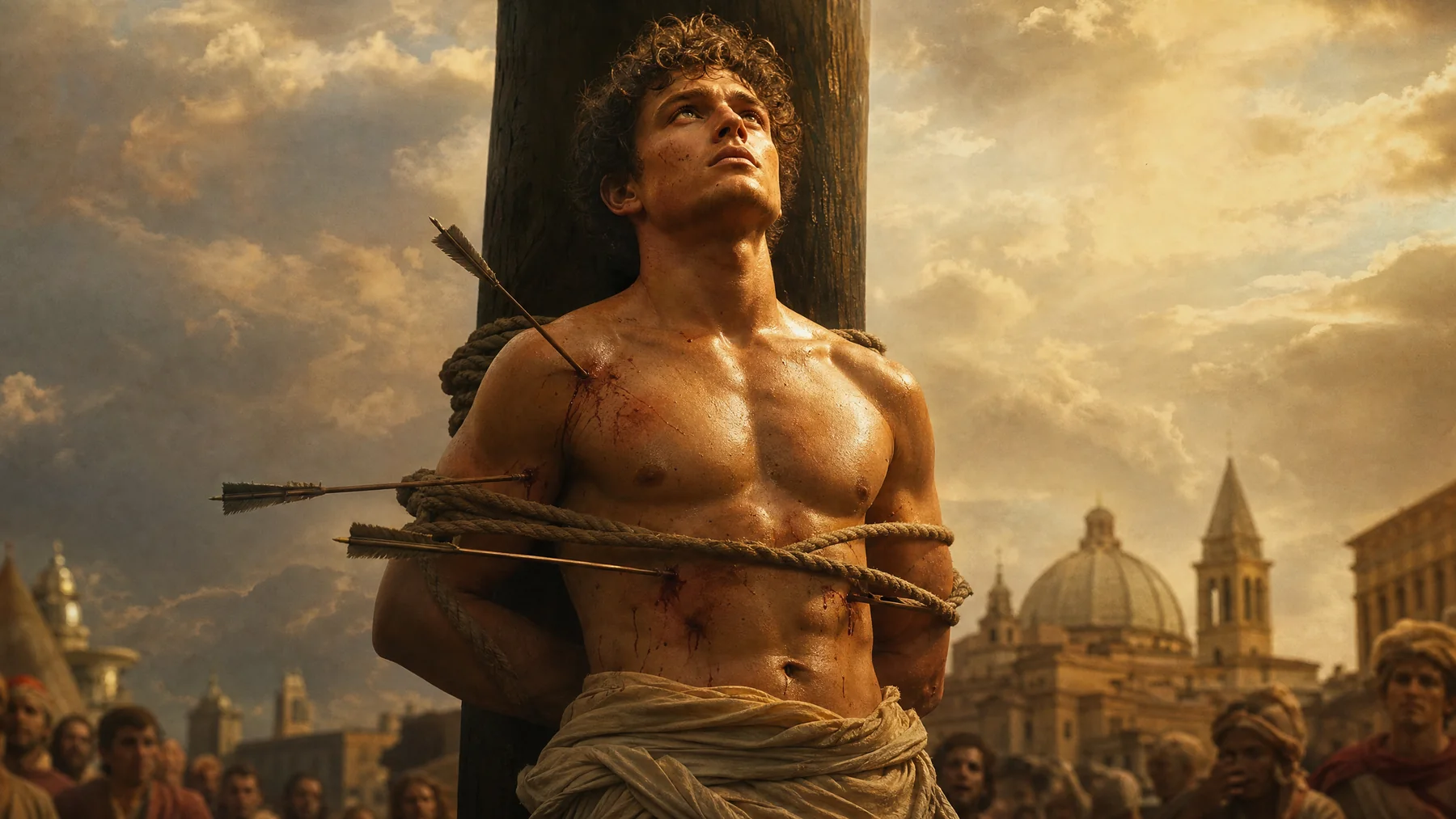
Today is January 20. The feast of Saint Sebastian. My feast day.
Saint Sebastian was a Roman soldier, a captain of the Praetorian Guard under Emperor Diocletian, who was discovered to be a Christian, condemned to death by arrow, left for dead, nursed back to health by a pious widow named Irene — and then, instead of fleeing, walked back to the Emperor and denounced him for his cruelty to Christians. At which point he was beaten to death with clubs and his body thrown into a sewer.
He was, by any reasonable measure, a man who refused to take the easy way out. Twice.
I have had this feast day my whole life. I have thought about it more the older I get. And today I want to write something for young men — something Sebastian himself, I think, would recognise.
Who Sebastian Was
He was young. He was physically capable — he is the patron of athletes and soldiers, depicted by Mantegna, Botticelli, El Greco, and Rubens as a figure of almost impossible beauty, arrows piercing a body that refused to fall. He had status. He had access. He operated at the highest levels of Roman imperial power.
He used all of that — not for himself, but in service of something he believed was worth more than his career, his comfort, or his life.
He joined the Roman army as a Christian specifically so that he could reach and help Christians who were being persecuted. He used his position to convert soldiers, nobles, the governor of Rome himself. He operated for years under cover, not out of cowardice but out of tactical intelligence — he could do more good alive and trusted than exposed and dead.
And when the moment came — when there was no longer any tactical advantage to concealment, when the Emperor had him tied to a post and filled with arrows — he did not recant. He did not bargain. He looked at the archers who were about to kill him and remained exactly who he was.
He survived. And then — and this is the part I find most extraordinary — he went back.
Not to flee. Not to regroup. Back to the Emperor. Back to the man who had tried to kill him. To tell him, to his face, that he was wrong.
That is not the behaviour of someone who is performing courage. That is the behaviour of someone who has genuinely made peace with the worst that can happen to them, and who has therefore become completely free.
What This Has to Do With Young Men Today
The crisis of young men in the Western world is real and it is serious. I have written about it before. The statistics on male loneliness, on male suicide, on the collapse of male friendship, on young men checking out of education, work, and civic life — these are not fabricated by culture warriors. They are real.
But I think most of the commentary on this crisis misses the deeper problem.
The deeper problem is not that young men have been told they are bad. It is that they have not been given anything worth being good for.
Sebastian did not become who he was because someone told him masculinity was valuable and he should feel better about himself. He became who he was because he believed in something specific — in Christ, in the people he was protecting, in a vision of the good that was clear and concrete enough to die for. The belief gave the courage its direction. Without the belief, courage is just recklessness.
The young men I know who are thriving — and there are many of them, despite the statistics — are not thriving because they have been validated. They are thriving because they have found something worth serving. A business they believe in. A family they are building. A faith they have actually made their own. A craft they are genuinely trying to master.
The antidote to the male crisis is not affirmation. It is purpose. And purpose requires an object worthy of it.
What I Take From My Patron
I am not Saint Sebastian. I do not pretend to his virtue or his courage. I have spent most of my life not in a Roman prison camp but in boardrooms, tax offices, and podcast studios — which have their own challenges, but are not quite the same.
But I take from him this: the man who knows what he believes, and why, and who he is responsible for, is the man who cannot be permanently broken. He can be knocked down — Sebastian was knocked down as literally as a man can be knocked down and survive. But he gets back up. And he goes back.
I have been knocked down. The ranch in Texas. The marriage. My father's death. Things I will not write about because they are not yet mine to share publicly.
I got back up. I went back. That is the only thing I know how to do.
On the feast of my patron, that feels like enough.
If you are at a point in your life where the structures you have built need to be rebuilt, or where you are thinking seriously about what comes next, that is a conversation I am always willing to have. Book a consultation.