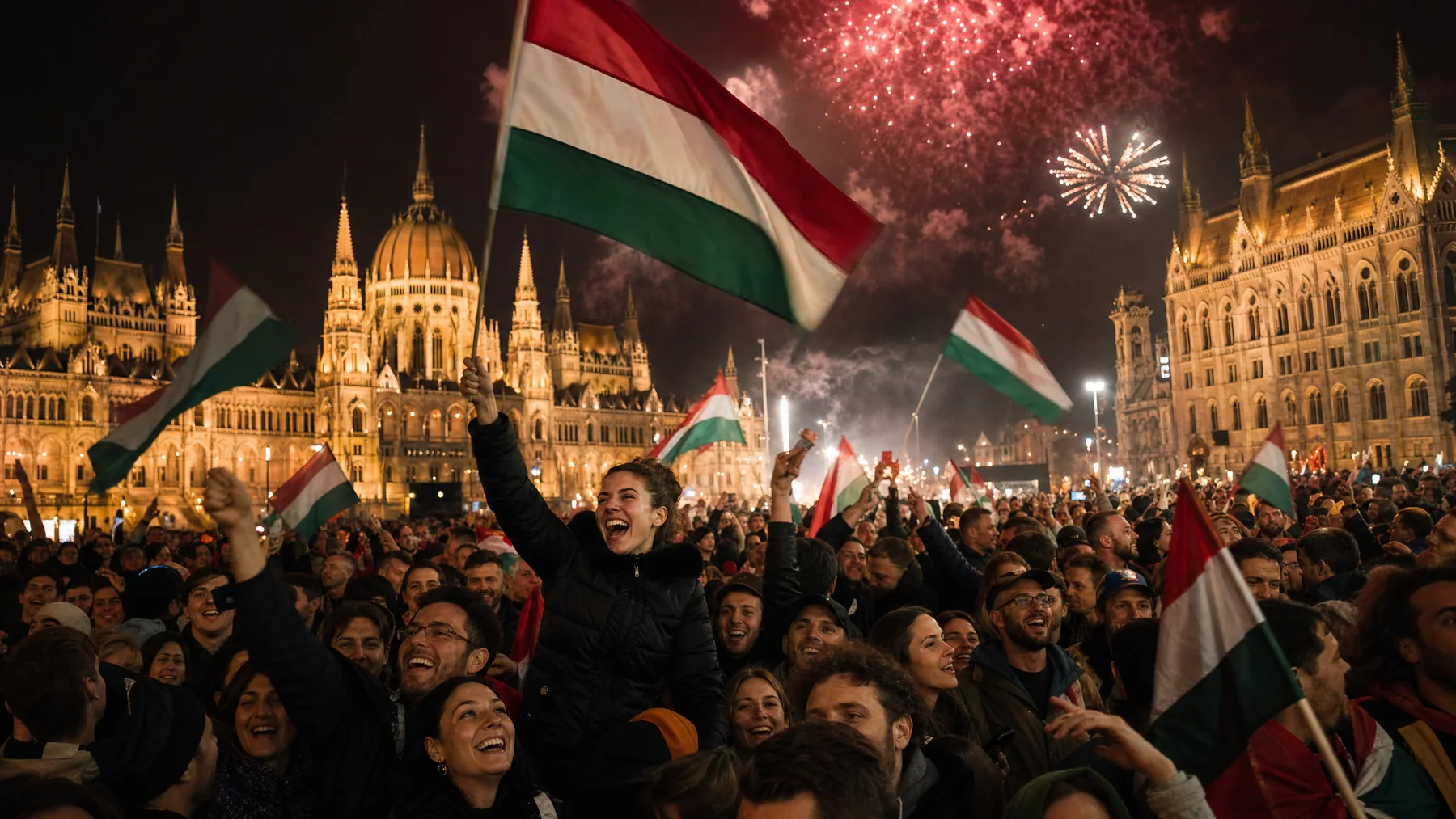
Viktor Orbán lost the Hungarian parliamentary election on April 19 in a landslide to Péter Magyar's Tisza Party, ending sixteen years of Fidesz rule. I am writing this from London, back from Crete, and the news has not fully settled in my mind yet.
Sixteen years. Orbán has been the dominant fact of Hungarian politics since 2010. He was the face of the illiberal right in Europe — the man who proved it was possible to win repeated democratic elections while systematically undermining democratic institutions, who bent the judiciary, controlled the media, gerrymandered the electoral map, and built a model of nationalist populism that governments from Poland to Italy looked to as a template.
And he lost. Badly.
What Actually Happened
Magyar is a former Fidesz insider — his ex-wife served as a government minister. His movement, Tisza, grew from virtually nothing to an electoral majority in roughly two years. The speed is extraordinary and reflects a particular dynamic that I think is underappreciated in Western commentary about Hungary.
The Hungarian public did not turn against Orbán because they became liberal. They turned against him because after sixteen years, the corruption had become impossible to ignore. The wealth flowing to Orbán allies, the Stasi-like surveillance of critics, the managed decline of public services while a connected elite prospered — these things accumulate. Even in a system that has been deliberately designed to insulate the incumbent from democratic challenge, the weight of reality eventually breaks through.
Magyar offered not ideology but accountability. Not left-wing alternative but the promise that the rules would be applied equally. That is a different and in some ways more powerful pitch than ideological opposition.
What This Means for Europe
I want to be careful here, because the temptation to over-interpret a single election result is always high.
Orbán's defeat does not mean that the illiberal right in Europe is finished. Poland's PiS lost and Law and Justice remains a potent political force. The AfD in Germany continues to poll strongly. Marine Le Pen remains the dominant figure in French politics. The phenomenon that Orbán represented — nationalist populism as a response to elite disconnection from ordinary voters — has not been resolved by his defeat.
But it does mean something. It means that the Orbán model, which depended on permanent incumbency and the systematic removal of democratic checks, can still be overcome by sufficient democratic mobilisation. That the tools of democratic backsliding are not irreversible. That accountability, when it is finally demanded clearly enough, can still win.
For those who believe in genuine constitutional democracy — not the managed democracy that Fidesz built, but the real thing — Hungary in April 2026 is a reason for cautious optimism.
The Practical Implication for My Clients
Hungary has been an interesting jurisdiction on the margins of my recommendations — low flat tax, EU membership, cheap property. I have consistently counselled caution about concentrating significant assets there under Orbán, precisely because a system designed to benefit political insiders can punish outsiders without warning or recourse.
A Magyar government will not immediately transform Hungary's institutional quality. But if the transition holds, and if the new government delivers on genuine rule of law reform, Hungary's trajectory could improve. Watch this space.
If Central and Eastern European jurisdictions are part of your planning and you want an updated assessment of what Hungary, Poland, or other post-communist states now offer, let's talk. The landscape is shifting. Book a consultation.