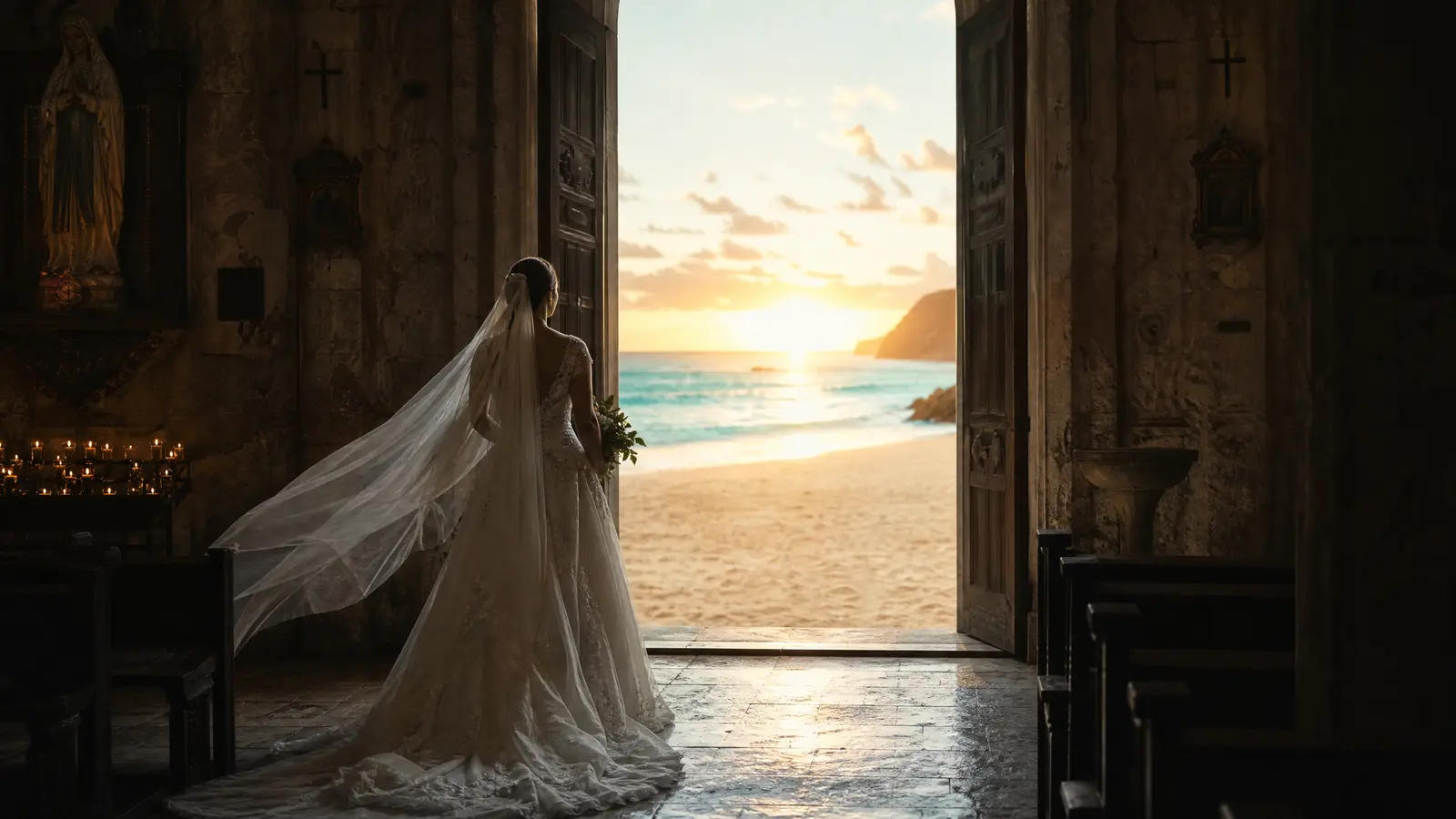
There is a bride, somewhere tonight, scrolling through photographs of white sand and rope-strung fairy lights, and she is furious.
She has found the venue. She has found the dress. She has found the man, and he loves her, and she loves him, and there is nothing standing between them and forever except one immovable, unglamorous, two-thousand-year-old institution that will not let her say her vows anywhere but inside a building she thinks is dim, cold, and frankly a little bit pokey.
The Catholic Church does not do beaches. She does not do vineyards, barns, cliff edges, or ballrooms with a view. She asks, gently but without apology, for her altar. And to a non-Catholic bride raised on Pinterest boards and destination-wedding fantasies, this can feel less like tradition and more like a slap.
This is the story of why the Church holds that line, what it costs the couples caught in it, and what it actually means, underneath all the frustration, to marry not on your own terms, but on God's.
The Ancient Argument the Church Refuses to Lose
To understand why a bride in Edinburgh or Cape Town or Chicago cannot simply say her vows where the sun sets prettiest, you have to go back centuries, to a Church terrified of secret marriages, disputed vows, and men who promised forever in private and vanished by morning. Out of that chaos came something called canonical form: the requirement that a Catholic's marriage, to be recognized as valid by the Church, be witnessed by an authorized priest or deacon, in front of two witnesses, following the Church's own rite. It is written into canon 1108 of the Code of Canon Law, unmoved by six decades of changing wedding aesthetics.
This is not bureaucracy for its own sake. It is the Church saying, with the stubbornness of a mother who has buried too many broken promises, that marriage is not a private arrangement between two feelings. It is a public, binding, sacramental act, and she will not let it happen in the shadows, or on a sandbar, where no one but the tide can testify to what was said.
To the modern bride, this can look like control. To the Church, it is memory. She has watched what happens when marriage is treated as decoration. She built the wall on purpose.
When Love Crosses the Aisle
Add a second faith to the equation and the tension sharpens. A Catholic and a Protestant fall in love, and suddenly there are two families, two traditions, two sets of expectations about what a wedding should even be. The Church calls this a mixed marriage, and she has thought about it far more carefully than most brides expect.
She does not forbid it. She has never forbidden it. What she asks is that it be handled honestly and formally, not improvised around. Under canon 1124, a Catholic needs permission from their bishop to marry a baptized non-Catholic, and the Catholic party makes a quiet promise: to stay faithful to the faith, and to do what they can to raise any children Catholic. It is not a threat. It is a boundary, drawn by an institution that has learned, the hard way, what happens when nobody draws one.
The Exit the Church Actually Offers, and Rarely Advertises
Here is what most frustrated brides are never told, often because nobody in the wedding-industrial complex has any incentive to tell them: the Church has a door.
It is called a dispensation from canonical form, and it exists precisely for situations like this one, where a full Catholic ceremony creates what canon law calls "grave difficulties." A mixed-faith family. A church too small, too far, too formal for the day the couple actually wants. A Protestant family who would never set foot in a Catholic sanctuary. As one detailed breakdown of the process explains, local bishops have real discretion to grant this dispensation when the obstacles are genuine, allowing the couple to marry in a civil ceremony, or in the non-Catholic partner's own church, and still have that marriage fully recognized, blessed, and bound by the Church.
This is not the Church surrendering. It is the Church choosing flexibility over rupture, provided the couple asks, honestly and in advance, rather than simply doing what they wanted and hoping no one checks. The one thing she will never permit is a second bite at the apple: a civil wedding followed, months later, by a full Catholic ceremony repeating the vows. Canon law is explicit that the marriage rite happens once, and once only, as one pastoral commentary on the form puts it, because to the Church a wedding is not a performance to be staged twice for different audiences. It is a single, unrepeatable act of consent.
So the choice, in practice, is rarely "civil now, Catholic later." It is dispensation, granted in advance, or the small, quiet Catholic ceremony first, with witnesses only, followed by the big beautiful celebration whenever and wherever the couple actually wants it.
What This Costs the Bride Who Never Asked for Any of This
None of this makes the frustration less real. If you were not raised Catholic, if this is not your Church, your saints, your incense, your childhood, then being told your wedding day must happen inside someone else's tradition can feel like grief wearing the mask of bureaucracy. You did not sign up for this. You fell in love with a person, not an institution, and now the institution has an opinion about your flowers, your venue, your very definition of the word wedding.
That anger is not irrational. It deserves to be named, not managed away with a leaflet from the parish office.
But there is a harder truth sitting quietly underneath it, and it is this: every marriage asks you to submit to something larger than your own preferences, long before the wedding day arrives. Marriage itself is not built on getting your way. It is built on the daily, unglamorous discipline of choosing someone, and something, beyond your own immediate wants. The Church's insistence on her altar is, in a strange way, a preview of exactly that lesson, delivered eighteen months too early and far less gently than anyone would like.
What the Catholic Spouse Can Actually Do
If you are the Catholic in this pairing, watching your beloved rage quietly at a canon law printout, you are not powerless. You are, in fact, the only person who can soften this.
Go to the parish early, not two months before the date but a year, and ask directly about dispensation. Priests are far more pastoral than the paperwork suggests, and most have walked a hundred couples through exactly this. Bring your fiancé with you, not as a formality but as a signal: this is not the Catholic party's private negotiation with the Church, it is a shared decision.
Separate the ceremony from the celebration in your own mind, and help your partner do the same. The vows can be small, sacred, and brief. The party, the dress, the beach photographs at golden hour, none of that has to happen inside the church walls at all. Many couples do the canonical ceremony with immediate family only, then throw the wedding everyone actually dreamed of the same evening or the following day.
And name what the Church is actually protecting, out loud, to your partner, even if it does not make the disappointment vanish. She is not trying to ruin a wedding. She is trying to guard something she believes is too important to leave to a sunset and a hashtag.
Not on Your Terms, but Something Truer
There is a phrase that echoes through every conversation with a priest about mixed marriages, spoken more in kindness than in rebuke: not on your terms, but God's. It sounds, at first, like exactly the kind of line that turns a frustrated bride further away from the faith rather than toward it.
But sit with it a little longer and it starts to sound like something else. Every marriage that lasts is eventually built on that same sentence, whether a church ever enters the story or not. Not on your terms alone. Not on his terms alone. On something both of you chose to kneel before, long before either of you knew what the marriage would actually cost.
The Church simply asks you to learn that lesson one day earlier than you planned, at the altar instead of at year seven. It is not the wedding you pictured. It might, in the end, be the truer rehearsal for the marriage you are about to live.