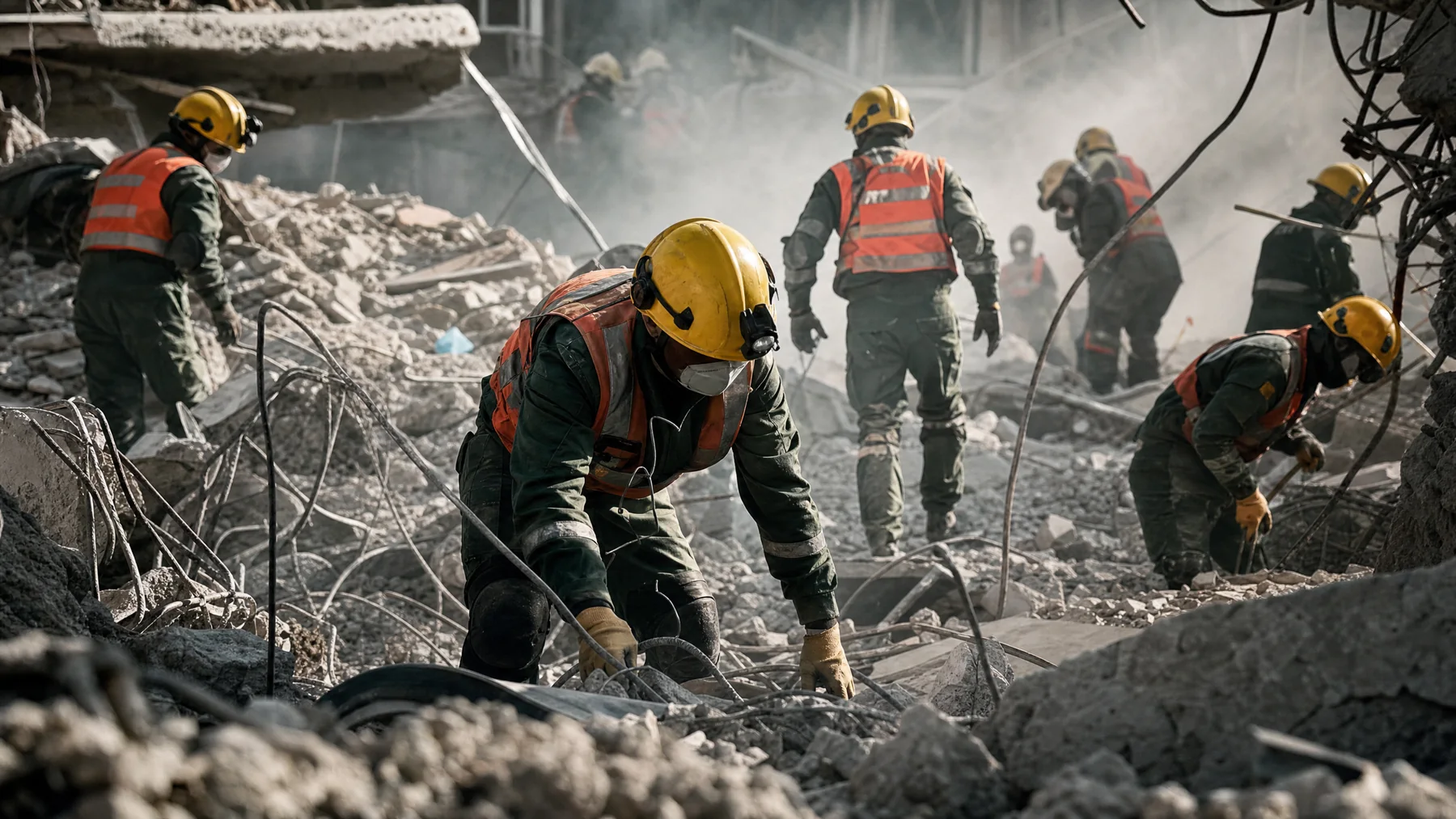
A devastating earthquake struck Myanmar in early March, killing thousands and destroying infrastructure across a country already devastated by four years of military junta rule and civil war. The Trump administration provided small amounts of disaster relief. The junta, which controls the formal state apparatus, has been accused of impeding aid access to opposition-controlled areas.
Natural disaster on top of political catastrophe. Myanmar is, by any measure, one of the worst humanitarian situations in the world right now, and it is receiving a fraction of the media attention it deserves because the Iran war is consuming all available oxygen.
I want to write about Myanmar. And about a question that nobody asks after a disaster.
The Question Nobody Asks
After every major natural disaster — earthquake, tsunami, hurricane — the coverage follows a predictable pattern. The immediate casualty figures. The rescue operations. The stories of survival and loss. The international aid pledges.
What rarely gets discussed is this: why do some places suffer catastrophically from natural events that other places survive with manageable damage?
The 2010 Haiti earthquake killed 230,000 people. A similarly sized earthquake in Chile two months later killed around 500. Same seismic event, roughly. Radically different outcomes.
The difference was not geological. It was institutional. Building codes, enforced or not. Construction quality, regulated or not. Emergency response infrastructure, funded or not. Urban planning, competent or corrupt. The quality of a country's institutions determined the death toll more than the magnitude of the earthquake.
Myanmar's catastrophic losses are not simply natural. They are the accumulated product of decades of misgovernance, military rule, corruption, and institutional hollowing — all of which were present before the first tremor.
What This Has to Do With Everything Else I Write About
I write about the relationship between institutions and human freedom. I write about why the quality of the state you live in matters — not just for your tax bill, but for the fundamental conditions of your security, your family's wellbeing, and your capacity to build anything lasting.
Myanmar is the extreme version of what happens when institutions fail completely. The earthquake did not create the catastrophe. It revealed a catastrophe that was already there.
The lesson I take from Myanmar — and from Haiti, and from every country where natural events become human disasters — is that the quality of your institutional environment is not a background condition. It is the single most important determinant of whether your life and your assets are genuinely secure.
This is why I consistently argue for multi-jurisdictional structures, for not concentrating your entire life in a single state whose institutional quality might deteriorate. Not because I expect every Western country to become Myanmar. But because institutional quality is not static, and the cost of being wrong about it is very high.
A Word on Aid
The Trump administration's reduction in global humanitarian aid — part of the USAID dismantling — is being felt acutely in Myanmar, where American-funded programmes were a significant component of the aid architecture.
I have complex views on foreign aid. Much of it has been ineffective or actively harmful. The critique that it creates dependency is not wrong.
But in the context of acute disaster — an earthquake that has flattened hospitals and blocked roads — the argument against emergency humanitarian assistance is harder to make. The people under the rubble in Myanmar are not the junta. They are ordinary civilians who had no say in the political decisions that created their circumstances.
Prudence about long-term development aid and generosity in acute disaster are not in tension. They can be held simultaneously.
If the relationship between institutional quality and genuine security is part of your thinking about where to base your life and your assets, that is one of the most important conversations you can have. Let's have it. Book a consultation.