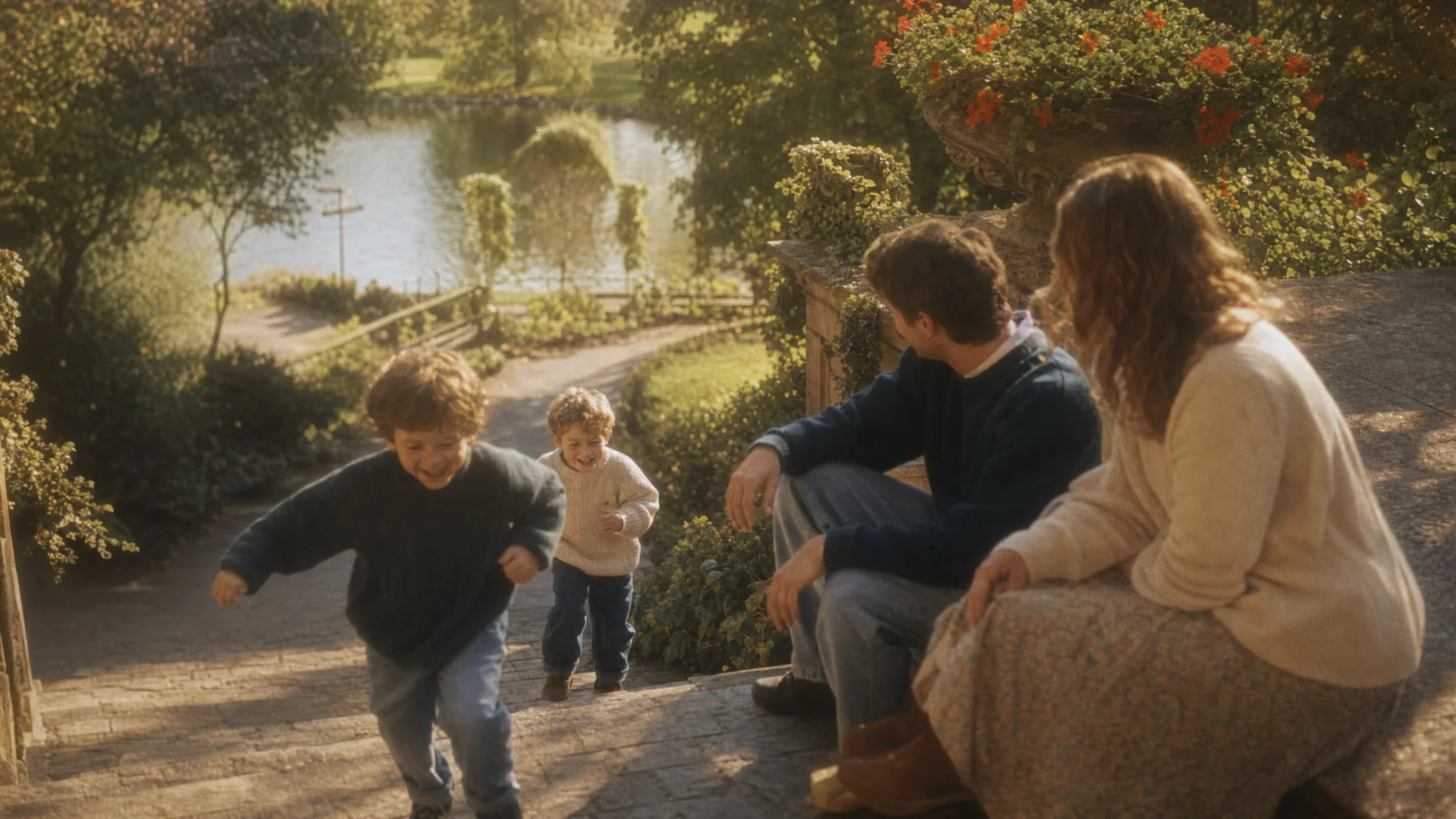
My son Kilian was born on January 28, 1998. He was my second child. I was twenty years old.
Twenty years old. I was barely a man myself — ambitious, restless, already convinced that the world was larger than Freiburg and that I was going to find out how large. And into this life arrived a second son, small and healthy and entirely dependent on a father who was still figuring out what kind of man he intended to be.
I want to write about the early years. The good years. The years I carry with me.
Zurich
When Kilian was small, we were in Zurich. Switzerland in those years was a revelation to a young man from Freiburg — clean, ordered, prosperous, a country that seemed to have solved certain problems that Germany had merely argued about for decades. I was building my career, learning IT, meeting people who would change the trajectory of everything.
Kilian and his brother grew up between languages. German at home, Swiss-German on the streets, English beginning to emerge from television and music and the particular bilingual chaos of a family in motion. Children absorb these things effortlessly. I watched it happen and was amazed.
There was a Saturday in Zurich — I cannot tell you the year precisely, but Kilian was maybe three or four — when we drove up into the mountains above the city. The lake below us, the Alps visible on every side, the air so clear it seemed to amplify everything. The boys ran on the grass above the treeline. I remember thinking: this is what a good life looks like. Hold onto it.
London
London came next. I had taken a job in the City, sent my CV to a London agency on what felt like an impulse, received an offer the same day, kissed my family goodbye, and flew on a Monday morning. Within months they had followed. We lived in a house in a part of London that has since become expensive and fashionable but was then simply a neighbourhood, which suited us perfectly.
London in those years was a city in full flower — the Blair era, the creative industries, the sense that Britain was finally comfortable with itself in a way it had not been for decades. The boys went to school there. Kilian discovered football with the conviction of someone who has found his religion. He was good at it — quick, technically capable, with the spatial intelligence that the game requires.
I remember taking him to matches. Standing on the terraces in the cold. The particular social warmth of an English football crowd, the humour and the passion and the theatrical self-pity when things went wrong. He loved it. I loved watching him love it.
Those Saturday afternoons are among the best memories I have of that time.
America
America was the biggest leap. Miami first, then the slow gravitational pull of Texas that I could not resist. For a boy who had grown up on Karl May's stories of the American West, arriving in Texas was like stepping into the mythology that had formed me.
The ranch in Bastrop — the Vaquera Ranch, red barn, big pond, horses, wide open land — was, for a brief time, an extraordinary place to be a child. The older children had space in a way that European children rarely do. Space to run, to work, to be genuinely useful in the daily life of a working property.
Kilian was a teenager by then, and teenagers are complicated even in paradise. But I remember him on horseback. I remember him helping with the horses, learning the rhythms of the ranch, growing into something that looked like competence and pride.
What I Want to Say
I became a father too young to fully understand what fatherhood required. I was building — always building — businesses, relationships, a vision of a life that kept expanding. The building sometimes consumed attention that should have gone elsewhere. This is not a confession of dramatic failure. It is the ordinary accounting of a young father who had too much ambition and not enough of the patience that children specifically require.
The adventures were real. Zurich, London, Texas — these were not small things to give a child. They were an education in the world's scale and its possibilities. I do not regret any of them.
But I know that movement has costs as well as gifts. Roots as well as routes. And the cost of constant motion is sometimes paid by the people who had no say in the decision.
Kilian is 28 today. He is navigating his own life, in his own way, with the particular difficulty of someone who has to make sense of an unusual childhood. I am proud of him for still standing. For still trying. For the resilience that is, I think, genuinely his own.
Happy birthday, son. Your father loves you. He has always loved you. He was just sometimes a long way from home.
Work with Sebastian
Nothing to sell today. Book a consultation in your own time.