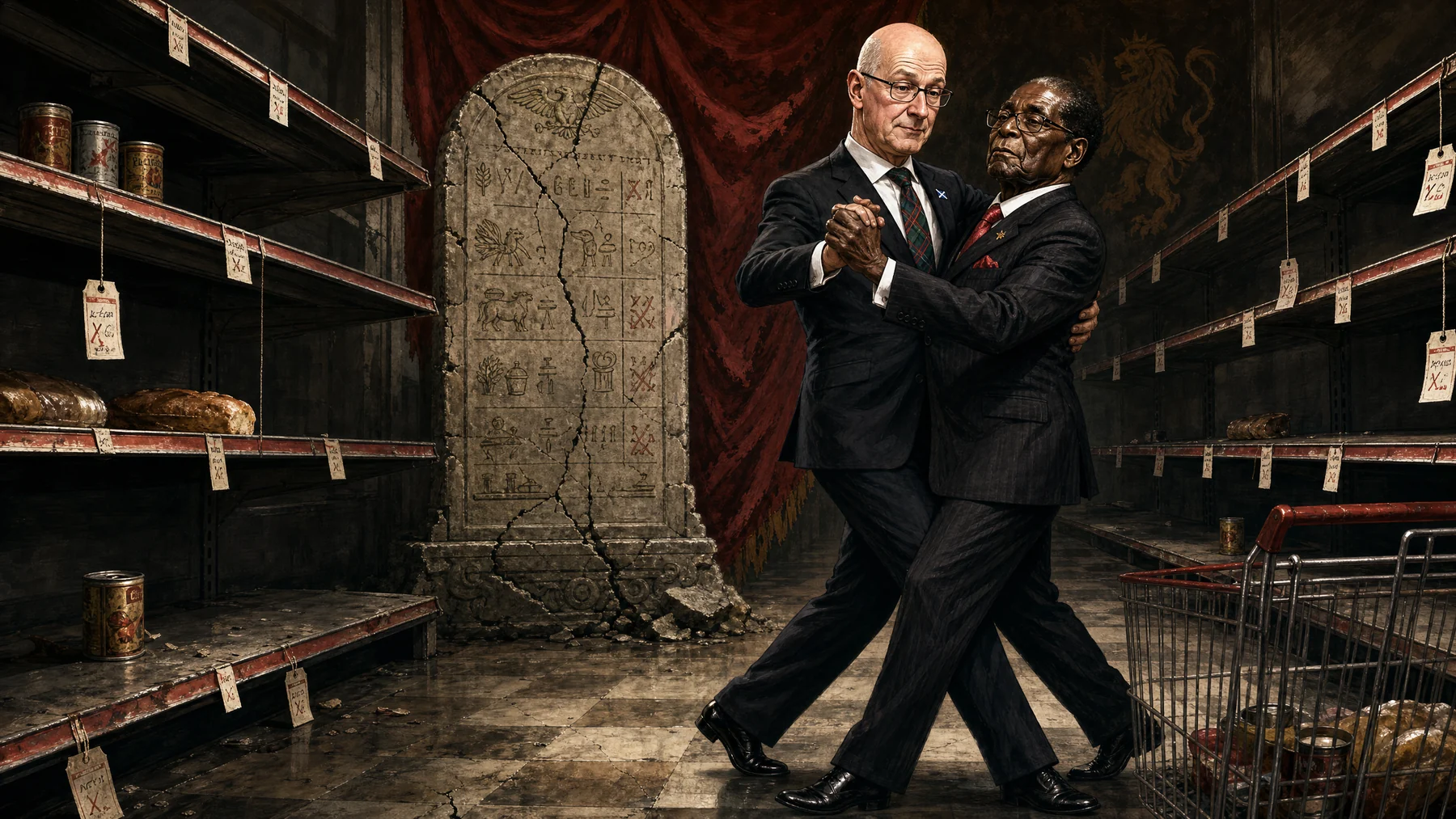
How the SNP just promised Scotland the economic policy of Roman Emperors, African dictators and Latin American caudillos, and what a competent government would actually do instead.
On 7 May, the Scottish National Party clung on to power. They lost six seats. They fell seven short of a majority. They limped over the line propped up by the Greens. And within hours of the result, John Swinney was on the BBC promising legislation to cap the price of “essential” supermarket goods within the first 100 days of the new parliament.
A man with no majority, no economic credibility and no functioning policy levers had reached for the one piece of populist quackery that economists have been laughing at for seventeen centuries.
Let me walk you through the company Swinney has chosen to keep.
Diocletian, 301 AD
In 301 AD the Emperor Diocletian had a problem. The denarius was being debased. Soldiers were being paid in increasingly worthless coin. Merchants, sensibly, were charging more to compensate. Diocletian, predictably, blamed the merchants.
He carved his solution into stone tablets across the empire: the Edictum De Pretiis Rerum Venalium (source). Maximum prices for over 1,200 goods and services, from wheat to haircuts to the wages of a sewer cleaner. The penalty for charging above the cap was death.
The result? Goods vanished from the markets. Merchants traded in secret or reverted to barter. The historian Lactantius, writing within a generation, recorded that the edict caused more shortages than it solved and was abandoned within a few years after considerable bloodshed. The price of gold in denarii rose 250 per cent during the edict’s enforcement.
Diocletian’s price cap is the textbook case of policy failure in the literal sense. It has been in the economics textbooks for centuries. John Swinney has either not read them or is hoping you have not.
Robespierre, 1793
The French revolutionaries had a go in September 1793 with the Law of the Maximum. Bread became scarce. Farmers refused to bring grain to market. Hoarders were sent to the guillotine. The law was repealed in December 1794. The pattern, by then, was already ancient.
Mugabe, 2007
Fast forward to summer 2007. Zimbabwe is in the grip of hyperinflation, somewhere north of 4,500 per cent and accelerating. Robert Mugabe issues Operation Reduce Prices (source), ordering manufacturers and retailers to slash prices by half.
More than 1,000 business owners are arrested in two weeks. Mugabe threatens to seize and nationalise any business that fails to comply. Within days, shelves in Harare and Bulawayo are empty. Butchers run out of meat. Petrol queues stretch out of the cities. The Cold Storage Commission is resurrected as the only legal slaughter and distribution channel for beef.
A spokesman for the Crisis in Zimbabwe Coalition summed it up at the time: Operation Reduce Prices was “a populist strategy primarily meant to ensure that Mugabe’s government remained in power.”
Sound familiar?
Chávez and Maduro
Then we arrive at the contemporary horror show. Hugo Chávez introduced sweeping price controls on basic goods in 2003. Nicolás Maduro expanded them; by 2016, Human Rights Watch was describing severe food shortages and a deep humanitarian crisis. By 2016, an estimated 80 per cent of basic food products were unavailable at any given store at any given time.
Farmers stopped producing the items on the controlled list and switched to anything not on it. Pasteurised milk vanished from the shelves; Greek yoghurt did not. White rice vanished; basmati did not. The shelves were not empty because Venezuelans were lazy or because the CIA had sabotaged the supply chain. They were empty because you cannot order people to sell goods for less than it costs to produce them and expect them to keep producing.
Inflation became hyperinflation. The bolivar collapsed. Child stunting and malnutrition rose every year from 2014 to 2020. Around seven million Venezuelans fled the country, generating the largest refugee crisis in the recorded history of the Americas. The phenomenon became known as the “Maduro diet”.
Maduro’s response? He blamed “evil profiteers” and sent 34,000 inspectors into shopping centres to police price tags during a single Christmas campaign. He arrested supermarket executives. He nationalised the supply chain. The shelves stayed empty.
This is what price controls look like when carried through to their logical conclusion. The empty shelves are not a bug. They are the mathematical consequence of forcing people to sell for less than the cost of production.
The Pattern
You will have noticed something across these cases. Diocletian. Robespierre. Mugabe. Maduro. What do they have in common?
- A currency in trouble or actively being debased.
- Inflation caused, fundamentally, by the government itself.
- An election or political crisis demanding a visible response.
- An inability or unwillingness to fix the actual cause.
- Therefore: blame the merchants. Cap the price. Carve it in stone, decree it from the palace, or stick it in a manifesto launched in Glasgow.
The SNP fits the template with embarrassing precision. Sterling has been hammered by post-pandemic money printing. UK food inflation, by the Office for National Statistics’ own admission, is running at 3.7 per cent and rising. Energy costs have been engineered upwards by net-zero levies that the SNP has championed at every opportunity, which is why the issue belongs in the same conversation as Britain’s broader tax-and-state problem. Employer National Insurance has just been hiked. Brexit friction and Middle East instability have not helped.
Swinney did not personally cause all of this. But neither has he done a single thing to address it. So he has reached for the political opiate of the populist in trouble: declare a maximum price, blame the supermarkets, and dare anyone to oppose him in front of pensioners worried about their grocery bill.
The Scottish Retail Consortium called the policy a “potty gimmick” and a “wrongheaded 1970s gimmick”. The Institute for Fiscal Studies called it “radical and risky”. The UK Government called it “incoherent and undeliverable”. Even sympathetic constitutional experts at the University of Glasgow have warned it will face legal challenges under the Internal Market Act and probably end up in the Supreme Court before a single tin of beans is capped.
None of that matters. The point is not for the policy to work. The point is for the photograph to exist: John Swinney bagging shopping at an Asda in Edinburgh, looking concerned, telling the camera he is on your side.
What Would Actually Work
Now to the question Holyrood will not ask. If not price caps, what?
The cost of living crisis in Britain has identifiable causes. None of them are supermarket greed. UK supermarkets operate on net margins of two to four pence in every pound. You could cap their entire profit margin away and the average grocery bill would barely move.
The actual drivers are these:
Monetary debasement. The Bank of England printed roughly £450 billion of new money during the pandemic (House of Lords report). Monetary expansion of that magnitude finds its way into prices. No one at Asda voted for this, and no price cap reverses it.
Energy policy. Every step of food production, from fertiliser to refrigeration to delivery, runs on energy. The UK has chosen to make its energy among the most expensive in the developed world. That choice shows up in your trolley.
Labour costs. Rises in employer National Insurance, minimum wage and pension contributions flow straight through into the price of goods produced by labour. Which is most of them.
Regulatory drag. HFSS rules, packaging regulations, traceability requirements. All defensible in isolation. All adding pennies to every line.
Capping the retail price does nothing about any of this; it is the opposite of the monetary sanity that has made Argentina’s inflation experiment worth watching. It simply shifts the loss from the consumer to the producer or the retailer, who responds in one of three ways: shrink the range, reduce the quality, or exit the category entirely. Croatia tried this in 2023 with 30 products and had to expand the list to 100 because manufacturers were quietly withdrawing the controlled lines. France’s 2023 deal lasted long enough for a few photo opportunities and was then forgotten.
If a Scottish Government were serious about helping low-income households with food costs, it would do what the economic literature has agreed on for fifty years. It would give them money.
A direct cash transfer to households below a defined income threshold leaves the price signal intact, and anyone serious about this should start with the United Kingdom country guide before pretending Holyrood can suspend economics by press release. The producer still receives the information about what costs what to produce. The household decides how to spend the cash. Nothing vanishes from the shelves because nothing has been mispriced. Milton Friedman called this the negative income tax, and even the most rabid anti-Friedmanite has yet to come up with a model where it produces empty supermarkets.
You could go further. Raise the personal allowance so that low-paid workers keep more of what they earn. Cut employer National Insurance so that wages do not have to be marked up three times before they reach the till. Reverse the most aggressive net-zero levies on energy, which are nothing but a regressive tax on the weekly food bill of every Scottish family.
None of these would generate the photo opportunity. None would give Swinney the deeply satisfying populist gesture of being seen to stand up to “the big supermarkets”. But they would actually reduce the cost of feeding a Scottish family, which is the question the SNP is pretending to answer.
What Happens Next
The SNP knows none of this matters in the short term. They will pass the law. The supermarkets will negotiate. There will be exemptions, sunset clauses, complicated legal carve-outs. The Supreme Court will probably eat half of it. Some products will quietly leave the shelves. Some farmers will quietly stop producing. Some smaller retailers will quietly close. And the SNP-friendly press will quietly stop covering the story.
Five years from now, when food inflation has not been tamed and the policy has been quietly rebadged or abandoned, nobody will be held accountable. Because the only function the policy ever needed to perform was to win an election in May 2026. Which it just did.
Diocletian’s edict survives in stone fragments scattered across the eastern Mediterranean. Mugabe’s Operation Reduce Prices is a case study in journals of African economics. Maduro’s price controls have their own Wikipedia article. It is called “Shortages in Venezuela.”
The SNP’s food price cap will join them on the shelf of populist failures, somewhere between the Law of the Maximum and the photograph of John Swinney packing bags at an Asda in Edinburgh.
Mehr Geld. Mehr Freiheit. Weniger Staat. If that sounds like a slogan, it is also the practical logic behind building a real Plan B.
More money. More freedom. Less state. Especially less of the kind of state that thinks it knows what a loaf of bread should cost.