I am writing this from Crete. We arrived two days ago — Amy, the children, a family holiday at an all-inclusive resort on the north coast. Packed, touristic, the kind of holiday I would not have chosen for myself but which the children love and which I have learned, over the years, to receive as the gift it is rather than measuring it against the holiday I would have designed.
I had wanted to take the family to Dubai. Obviously that was not possible this April.
So Crete. And yesterday, despite the resort's gravitational pull toward the pool and the buffet, I made the journey inland to Knossos.
Knossos
The Palace of Knossos is the largest Bronze Age archaeological site on Crete and, by extension, one of the most significant in Europe. It was the centre of the Minoan civilisation — a culture that flourished for roughly fifteen hundred years, from approximately 2700 BC to 1450 BC, before disappearing from history with a completeness that still has not been fully explained.
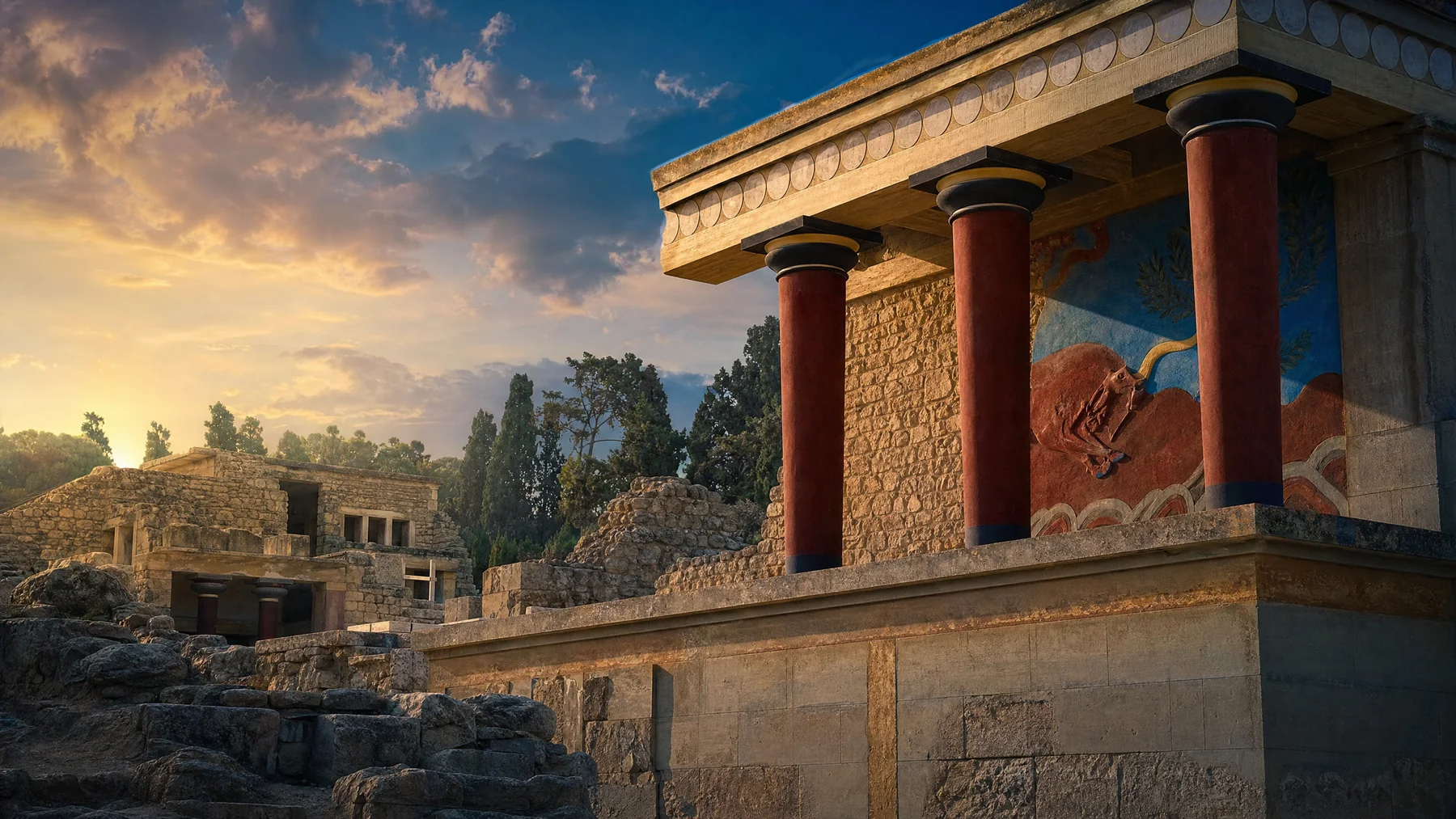
Sir Arthur Evans excavated and controversially reconstructed the palace in the early twentieth century. The reconstructions are vivid — red columns, frescoed walls, the famous bull-leaping fresco showing athletes vaulting over charging bulls with a grace and athleticism that looks entirely contemporary. Evans was criticised for his reconstructions, which are partly speculative. But standing there, looking at what he produced, you understand the impulse. He was trying to bring something back from the dead.
What the Minoans Were
The Minoans were, by the standards of their time, extraordinarily sophisticated. Their palace at Knossos had running water. Hot and cold. A drainage system that would not look out of place in a modern building. Flushing toilets. Ventilation systems designed to cool the interior during the Mediterranean summer.
They had a script — Linear A — that has never been deciphered. They had a writing system. They had art of remarkable beauty and life: dolphins, octopuses, flowers, people dancing and playing sports, rendered with a fluency and joy that stands in stark contrast to the formal rigidity of Egyptian art from the same period.
They traded across the Mediterranean. They had no significant military fortifications — the palaces at Knossos and Akrotiri were not built for defence. Either they felt secure, or they had other means of managing conflict.
They disappeared.
The exact cause remains debated. The eruption of the Thera volcano — modern-day Santorini, visible from the northern coast of Crete — occurred around 1600 BC and was one of the largest volcanic events in human history. The resulting tsunami, ash fall, and climate disruption would have been catastrophic. But the Minoan culture continued, diminished, for another century or more after Thera.
The final collapse, around 1450 BC, coincided with the arrival of Mycenaean Greeks. Whether it was invasion, absorption, or collapse from within that ended the Minoan civilisation is still not settled.
What is certain is that a culture that had produced running water, a writing system, and art of lasting beauty was gone. Completely. Within a generation.
What Knossos Made Me Think About
I stood in the throne room — the gypsum throne of Minos, the oldest throne in Europe, still sitting where it was placed three and a half thousand years ago — and I thought about civilisational endings.
We are not as different from the Minoans as we like to believe. We have indoor plumbing and they had indoor plumbing. We have frescoes and they had frescoes. We have writing and they had writing. We have international trade networks and they had international trade networks.
And they are gone. The language is gone. The religion is unrecoverable. The names of their kings, their artists, their merchants — unknown. Everything we know about them was buried under metres of earth for three thousand years and has been laboriously reconstructed from fragments.
Our civilisation is not permanent. No civilisation has been permanent. The things we take for granted — the institutions, the infrastructure, the accumulated knowledge — are not immutable features of reality. They are contingent achievements that require continuous maintenance and can be lost.
This is not pessimism. It is realism. And realism, honestly confronted, produces not despair but a particular kind of urgency. The urgency to build things worth building while there is time. To pass on to your children not just assets but knowledge, values, and the capacity to rebuild if rebuilding is required.
The Minoans could not have known they were about to disappear. We have more warning than they did. Whether we are using it is another question.
Work with Sebastian
The Minoan reflection applies directly to personal financial planning: the structures that seemed permanent can disappear. Build redundancy. Diversify. Do not assume continuity. Book a consultation.