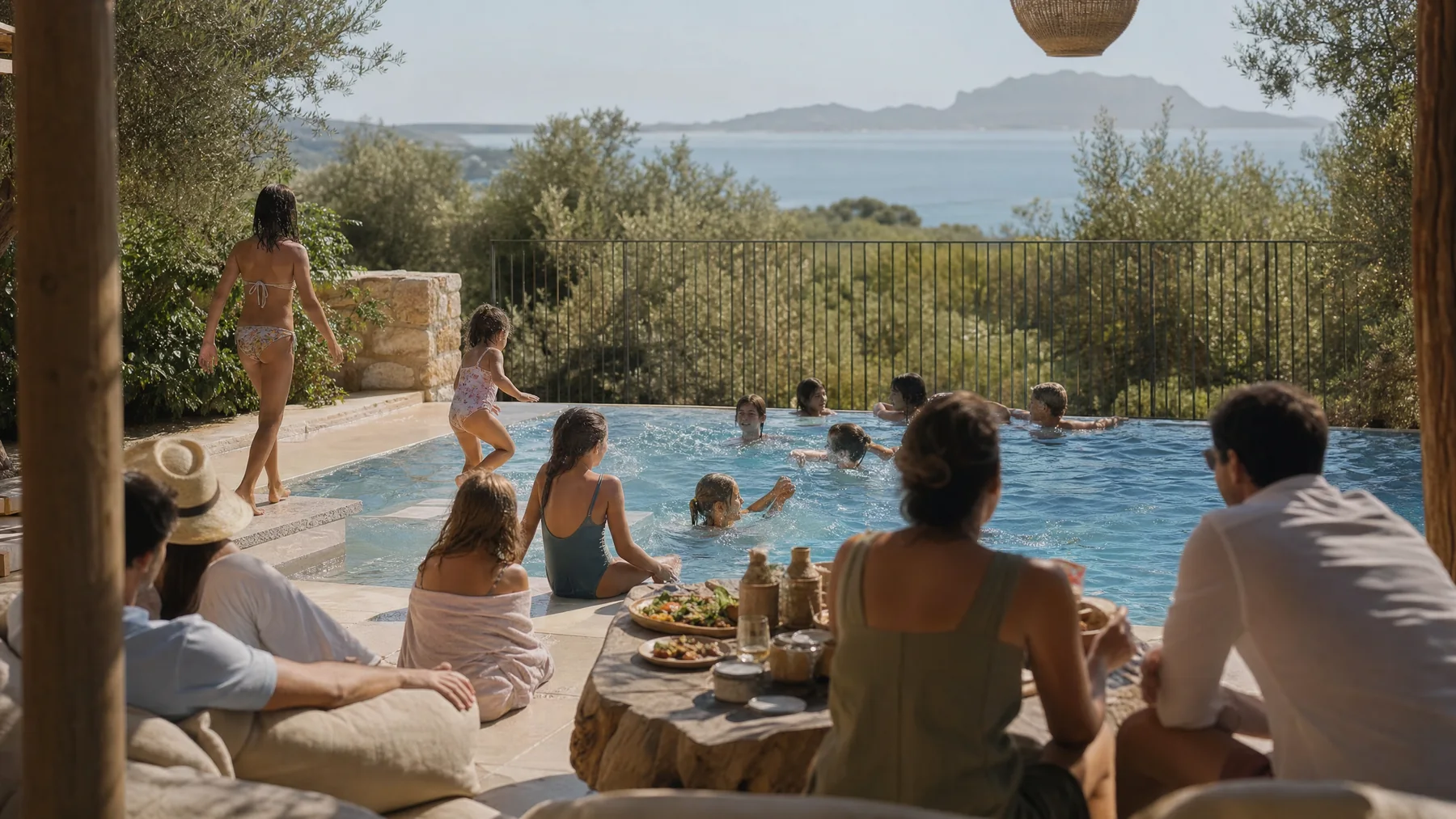
I am still in Crete. The children are at the pool. Amy is reading in the shade. The buffet, which I eyed with the reflexive skepticism of a man who usually eats better than this, has turned out to be perfectly decent.
I wanted to be in Dubai. Obviously that is not possible with Iranian missiles making a habit of the Gulf airspace.
So we are here, at a large all-inclusive resort on the north coast of Crete — the kind of holiday I spent years telling myself was beneath my standards, and which turns out to be, in its own particular way, exactly what a large family with children of many different ages actually needs.
What I Got Wrong About All-Inclusive
The objection to all-inclusive holidays is usually aesthetic. The buffet. The animation team. The proximity to other tourists. The absence of authentic local experience.
All of these objections are legitimate. And all of them are, when you have ten children of wildly varying ages and needs, essentially irrelevant.
What the all-inclusive actually provides: a contained environment where every child can find something to do at any moment, without the logistical burden of coordinating meals, snacks, activities, and transitions across a city or countryside. The youngest ones can splash in the shallow pool under supervision. The teenagers have their own space. Amy and I can sit in the same place for more than twenty minutes without someone needing us to find a restaurant or negotiate a menu in Greek.
This is not glamorous. It is, however, deeply functional. And function, I have learned with the particular humility of middle age, is underrated.
What Greece Does to You
Beyond the resort, though, Greece does what Greece always does. It puts things in perspective.
The light here is different from anywhere else in the world — a quality of Mediterranean afternoon sun that turns everything to gold and makes the white buildings and the blue sea look like a painting that was painted specifically to make you feel that your ordinary life is unnecessarily complicated.
The pace is different. Lunch takes two hours not because the service is slow but because the culture has decided, correctly, that two hours for lunch is the appropriate allocation. Time is handled differently. Urgency has a lower baseline.
And then there is the history. Knossos, which I wrote about two days ago. But also the Byzantine churches hidden in mountain villages. The Venetian architecture in the harbour towns. The Ottoman fountains. Three thousand years of civilisation layered on top of each other on a single island in the eastern Mediterranean.
England, where I spend half my year, is old. Germany, where I grew up, is ancient in parts. But Crete is something different — a place where the depth of time is physically present in the landscape in a way that reorients your sense of what matters and what is temporary.
Almost everything is temporary. The sea is not. The mountains are not. The capacity of human beings to build beautiful things and to sit in the sun and eat and laugh — that also seems durable.
I was wrong about all-inclusive. It is, for a family of our size and composition, exactly right.
Back in London next week. If your planning conversations have been waiting for me to return from holiday, the queue opens again. Book a consultation.