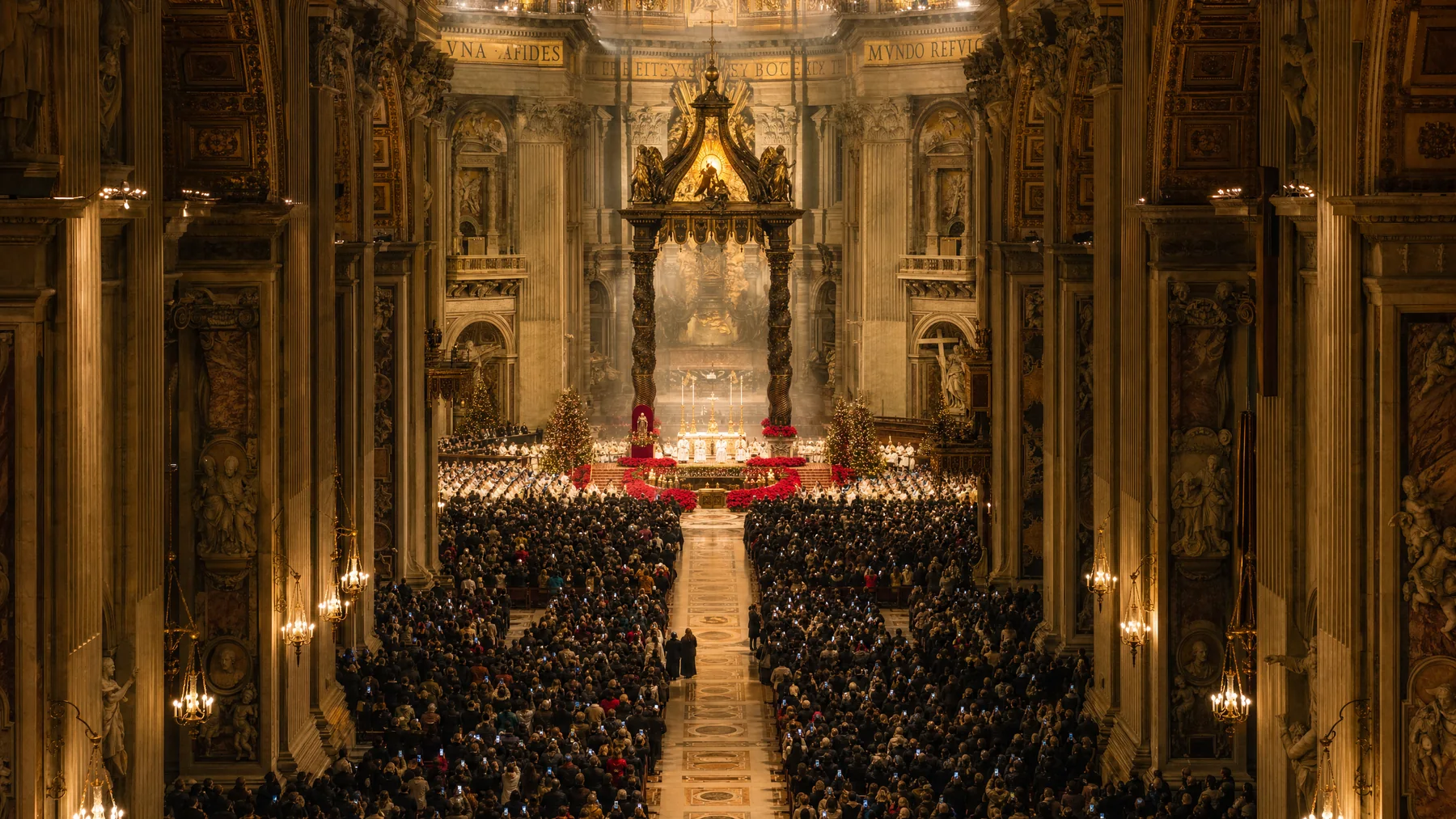
Tonight Pope Leo XIV celebrates Christmas Mass in St Peter's Basilica — reviving a tradition not observed since 1994, when a pope last celebrated the full Christmas Day Mass from the central altar beneath the basilica's great dome.
I will not be in Rome. I will be with my family, as I am every Christmas Eve. But I have been thinking about this first Christmas of Pope Leo's pontificate, and about what this night means, and I want to write something that is not about tax or geopolitics or emigration.
I write about freedom for a living. But tonight I want to write about the source of it.
The Incarnation Is the Most Radical Claim in Human History
Christians believe that on a specific night, in a specific place, in a stable in Bethlehem, God became a human being. Not a metaphor. Not a legend. Not a useful story with moral lessons. An actual historical event in which the Creator of the universe took on human flesh, human limitation, human vulnerability, and was born of a woman into poverty and obscurity.
This is a scandalous claim. It was scandalous when it was first made. It remains scandalous now.
It is scandalous because it means that human beings — each one, however poor, however apparently insignificant — carry within them something that cannot be simply abolished by the state, instrumentalised by the market, or reduced to a productive unit by any system of social organisation.
If God became human, then the human person has a dignity that is prior to and independent of anything any government can grant or revoke.
This is the theological root of what I believe about freedom. It is not primarily an economic argument. It is not primarily a political argument. It is a metaphysical one. Human beings are not raw material for the state's projects. They are not economic inputs. They are not subjects of the sovereign's will. They are, if Christianity is true, beings in whom God himself chose to dwell.
What This Means Practically
The reason I care about the overreaching state is not primarily that I want to keep my money. It is that I believe the state, when it expands without limit, is making a claim about human beings that is false. It is saying: you exist to serve the collective, and the collective is us.
That claim is not merely economically inefficient. It is theologically wrong. The person is not for the state. The state — at its legitimate best — is for the person.
Christmas is the annual reminder of this. The God of the universe did not arrive as a conquering power. He arrived as a child who needed to be fed and kept warm and protected by two ordinary people in difficult circumstances. He arrived as someone the state of his day — represented by Herod — would immediately try to kill.
The first enemies of the Incarnation were not atheists or philosophers. They were politicians who felt threatened by a power they could not control.
That pattern has repeated throughout history. It is repeating now.
To My Readers
To those who share this faith: a holy and joyful Christmas. May this night be what it has always been — not the conclusion of a shopping season but the beginning of something that matters.
To those who do not share it: I write these things not to convert you but to be honest with you. You know where I stand. The freedom I advocate for in my professional life has its roots in convictions that go deeper than economics. Now you know what they are.
To my children, wherever they will read this: your father loves you. You are his greatest work. Not the businesses, not the platform, not the articles. You.
God bless you all. Merry Christmas.
Work with Sebastian
The office is quiet this week. January is when we get back to work. If you want to start 2026 with a serious conversation about your freedom, your structures, and your options, I will be ready. Book a consultation.