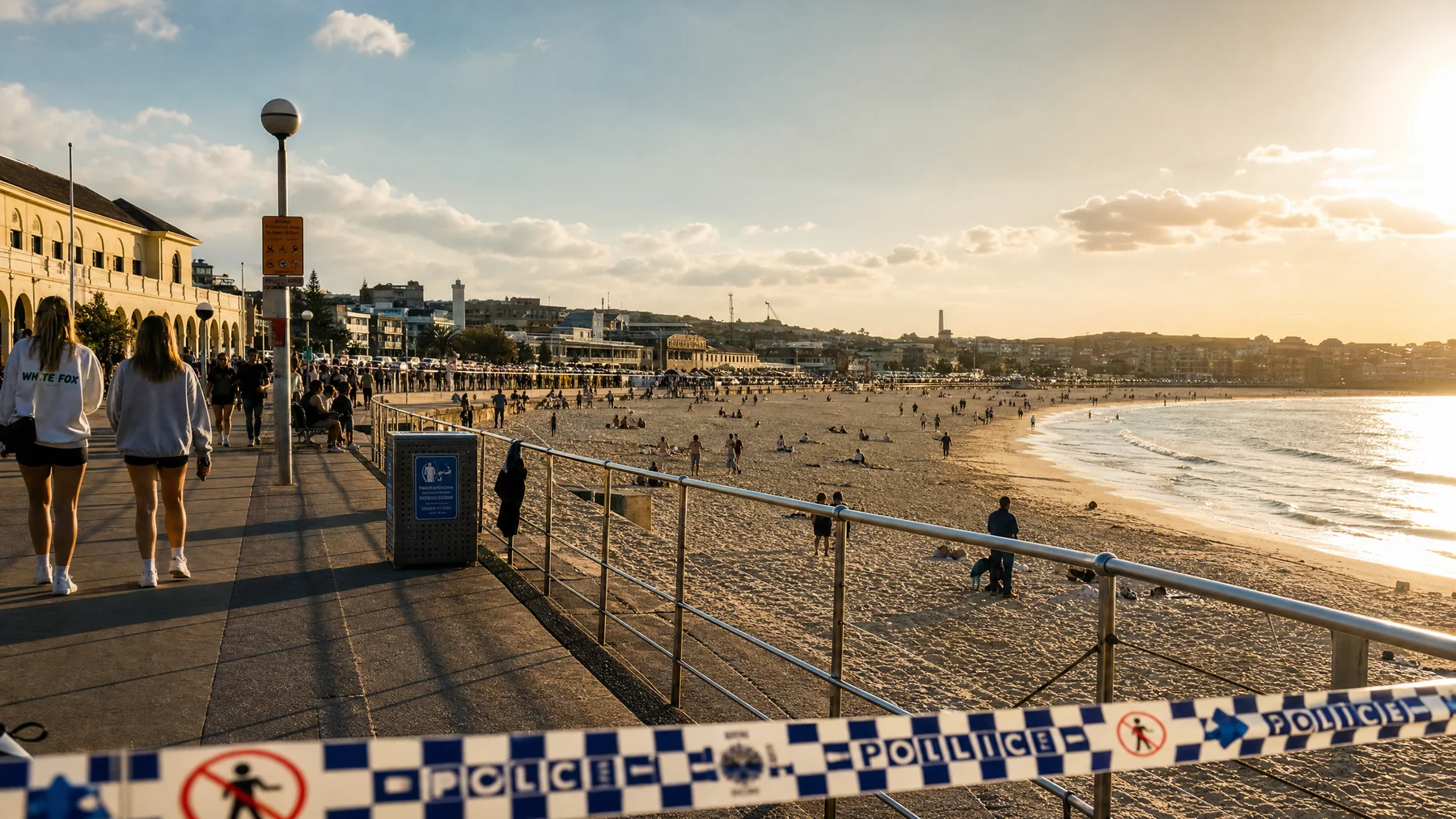
On December 14, a father and son opened fire on a Hanukkah celebration at Bondi Beach in Sydney, killing 15 people and injuring more than 40. Authorities described the motivation as Islamic State ideology. One gunman was killed by police. It is the deadliest terrorist incident in Australian history.
I want to say something about this that will make some people uncomfortable.
Not about the perpetrators, whose ideology is clear and whose act was monstrous. Not about the victims, who deserve nothing but grief and solidarity. But about the conversation that Australia — and Europe, and the entire Western world — is still not having honestly.
What Happened
The facts are as reported. Two men, motivated by explicit jihadist ideology, attacked a Jewish community event at one of Australia's most famous public spaces, on one of the most significant nights in the Jewish calendar.
The attack was not random. It was targeted. The victims were chosen because they were Jewish. This is an antisemitic terrorist attack, and it must be named as such without equivocation.
The Australian government responded appropriately in the immediate term — condemnation, investigation, security reinforcement.
The Conversation That Is Not Happening
And yet.
Across the Western world, there is a pattern that repeats after every jihadist attack. Condemnation. Solidarity. Calls for unity. A brief spike in discussion of radicalisation. And then a return to the default position, which is that any serious discussion of the relationship between mass immigration from certain regions and the importation of certain ideologies is beyond the bounds of acceptable discourse.
I am not making a blanket statement about immigration. I am not saying all immigrants are dangerous. I am observing a specific and documented problem: the importation of an ideology that is explicitly antisemitic, explicitly hostile to Western liberal values, and explicitly committed to violence as a legitimate political tool.
This ideology does not arrive from nowhere. It travels with people. And the question of how to prevent its arrival and spread is one that Western governments have been systematically reluctant to address with the directness the situation requires.
The Gun Buyback Misses the Point
Australia announced a nationwide gun buyback programme in response to the attack — the largest since the 1996 Port Arthur massacre.
I understand the political instinct. After mass casualty violence, governments reach for the tools they have.
But the Bondi Beach attack was not committed with legally owned firearms. It was committed by men who wanted to kill Jews because of who they are. No gun buyback programme addresses that motivation.
Addressing the motivation requires a conversation about ideology, about community, about what values Australia requires of those who settle there, and about what happens when those values are not shared.
A Word on the Jewish Community
As a Catholic, I hold a specific and non-negotiable position on this: antisemitism is a sin. Not merely a social problem, not merely a policy failure, but a moral evil. The Church's teaching on this, clarified definitively at Vatican II and reaffirmed by every pope since, is clear.
Jews have lived in Western countries for generations, contributing to science, culture, commerce, law, and the arts in proportions that dwarf their share of the population. The Bondi Beach attack is an extreme expression of something that has been building for years in more diffuse forms — harassment, vandalism, exclusion, the normalisation of language that would have been immediately recognised as antisemitic a generation ago.
This deterioration must be named clearly and opposed without equivocation. It is not a left-wing or right-wing issue. It is a civilisational one.
The deteriorating security environment in Western cities is one more variable for families thinking seriously about where to base their lives. If this is part of your thinking, let's talk. Book a consultation.