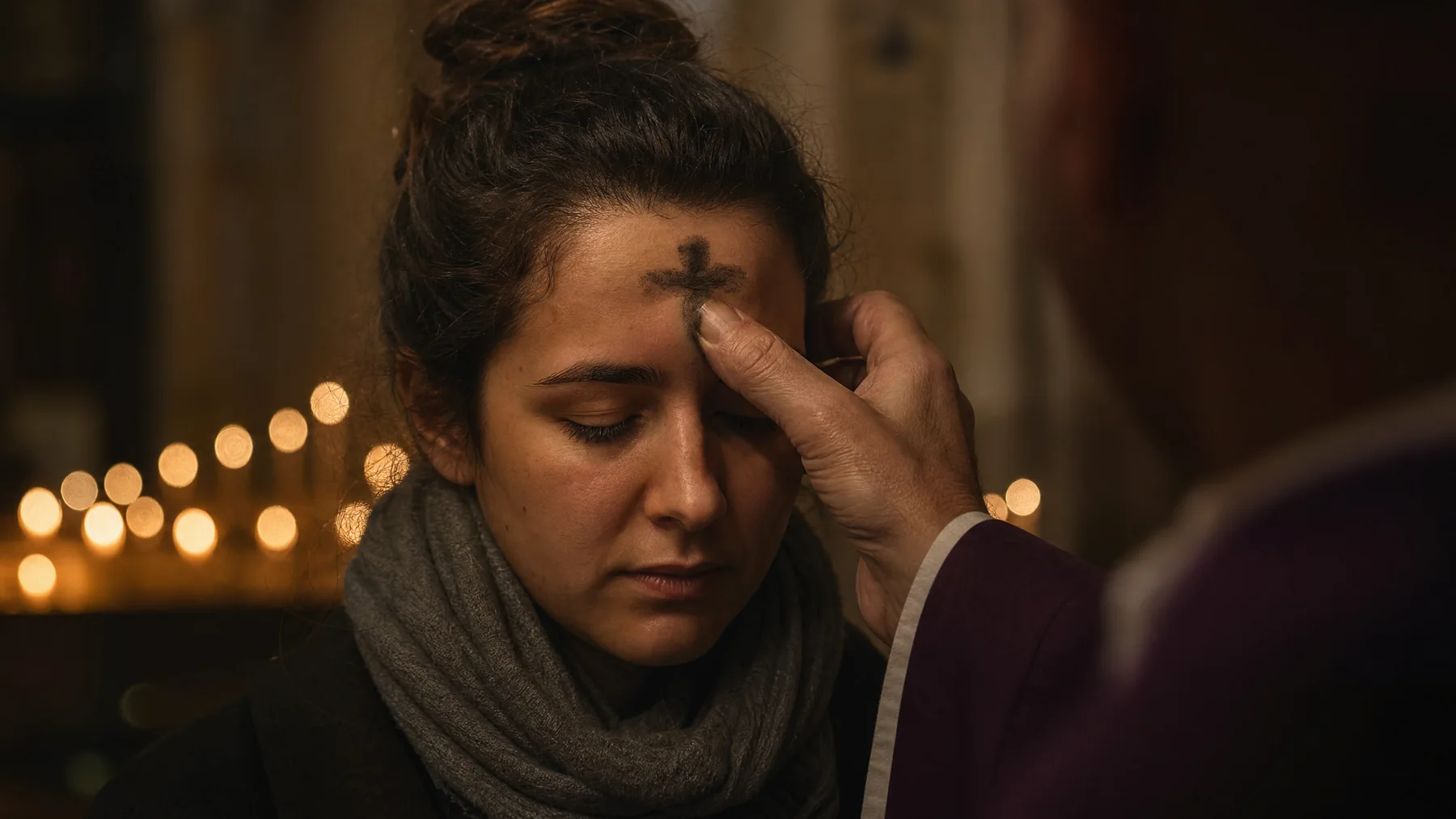
Today is Ash Wednesday. The beginning of Lent.
The rite is ancient — ashes have been used as a sign of penitence since at least the early Church, and in the Hebrew tradition long before that. The priest marks your forehead with a cross of ash and says one of two things: "Remember that you are dust, and to dust you shall return." Or: "Repent, and believe in the Gospel."
Both are correct. Both are necessary.
I went to Mass this morning. I do most years. There is something clarifying about standing in a queue of ordinary people — professionals, parents, retirees, the young and the old — waiting to be told, in the bluntest possible terms, that we are mortal and that we need to change.
No other institution in modern life does this. No other institution has the honesty, or perhaps the audacity, to begin its most solemn season by reminding you that you are going to die.
Why Lent Is the Season the Modern World Needs Most
The commercial culture's relationship to mortality is one of frantic denial. Anti-ageing creams. Wellness routines. Cryonic preservation. Biohacking. The entire multi-billion dollar industry of life extension is, at its core, a refusal to accept the terms on which human life is offered.
Lent accepts those terms. It says: you have a limited amount of time. You have not used all of it well. There is still time to change. But not unlimited time.
This is not morbid. It is clarifying. The man who knows he is going to die — who has genuinely accepted this rather than merely intellectually acknowledged it — is the man who knows what matters. He does not waste his finite days on infinite postponements. He does not keep saying "eventually" about the things that actually count.
My father died at 59. Suddenly. Without warning. He had been planning to do things "eventually" and he ran out of eventually.
I think about this every Ash Wednesday.
What I Am Giving Up
I do not generally discuss the specifics of my Lenten practice publicly. That would be performative in a way that defeats the purpose.
But I will say this: Lent works best when the sacrifice is proportionate to the attachment. The thing that is hardest to give up is usually the thing that is most worth giving up — not because it is inherently bad, but because it has accumulated too much weight in your life.
The purpose of the sacrifice is not the sacrifice itself. It is what the space created by the sacrifice makes possible. Clarity. Prayer. The attention you have been directing at the thing you gave up, redirected toward the things you have been neglecting.
Forty days. The same number as Moses in the desert. As Elijah's journey to Horeb. As Christ's temptation. The number itself is a tradition, a continuity, a reminder that you are part of something larger than your own timeline.
For Those Who Do Not Observe Lent
I write about this because I think the underlying logic of Lent — chosen limitation as a path to freedom, voluntary restraint as a clearing of space — is something that secular culture has lost almost entirely and would benefit enormously from recovering.
You do not need to be Catholic to fast. You do not need to believe in the Resurrection to benefit from forty days of deliberately reduced consumption, increased attention, and honest self-examination.
The practice is older than Christianity. The wisdom is human.
Remember that you are dust. And act accordingly — while there is still time.
Work with Sebastian
No consultation pitch today. Book a consultation when you are ready.