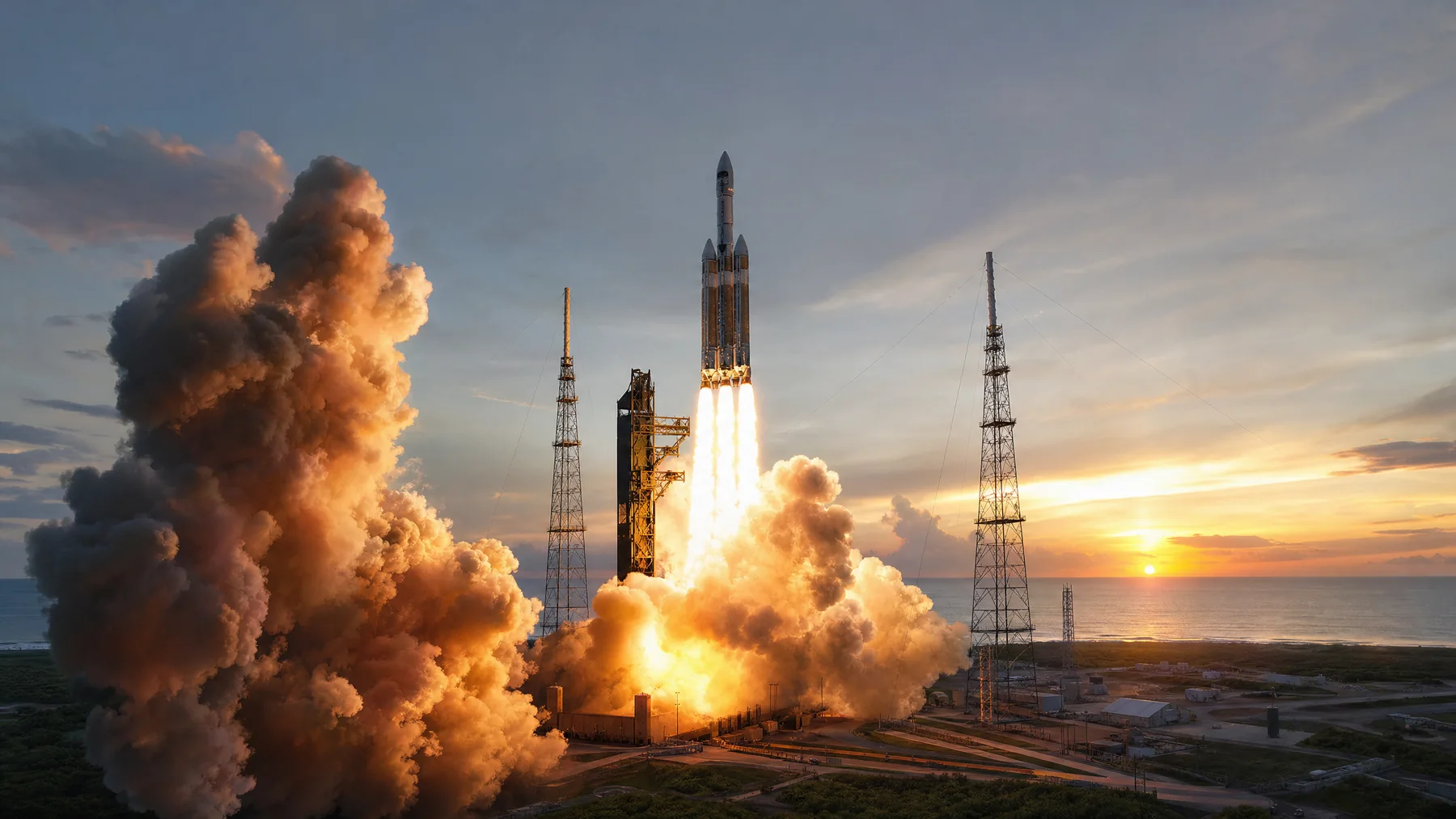
NASA launched Artemis II from Kennedy Space Center on April 1, 2026, carrying four astronauts — Reid Wiseman, Victor Glover, Christina Koch, and Canadian astronaut Jeremy Hansen — on a lunar flyby mission. The first crewed flight beyond low Earth orbit since Apollo 17 in December 1972.
Fifty-four years.
I want to write about this because I think I underestimated how much it would matter to me.
Why This Feels Different
I grew up on Karl May's stories of the American West and Ronald Reagan's vision of America as a frontier nation. The space programme was part of that mythology — the idea that humanity's destiny was not to stay contained within whatever boundaries it had inherited, but to push outward, to discover, to go where no one had gone before and come back changed.
Apollo was before my time, but the footage is seared into cultural memory. Armstrong and Aldrin on the lunar surface. The earthrise photograph. The particular quality of the crackling radio transmissions that somehow conveyed both the vast distance and the intimacy of human presence.
And then it stopped. For reasons that were partly political, partly financial, partly the loss of the competitive pressure that the space race had provided, humanity stopped going to the Moon and turned its ambitions inward, to low Earth orbit, to the International Space Station, to the incremental and the cautious.
Artemis II changes that. On April 6, the crew broke the record for the furthest humans have ever been from Earth, reaching 406,771 kilometres as they travelled around the far side of the Moon. Four human beings, further from Earth than any person in history, in a capsule hurtling around a dead world in the void.
What This Has to Do With Everything Else
I write about freedom. I write about the importance of not allowing the state to contain your ambitions, your assets, your family's options within the borders it has assigned you. I write about going further, building more, refusing to accept that the horizon in front of you is the final one.
The space programme, at its best, is the civilisational expression of that same impulse. The refusal to accept that this planet, this atmosphere, this gravity well is the limit of what humanity can do or be.
In a week when Iran is firing missiles across the Gulf, when the geopolitical order is accelerating its deterioration, when every news cycle seems to bring another reminder of human capacity for violence and stupidity, four people are going around the Moon.
I find this genuinely consoling. Not because space exploration solves any of the earthly problems. But because it demonstrates that the same species capable of the worst is also capable of this. That the impulse to go further is real and durable and, occasionally, wins.
Go further. It is always worth it.
Work with Sebastian
No business pitch today. Just a reminder that the most interesting journeys begin when you decide the horizon in front of you is not the final one. Book a consultation when you are ready to start yours.