Contents
- 1. Czech Republic: Country Overview
- 2. Putting the Czech Republic on the Map
- 3. What Others Say About the Czech Republic
- 4. Tax Benefits: What the Czech Republic Has to Offer
- 5. Tax Rates at a Glance
- 6. Tax Residency: What Triggers It
- 7. Double Tax Treaties
- 8. Avoid Remaining Tax Resident at Home
- 9. Tax Considerations When Leaving Your Home Country
- 10. Company Setup & the Paušál Regime
- 11. Who Should (and Shouldn't) Move to Czech Republic
- 12. Visas and Residence Permits
- 13. Path to Citizenship
- 14. Banking in the Czech Republic
- 15. What Makes the Czech Republic Genuinely Attractive
- 16. Cost of Living in Czech Republic
- 17. Buying Real Estate in the Czech Republic
- 18. Retiring in the Czech Republic
- 19. US Citizens: What You Need to Know
- 20. Correct Preparation
- 21. Automatic Exchange of Information (OECD CRS)
- 22. Further Relocation Formalities
- 23. How We Help With Your Move to the Czech Republic
I.
Czech Republic: Country Overview
The Czech Republic (Czechia) sits at the geographic centre of Europe: landlocked, surrounded by Germany, Austria, Slovakia, and Poland, with Prague at its centre — 350 kilometres from Munich, 330 from Vienna, 550 from Berlin. It has been a European Union member since 2004 and a Schengen member since 2007. It has not yet adopted the Euro — the currency is the Czech Koruna (CZK), currently trading at approximately 24–25 CZK per EUR. Population: 10.9 million.
The income tax system is among the most competitive in the EU: 15% flat rate on taxable income up to CZK 1,935,552 (~€77,000) per year, and 23% above that threshold. For comparison, the UK top rate is 45%, Sweden’s is 57%, and even Germany’s is 42–45%. There is no inheritance tax between close family members (and for others, gifts and inheritances are treated as income — typically at the lower tax bracket). The capital gains on securities are exempt after a three-year holding period — selling shares, funds, or ETFs held for more than three years generates no tax liability.
The headline that most internationally mobile professionals have missed: the Czech paušál (flat-rate expense) system and the Paušální daň (lump-sum tax) for sole traders, which can reduce the effective total tax and social contribution burden to approximately 6% of revenue for digital professionals and consultants — the lowest in the EU. See Section X.
What to be aware of: Czech residence is practical and highly liveable, but it is not a zero-tax escape. The lump-sum regime, progressive employment taxation, company substance, and EU reporting environment must be reviewed before assuming the country fits your income structure.
II.
Putting the Czech Republic on the Map
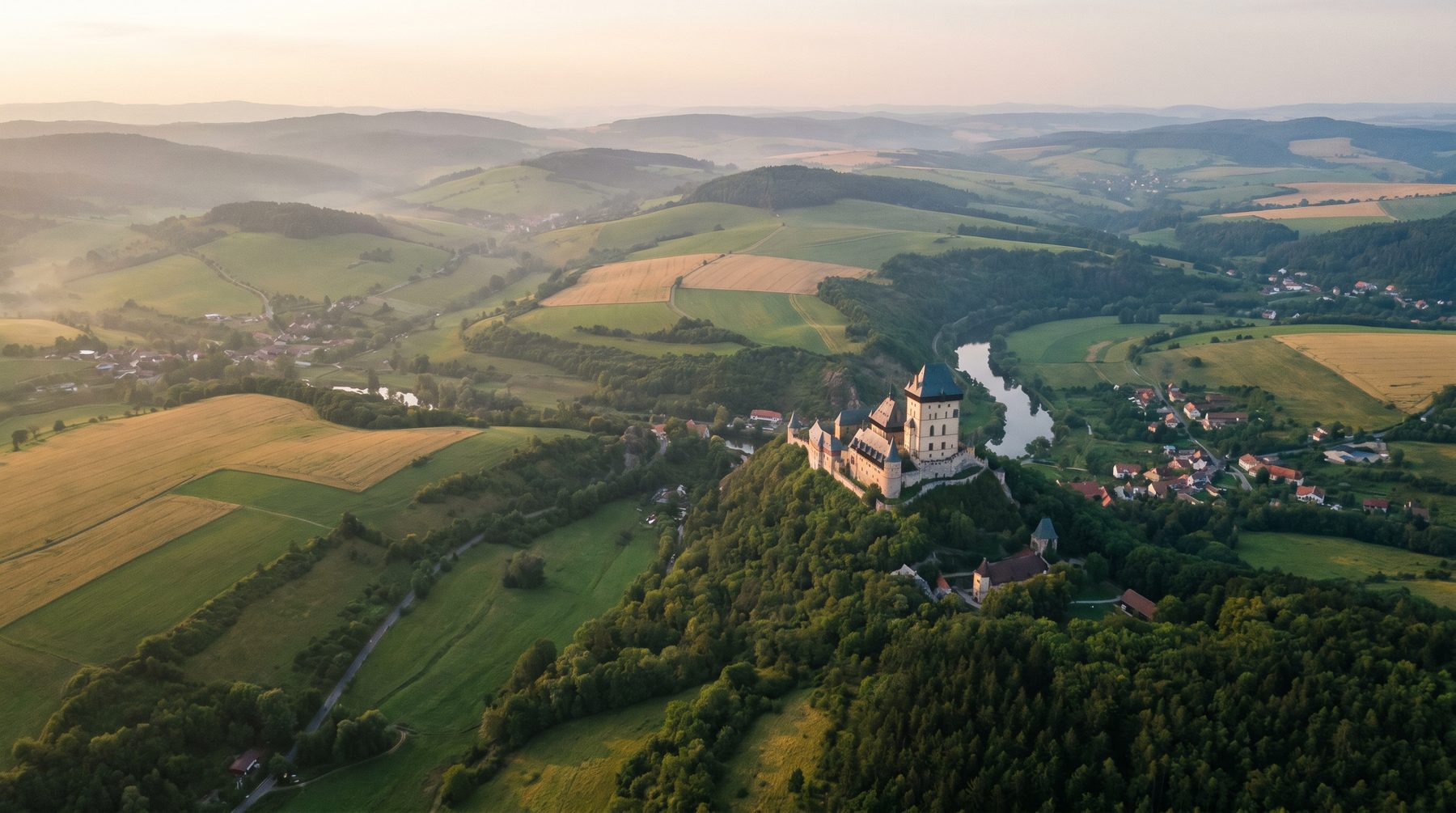
Prague is one of the few cities in Europe that survived the 20th century's waves of destruction largely intact. The Old Town square with its astronomical clock. The Charles Bridge at 5am in November fog, when there are no tourists and the saints on the parapet emerge from the mist in sequence. The Castle district rising above the Vltava on its hill of churches and palaces and gardens, each century layered visibly on the one before. There is a reason why the phrase "the Paris of Central Europe" is used about Prague rather than Budapest or Vienna or Warsaw — it is that Prague kept more of its original fabric, and the fabric is genuinely extraordinary.
The city has changed substantially since 1989. The backpacker-hostel Prague of the 1990s has given way to a European capital of considerable sophistication and significant wealth. The restaurant scene has matured — Czech cuisine, which was always more interesting than its reputation suggested, has found a generation of chefs who take it seriously. The natural wine bars, the coffee culture, the design studios in Holešovice and Vinohrady — these are not aspirational gestures; they are established facts about daily life in Prague in 2026.
Outside Prague, the country has a coherent geographic character that visitors rarely explore. Český Krumlov in South Bohemia is a UNESCO World Heritage town built on a meander of the Vltava, with a castle that contains one of the best-preserved Baroque theatres in Europe. Brno in Moravia is the Czech Republic's second city — more sober than Prague, more intellectual in character, home to a significant tech and startup community. The Moravian wine country south of Brno produces wines — particularly Welschriesling and Palava — that are almost unknown outside the country and deserve a wider audience. The Krkonoše (Giant Mountains) and Šumava (Bohemian Forest) on the German and Polish borders offer hiking and skiing of quiet quality.
Vienna is 90 minutes by train. Munich is 3.5 hours. Berlin is 4 hours. The Czech Republic's central position in Europe means that its professional residents are never more than a few hours from the continent's major business centres.

III.
What Others Say About the Czech Republic
“Prague never lets you go… this dear little mother has sharp claws.”
— Franz Kafka, in a letter to Oskar Pollak, 1902
“The ancient splendour and beauty of Prague, a city beyond compare, left an impression on my imagination that will never fade.”
— Richard Wagner, composer
“The streets of Prague were a fantasia scarcely touched by the twenty-first century — or the twentieth, or the nineteenth, for that matter. It was a city of alchemists and dreamers, its medieval cobbles once trod by golems, mystics, invading armies.”
— Laini Taylor, Strange the Dreamer, 2017
IV.
Tax Benefits: What the Czech Republic Has to Offer
The Czech Republic combines low headline rates with one of the EU's most generous capital gains regimes. Personal income tax is just 15% for most earners, rising to 23% only above CZK 1,762,812/year (around €72,000) — meaning most professional incomes fall entirely within the 15% bracket. From 1 January 2026, the previous CZK 40 million annual cap on the securities exemption was abolished: long-term holdings of shares and corporate stakes (3+ years) can now be sold tax-free regardless of amount. Cryptocurrency benefits from a 3-year holding period exemption (capped at CZK 40M) plus a €4,000/year low-value exemption — placing the Czech Republic among the most crypto-friendly jurisdictions in the EU. There is no wealth tax, no inheritance or gift tax for direct family, and a 21% corporate rate.
- ›15% / 23% progressive personal income tax — 15% on income up to CZK 1,762,812/year (raised in 2026); 23% above. Combined with 6.5% social insurance and 4.5% health insurance, the all-in marginal rate at high incomes is approximately 34% — among the lowest combined burdens in the EU for high earners.
- ›Paušální daň (flat tax for sole traders) — eligible OSVČ with turnover up to CZK 2 million pay a single fixed monthly amount covering income tax, social security, and health insurance. 2026 rates: CZK 9,984/month (Band 1, ≤CZK 1M); CZK 16,745/month (Band 2, ≤CZK 1.5M); CZK 27,139/month (Band 3, ≤CZK 2M). No annual return required for the self-employment portion.
- ›Securities and corporate stakes — full exemption from 2026 — long-term capital gains on shares and corporate stakes held for 3+ years are now fully exempt from personal income tax regardless of amount. The CZK 40 million annual cap that previously limited the exemption was abolished from 1 January 2026.
- ›Crypto-friendly tax regime — cryptocurrency gains are tax-free if held for more than 3 years (subject to a CZK 40 million annual cap that still applies to crypto), or if total annual crypto profit is under EUR 4,000. This is one of the most favourable crypto tax regimes in the EU.
- ›0% on direct-family inheritance and gifts — spouses, children, parents, and other close relatives are exempt from inheritance and gift tax.
- ›0% wealth tax — the Czech Republic has no annual wealth tax.
- ›21% corporate income tax — raised from 19% effective 1 January 2024. Standard SME participation exemption available; 12% reduced VAT applies to many essentials including groceries, medicines, accommodation, and cultural admissions; 0% VAT on books from 2024.
- ›90+ double tax treaties — including comprehensive DTAs with the US, UK, Germany, France, Switzerland, Singapore, and most G20 economies. Czech companies have been able to file accounting and tax declarations in EUR/USD/GBP since the 2024 tax year.
- ›Prague as a digital nomad and startup hub — Prague consistently ranks in Europe's top 10 cities for digital nomads, with cost of living substantially below Western Europe and developed-country infrastructure, healthcare, and English-speaking professional services.
V.
Tax Rates at a Glance
| Tax | Rate | Notes |
|---|---|---|
| Personal income tax | 15% / 23% | 15% up to CZK ~1.9M (~€77K); 23% above |
| Capital gains (listed securities) | 0% | After 3-year holding period; shorter holds taxed as ordinary income |
| Dividend withholding (from Czech s.r.o.) | 15% | Flat rate on distributions to individuals |
| Inheritance / gift tax | 0% (direct family) | Others: treated as income at 15%/23% |
| Wealth tax | 0% | None |
| VAT (DPH) | 21% | Standard; 12% and 0% reduced rates |
| Corporate income tax | 21% | Standard rate (raised from 19% in 2024) |
| Social security (employee) | 6.5% | Pension; employee contribution |
| Social security (employer) | 24.8% | Total employer burden |
| Health insurance (employee) | 4.5% | |
| Health insurance (employer) | 9% |
Cryptocurrency and Crypto Assets
Treated as income from the sale of other assets. Gains taxed at 15% (or 23% above threshold). The three-year capital gains exemption does NOT apply to cryptocurrency — unlike listed securities. No specific crypto legislation exists; general income rules apply. An amendment to clarify crypto tax treatment was under parliamentary discussion as of 2026.
VI.
Tax Residency: What Triggers It
Czech tax residency is triggered by either:
- ›183 days or more of physical presence in the Czech Republic in a calendar year
- ›Maintaining a permanent home (bydliště — place of permanent residence) in the Czech Republic, regardless of days
The second trigger is important: registering a Czech address as your permanent residence (required within 30 days of arrival for EU citizens) creates a legal presumption of Czech tax residency even if you spend fewer than 183 days in the country. Many new arrivals who intend to maintain their home-country tax residency inadvertently create Czech tax residency through residential registration. Take advice before registering.
Once Czech tax resident, worldwide income is subject to Czech income tax at 15%/23%. There is no territorial exemption for foreign income — Czech tax applies on the same basis as local income.
- ›For EU citizens: Free movement applies; no immigration process required. Registration with the Foreign Police is required within 30 days of stays over 90 days.
- ›For non-EU citizens: A long-stay visa or residence permit is required. Options include employment visa, business visa, investor visa (see Section XII).
VII.
Double Tax Treaties
The Czech Republic has one of the most comprehensive DTA networks in Central Europe — approximately 90 active double tax treaties, including:
- ›United Kingdom
- ›United States
- ›Canada
- ›Australia
- ›Germany
- ›Austria
- ›Switzerland
- ›All EU member states
- ›Most OECD countries
For British nationals, the UK-Czech Republic DTA provides relief on cross-border income flows and establishes the standard residency tie-breaker. For Australian nationals, the Australia-Czech DTA applies. The breadth of the treaty network is a genuine practical advantage over some other Central European destinations (Georgia, for example, has no DTA with Austria or Switzerland).

VIII.
Avoid Remaining Tax Resident at Home
Because Czech tax is levied on worldwide income at 15%/23% — and is not a territorial system — the Czech Republic is not an effective tax shelter for those who do not genuinely relocate. The tax advantages are real (flat 15%, 0% CGT after 3 years, paušál regime) but they require genuine Czech tax residency, which requires genuinely living in the Czech Republic.
- ›For UK nationals: The Statutory Residence Test governs UK non-residency. Once genuinely non-UK-resident and Czech tax resident, UK income is taxed at Czech rates (15%/23%) rather than UK rates (up to 45%) — a meaningful saving even after allowing for the Czech liability. Manage your UK days carefully in the year of departure.
- ›For Australian nationals: Establish cessation of Australian tax residency (see Section IX). Once Australia-non-resident and Czech-resident, Australian-source investment income is taxed at applicable Australian non-resident withholding rates (typically 10–15% on interest, 30% on unfranked dividends), with treaty reductions under the Australia-Czech DTA.
The Czech Republic is most compelling for those who want to genuinely live in Central Europe — not for those who want a nominal registration while living primarily elsewhere.
IX.
Tax Considerations When Leaving Your Home Country
Before you relocate to Czech Republic, you need to understand what tax consequences arise in your current country of residence at the point of departure. These rules vary significantly by country and must be assessed individually. Many countries impose an exit tax, deemed disposal charge, temporary non-residence rule, or continuing reporting obligation when a tax resident leaves.
- ›United Kingdom. SRT applies. Days in the UK in the year of departure, UK ties retained, and the specific split-year provisions determine the exact date of departure. The temporary non-residence rules apply for five years — gains on assets held at departure are claw-backable if you return within five years.
- ›Australia. CGT Event I1 on departure. The ATO scrutinises moves to Central European jurisdictions less than moves to traditional zero-tax destinations — but the departure rules apply the same way.
- ›Canada. Departure tax at market value on most assets. Canada-Czech DTA applies to ongoing Canadian-source income.
- ›United States. Worldwide taxation regardless of Czech residency. See Section XIX.
A tax consultation before you move is not optional — it is essential. The cost of getting this wrong is almost always greater than the cost of getting proper advice upfront. We help clients assess home-country exit taxes, treaty position, reporting obligations, and the correct order of steps before relocating to Czech Republic.
X.
Company Setup & the Paušál Regime
The Czech Republic offers one of the most compelling tax environments in the EU for self-employed professionals — not through zero tax, but through a simplicity and efficiency that is unmatched in the region.
The Živnostenský List — Trade Licence
Czech sole traders register a živnostenský list (trade licence) through the Trade Licensing Office. For most professional services — IT, software, consulting, marketing, creative services — the licence category is "Free Trade" (volná živnost), requiring no professional exam and obtainable within days for approximately CZK 1,000 (€40).
The flat-rate expense deduction (Paušální výdaje): For most professional services, 60% of gross revenue is deducted as a notional flat expense. The remaining 40% is taxable income.
Example on CZK 2,000,000 revenue (~€80,000):
- ›Taxable income (40%): CZK 800,000
- ›Income tax at 15%: CZK 120,000
- ›Effective income tax rate on revenue: 6%
Social and health contributions add approximately CZK 150,000–175,000/year on this revenue. Total burden: approximately 14% of gross revenue — the lowest effective rate for self-employed professionals in the EU.
- ›The Paušální daň (lump-sum tax): Since 2021, sole traders with revenue under CZK 2,000,000/year can elect a single monthly payment of approximately CZK 8,716/month (~€348) covering all income tax, social insurance, and health insurance. Annual cost: approximately CZK 104,592 (~€4,200) — covering all obligations.
- ›Czech s.r.o. (LLC): Standard corporate structure. Minimum capital: CZK 1. Corporate tax: 21%. Dividends to individual: 15% withholding. Combined rate on distributed profits: approximately 32.85%. Less efficient than the sole trader paušál regime for individuals below the revenue cap, but appropriate for larger businesses, liability management, and retained profit.
Is a local structure always the right answer?
Not necessarily. While the paušál system is exceptional for self-employed professionals, for entrepreneurs operating larger businesses or those with income from multiple international sources, it may be more tax-efficient to structure operations through a company incorporated in a low-tax jurisdiction outside the Czech Republic — and manage the Czech personal tax position separately.
Czech tax residents pay 15%/23% on worldwide income. For passive income, capital income above the three-year CGT-exempt threshold, and larger business profits above the paušál cap, the Czech tax position must be weighed against what a properly structured international vehicle could offer.
Popular international structures for Czech-resident entrepreneurs include:
- ›US LLC (single-member, disregarded entity): No US corporate tax if the owner is a non-US person. Income flows through to the individual and is reportable as personal income in the Czech Republic — useful as an operational vehicle for international service businesses where the LLC itself adds credibility or banking access.
- ›Singapore company: 17% headline rate with extensive SME exemptions. Strong international credibility and banking access. The 21% Czech corporate rate is competitive with Singapore, so the primary advantage is banking access, credibility, and holding structure benefits rather than pure rate arbitrage.
- ›UAE company (mainland or free zone): 0% on qualifying income. For Czech-resident entrepreneurs with significant non-Czech-source business income, a UAE operating company can reduce the corporate-level tax burden significantly — though Czech CFC rules must be assessed.
We help clients design the right structure for their specific situation. Learn more about our company setup services →
Careful planning is essential. Using a foreign company while residing in the Czech Republic can trigger Permanent Establishment (PE) risk and Czech CFC rules may apply to passive income accumulated in low-tax foreign entities. The right structure depends on your business model, income profile, and whether the paušál regime covers your situation. We help clients navigate this before committing to any structure.
XI.
Who Should (and Shouldn't) Move to Czech Republic
Section 11 is where the relocation decision becomes practical. Czech Republic can be an excellent fit for some profiles and a poor fit for others; the decisive question is whether the tax rules, lifestyle, residence requirements, banking, healthcare, and family situation point in the same direction.
Good Fit
- › EU-based digital professionals, developers, consultants, and designers with revenue under CZK 2,000,000/year who can use the Paušálnà daÅ and pay ~7% total tax and social contributions. This is the most compelling category â no other EU jurisdiction offers anything close to this rate for self-employed professionals
- › Investors with long-term equity portfolios. The 0% CGT on listed securities after three years makes Czech residency particularly attractive for those building equity positions over time. Buy, hold three years, sell tax-free
- › Those who want EU access, Schengen travel, and a low-tax environment. No other combination of EU membership, Schengen travel, flat 15% income tax, and 0% CGT after 3 years exists anywhere else in the world. Bulgaria has 10% but lower EU connectivity; Ireland has CGT and higher income tax; Malta and Cyprus both have territorial complications
Poor Fit
- × Those expecting zero tax. Czech Republic is low-tax, not zero-tax. At 15% flat on worldwide income, the obligation is real
- × High-revenue businesses above the paušál cap. Above CZK 2,000,000 in revenue, the paušál systemâs advantages diminish. The s.r.o. at 21% + dividend withholding is not exceptional relative to other EU options
- × Those who want Mediterranean climate. Prague winters are cold; Central European summer is warm but not long. This is entirely subjective but matters for long-term satisfaction

XII.
Visas and Residence Permits
EU/EEA citizens: Free movement. Must register with the Foreign Police within 30 days of stays over 90 days. After five years of continuous legal residence, apply for permanent residency.
Non-EU citizens:
- ›Long-stay Visa (D Visa): For stays over 90 days; issued by Czech embassies before arrival. Converted to residence permit after arrival.
- ›Employee Residence Permit: Employer-sponsored; requires an employment contract with a Czech entity.
- ›Entrepreneur Residence Permit: For self-employed persons. Requires: evidence of trade licence, proof of accommodation, financial sufficiency (at least 12 months of the minimum wage in savings). Renewable annually, can convert to permanent residency after five years.
- ›Investment Residency: Czech Republic does not have a formal golden visa programme, but significant investment in a Czech business can support an entrepreneur residency application.
- ›Digital Nomad Visa: No dedicated digital nomad visa category as of 2026; the entrepreneur permit is the closest equivalent for self-employed remote workers.
- ›Permanent residency: After five continuous years of legal residence. Czech citizenship: after ten years of legal residence, including five years permanent residency, plus language exam.
XIII.
Path to Citizenship
Czech citizenship by naturalisation requires ten years of legal residence (including five years of permanent residency), a Czech language exam, demonstration of good character, and evidence of integration. Dual citizenship is generally not permitted under Czech law — applicants typically must renounce their existing citizenship, with limited exceptions for those who acquire Czech citizenship through birth or marriage.
This is a significant constraint for British, Australian, or American nationals who would need to renounce their existing citizenship. Weigh this carefully before pursuing naturalisation.
XIV.
Banking in the Czech Republic
Czech banking is dominated by four large institutions — Česká spořitelna (Erste Group), Komerční banka (Société Générale), ČSOB (KBC Group), and Moneta Money Bank — alongside digital challengers including Air Bank, Revolut, and Wise. Local accounts in Czech Koruna are useful for day-to-day expenses: rent, utilities, local transactions, and for registering with the Czech tax authority. Air Bank is particularly popular with younger expats and digital professionals for its straightforward account opening and strong digital interface.
EU nationals can open accounts with a registration certificate from the Foreign Police. Non-EU nationals require a residence permit. Account opening is generally straightforward once registration documentation is in place.
Where to hold your main accounts
For internationally mobile individuals and entrepreneurs, it is generally advisable to maintain your primary banking relationships outside the Czech Republic, in a jurisdiction with stronger international banking infrastructure and a full range of investment and private banking services. Czech banks operate in Czech Koruna — a currency that, while stable, adds unnecessary conversion costs for internationally mobile clients whose income arrives in euros, US dollars, or sterling. The Czech banking sector is solid and regulated but is not a primary hub for international wealth management or private banking.
Jurisdictions we frequently recommend for primary international banking include:
- ›Switzerland — private banking tradition, multi-currency accounts, strong asset protection, and extensive experience with internationally mobile clients. Swiss banks are well-suited for Czech-resident investors managing international equity portfolios, particularly given the 0% CGT on securities after three years — gains accumulated tax-free in the Czech Republic can be managed and reinvested through a Swiss private banking relationship.
- ›Singapore — Asia-Pacific hub, excellent international wire infrastructure, and broad acceptance by global counterparties. Particularly useful for clients with business or investment exposure to Asian markets.
- ›United States — US dollar accounts at major US banks are universally accepted. Useful for USD-denominated businesses and for American clients managing ongoing US financial ties.
- ›Georgia (Caucasus) — straightforward account opening for non-residents, low fees, and a solid banking system for its size. Useful as a secondary account for euro or USD transactions at low cost.
We help clients identify the right banking structure for their specific situation. Learn more about our offshore banking services →
Important: not all banks are compatible with all residencies. Some Swiss and Singaporean private banks have restrictions on clients resident in certain jurisdictions, and compliance requirements vary. Residency status, income profile, source of wealth, and business type all affect which institutions will accept you and on what terms. We help clients navigate this before they commit to any banking structure.
XV.
What Makes the Czech Republic Genuinely Attractive
- ›Cost of living relative to income. Prague’s cost of living is approximately 35–40% below London, 30% below Paris, and 25% below Amsterdam — while salaries for professional roles in tech, finance, and consultancy have converged significantly with Western European levels. The combination of lower living costs and lower income tax creates disposable income that is simply not available in the major Western European capitals.
- ›Quality of life. Prague is one of the most beautiful cities in Europe, genuinely pleasant to live in on a day-to-day level — walkable, with excellent public transport, abundant green space, active cultural life, and some of the best beer in the world at approximately £1.50 per pint. Crime rates are low.
- ›Central location. The ability to reach Munich, Vienna, Berlin, Warsaw, or Budapest within 4–5 hours by car or train — and Paris, London, or Rome by a 1.5-hour flight — is practically valuable for internationally mobile professionals.
- ›EU and Schengen membership. Full freedom of movement across the EU. The Czech Koruna provides some currency flexibility that Euro-zone membership would not.
- ›Established expat community. Prague has had a substantial English-speaking expat community since the early 1990s — American, British, Irish, and increasingly Australian and Canadian. English is widely spoken by younger Czechs across most professional contexts.
XVI.
Cost of Living in Czech Republic
The Czech Republic is no longer a cheap Eastern European base. Prague is the cost centre, while Brno and regional cities remain more affordable for those not tied to the capital.
Typical monthly costs for an internationally mobile professional or family in the Czech Republic (2026 planning ranges):
| Category | CZK/month | GBP/month | USD/month |
|---|---|---|---|
| 1-bed apartment, desirable area | CZK 27,050–55,020 | £900–1,850 | $1,200–2,400 |
| 2-bed apartment / small house | CZK 50,830–104,880 | £1,700–3,550 | $2,200–4,550 |
| International school (annual per child) | CZK 82,230–262,200 | £2,800–8,900 | $3,600–11,400 |
| Private health insurance (annual individual) | CZK 16,100–53,820 | £550–1,850 | $700–2,350 |
| Restaurant meal, mid-range (per person) | CZK 800–1,260 | £50–50 | $50–50 |
| Monthly groceries, single person | CZK 11,590–26,310 | £400–900 | $500–1,150 |
| Utilities and internet, apartment | CZK 5,150–14,350 | £150–500 | $200–600 |
- ›Comfortable single professional (no children): CZK 64,400–119,600/month (£2,200–4,050 / $2,800–5,200)
- ›Family of four with private schooling: CZK 149,500–276,000/month (£5,050–9,350 / $6,500–12,000)
These figures are planning ranges, not promises. The actual budget in the Czech Republic depends heavily on housing quality, neighbourhood, school choice, healthcare needs, car ownership, travel frequency, and whether you are trying to live like a local or maintain a Western expatriate standard.
XVII.
Buying Real Estate in the Czech Republic
EU citizens and Czech residents can purchase property in Czech Republic without restrictions. Non-EU citizens who are not Czech residents face some additional requirements, though these have been simplified in recent years.
Price ranges (Prague, 2025):
| Area | Property type | Price range (CZK/sqm) | EUR/sqm |
|---|---|---|---|
| Prague 1 (old town) | Apartment | CZK 150,000–250,000 | €6,000–10,000 |
| Prague 2/3 | Apartment | CZK 100,000–160,000 | €4,000–6,400 |
| Prague 5/6 (residential) | Apartment | CZK 90,000–140,000 | €3,600–5,600 |
| Prague suburbs | House | CZK 60,000–100,000 | €2,400–4,000 |
| Brno city centre | Apartment | CZK 70,000–110,000 | €2,800–4,400 |
Transaction costs:
- ›Real estate acquisition tax: 0% (abolished in 2020)
- ›Real estate agent fees: 2–4%
- ›Legal fees: 0.5–1%
- ›Notary fees: approximately 0.2–0.5%
- ›Total buyer costs: approximately 3–5%
Prague property prices have risen 70–80% since 2015, driven by low interest rates, supply constraints in the historic city core, and strong expat demand. Yields in Prague are modest — 3–4% gross — but property values have appreciated strongly.

XVIII.
Retiring in the Czech Republic
The Czech Republic is not a traditional retirement destination — the climate is Central European rather than Mediterranean, and the Czech public health system (though functional) operates primarily in Czech. However, for those with genuine affinity for Central European culture and lifestyle, it offers exceptional value for retirees with foreign-source pension income:
Foreign pensions are taxable in the Czech Republic at 15%/23% — there is no territorial exemption. But the flat 15% rate on pension income up to ~€77,000/year is competitive with almost any other EU jurisdiction.
Pension tax treatment for common nationalities:
- ›UK: UK private pensions taxed in Czech Republic under UK-Czech DTA (typically: taxable in country of residence = Czech Republic, at 15%)
- ›Canada: CPP/OAS subject to Canadian non-resident withholding; Czech DTA applies
- ›Australia: Superannuation pension phase; Czech DTA applies
Healthcare: EU-standard public healthcare available to Czech residents. Private health insurance for comprehensive cover runs €1,000–2,400/year. Prague has several private hospitals (Canadian Medical, Motol University Hospital) with English-speaking staff.
XIX.
US Citizens: What You Need to Know
US citizens and long-term green card holders are taxed by the United States on their worldwide income, regardless of where they live. Relocating to the Czech Republic does not end US tax obligations — it changes the picture, but does not eliminate it.
Key considerations for US citizens in the Czech Republic:
- ›Foreign Earned Income Exclusion (FEIE): US citizens who qualify as bona fide residents of the Czech Republic or pass the physical presence test can exclude a significant amount of foreign earned income from US federal income tax. This applies to wages and self-employment income — not passive income such as dividends, interest, capital gains, pensions, or rental income.
- ›Foreign Tax Credit: Income tax paid in the Czech Republic can generally be credited against US tax on the same income, reducing or eliminating double taxation. The credit is particularly important for income not covered by the FEIE and for taxpayers whose income exceeds the annual FEIE threshold.
- ›Treaty position: Treaty relief between the United States and the Czech Republic is limited or fact-dependent. Before relying on any treaty position, US citizens should confirm the current treaty status and the exact income category with a qualified US international tax adviser. A treaty does not automatically remove US filing obligations, and most treaties contain savings-clause rules that preserve US taxation of citizens.
- ›FBAR: US persons with bank accounts in the Czech Republic exceeding $10,000 in aggregate must file FinCEN Form 114 (FBAR) annually. Failure to file can carry severe penalties, even when no tax is due.
- ›FATCA: US citizens may also need to report foreign financial assets on Form 8938. Banks in the Czech Republic may separately identify US account holders under FATCA procedures and report account information through the relevant channels.
- ›Social Security and self-employment tax: The FEIE reduces income tax but does not automatically eliminate US self-employment tax. Whether US Social Security tax applies depends on employment status, entity structure, and any applicable totalization agreement.
US citizens considering the Czech Republic should work with a qualified US international tax adviser alongside local counsel. The interaction between US tax law and Czech Republic tax law is manageable, but it requires careful planning before the move, not after the first filing deadline arrives.
XX.
Correct Preparation
- ›When should I register the trade licence? Before you begin earning income in the Czech Republic. The trade licence registration is straightforward and inexpensive (CZK 1,000); delaying it means operating without legal basis and missing the Paušální daň election window.
- ›When must I elect Paušální daň? By 10 January of the tax year to which it applies. If you arrive in October and want Paušální daň to apply from 1 January of the following year, you must make the election by 10 January of that year.
- ›Must I learn Czech? Czech is the language of government, courts, and official life. Conversational Czech improves daily life; professional Czech is required for navigating official processes independently. English is widely spoken in Prague professional settings, but a Czech accountant or lawyer is essential for tax and regulatory matters.
What is the recommended order of steps?
- 1.Home-country departure tax analysis
- 2.Secure Czech accommodation (lease in your name)
- 3.Register with the Foreign Police (EU citizens) or apply for visa/permit (non-EU)
- 4.Register trade licence at Trade Licensing Office
- 5.Open Czech bank account
- 6.Register with Czech tax authority (Finanční úřad)
- 7.Elect Paušální daň by 10 January (if applicable)
- 8.Notify home-country tax authority of departure
- 9.Establish 183-day presence in first full year
XXI.
Automatic Exchange of Information (OECD CRS)
The Czech Republic participates in the OECD Common Reporting Standard (CRS), the global framework for automatic exchange of financial account information between tax authorities. The Czech Republic has been exchanging information with partner jurisdictions since 2017.
In practical terms, this means: if you hold bank accounts or financial assets in the Czech Republic, the financial institution in the Czech Republic will report your account details — balance, income, and identifying information — to the local tax authority, which will then automatically share this information with the tax authority of your country of tax residence.
The key point is that CRS follows tax residence, not nationality or citizenship. For example, a Swedish citizen who has genuinely become tax resident in the Czech Republic is treated, for CRS purposes, as a tax resident of the Czech Republic — not as a Swedish reportable person merely because of the passport. The same principle applies to any non-US nationality: the account should be reported to the country of tax residence, not automatically to the country of citizenship.
CRS does not create a tax liability — it creates transparency. If you are properly tax resident in the Czech Republic and have correctly severed residency in your home country, CRS reporting simply confirms what should already be declared. The risk arises when individuals attempt to maintain dual residency, leave old tax-residence indicators unresolved, or claim the Czech Republic residency without genuinely living there.
US citizens are different. The United States does not participate in CRS in the same way. Americans are affected by FATCA instead: banks outside the United States generally identify US persons and report their account information through FATCA channels to the US authorities, regardless of whether the person is tax resident in the Czech Republic or anywhere else.
Key point: CRS is not a problem for those who have relocated correctly. It is a problem for those who have not. Proper tax residency planning — with genuine physical presence and documented ties to the Czech Republic — is the only sustainable approach. CRS follows tax residence, not citizenship; FATCA follows US-person status.
XXII.
Further Relocation Formalities
Upon establishing residence in the Czech Republic, you will need to obtain a DIČ / birth-number based tax registration where required from the competent local authority. This is required for most financial and legal transactions in the Czech Republic, including opening bank accounts, signing contracts, registering with tax authorities, and dealing with public offices.
You will also need to obtain or complete the relevant Czech residence card or registration certificate process once your residence status has been approved. This document or registration record becomes your practical proof of residence in the Czech Republic and is usually required for banking, telecom contracts, utilities, leases, property transactions, and day-to-day administrative matters.
- ›Driving licences from most countries are accepted only for a limited period after arrival. Once you become resident in the Czech Republic, you should verify whether your licence can be exchanged directly or whether a local medical certificate, translation, theory test, or practical test is required.
- ›Health insurance should be arranged before arrival unless you are immediately covered by a local public system. In many cases, private international cover is the safest bridge solution while residence, employment, or social-security registration is still being completed.
- ›Importing personal effects should be planned before shipping anything to the Czech Republic. Household goods may qualify for relief when imported shortly after taking up residence, but customs paperwork, inventory lists, timing rules, and vehicle-import duties can make late or informal shipping expensive.
- ›Proof of address and banking are often linked. Banks, telecom providers, and government offices may require a lease, utility bill, local address certificate, or residence registration before they will open an account or complete onboarding.
- ›Ongoing local compliance should not be treated as an afterthought. Calendar reminders for residence renewals, tax registrations, local filings, health-insurance renewals, and address updates help prevent administrative problems that can later undermine the tax-residency position.
XXIII.
How We Help With Your Move to the Czech Republic
We offer comprehensive tax and legal support for your relocation to the Czech Republic. We follow a proven process — and where the Czech Republic requires specialist local input, we involve appropriately qualified local tax, legal, immigration, and banking advisers on the ground, while remaining responsible for overall coordination.
The results speak for themselves: we have helped over 100 entrepreneurs and business owners significantly reduce their tax burden through carefully planned relocations. Careful planning, thorough advice, and comprehensive support are our standard. Legally sound structuring within the framework of international tax law is our highest priority.
Our services typically include one or more of the following:
- →Tax advice on the consequences of relocating abroad: analysis, projections, assessments
- →Home-country departure tax analysis
- →Czech tax structure selection (sole trader paušál vs. s.r.o.)
- →Introduction to Czech lawyers, tax accountants, and trade licence specialists
- →Paušální daň election planning and timing
- →Banking introductions
- →Property rental or purchase support
- →Coordination between your home-country adviser and your the Czech Republic professional team
Our fees are generally billed on a time basis; fixed prices apply for certain services such as company formation.
As a first step, we recommend booking a consultation to discuss your plans — by phone, Zoom, or Signal. Together we find the best approach and establish contact with our local partner. As project coordinator, we keep all the threads in hand that are necessary for the successful implementation of your plans.